
Part Three — The Translations: Field Guides for the Creative Borderlands
How Creators Navigate the Borderlands Between Language and Image

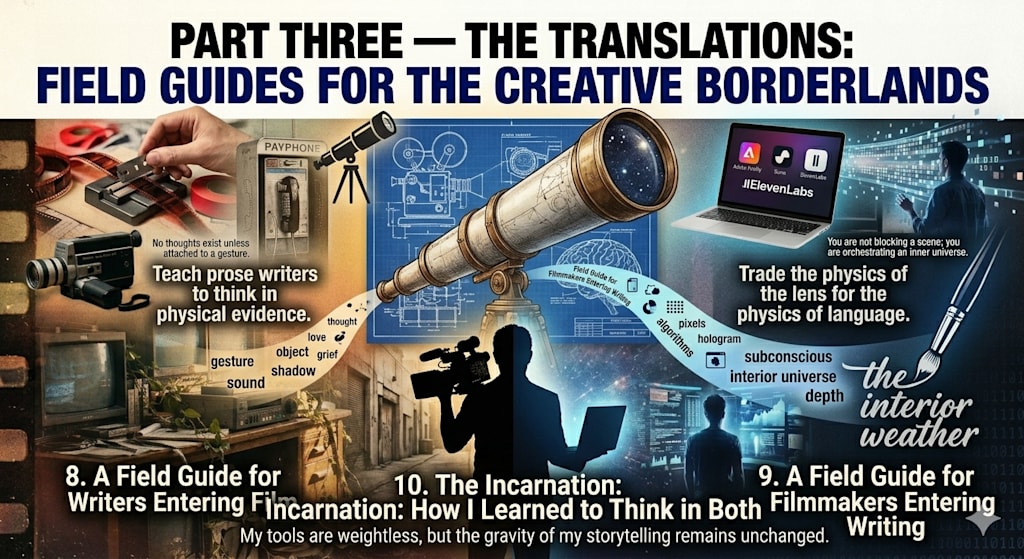
A Field Guide for Writers Entering Film
When a prose writer steps onto a film set or opens a screenwriting program for the first time, they often experience a kind of creative vertigo. They are used to absolute sovereignty. On the flat page, a writer can spend three paragraphs drifting through a character’s interior world dissecting grief, nostalgia, resentment, or the quiet ache of memory.
But cinema is an unforgiving country.
It demands a different passport.
If you want to cross the border from prose into film, you must abandon your abstract nouns and learn to think in physical evidence. Film does not care what a character thinks. It only cares what the camera can see, hear, or infer through behavior.
The Law of the Frame
The first and most brutal lesson is this:
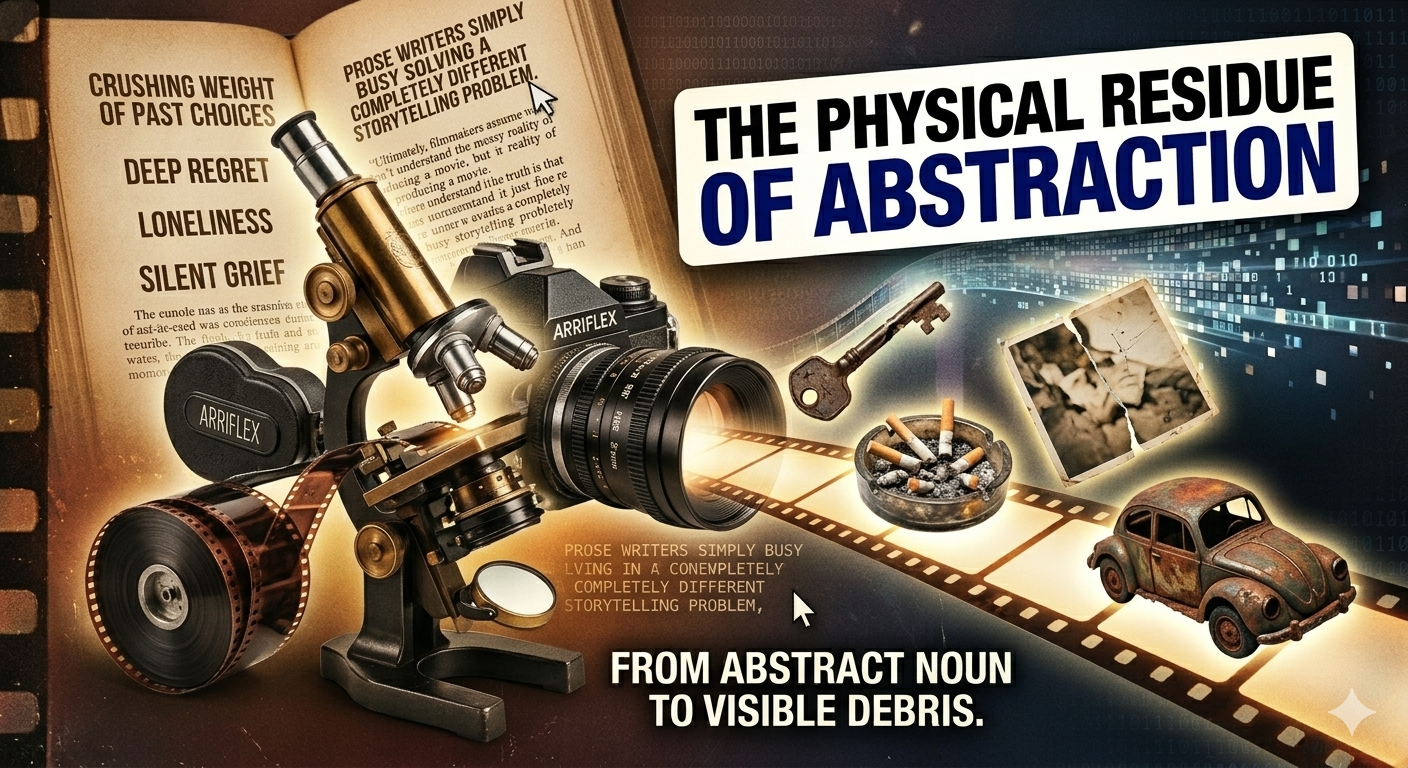
On screen, a character’s inner thoughts do not exist unless they are attached to a gesture, an object, a shadow, or a sound.
You cannot write:
“She felt the crushing weight of her past choices as she sat in the kitchen.”
The camera cannot film “past choices.”
The lens cannot capture “crushing weight” as an idea.
Instead, you translate the interior landscape into physical residue:
• the sink overflowing with three days of unwashed dishes
• her fingers tracing a cracked line in the laminate countertop until her knuckle turns white
• the rhythmic, maddening hum of an old refrigerator that should have died years ago
In cinema, the invisible must be made visible.
If a state of mind cannot be seen or heard, it is a ghost that never makes it through the lens.
You are no longer writing thoughts.
You are capturing the debris those thoughts leave behind in the physical world.
The Exercise of Silence
To survive this translation, a prose writer must practice the discipline of silence.
In prose, dialogue and interior monologue carry the emotional weight. Writers love a brilliant exchange or a poetic internal revelation.
But in films, words are often the booby prize.
The strongest cinematic moments are paid for in:
• silence
• geometry
• timing
• breath
• negative space
Imagine a page of interior monologue where a woman realizes her marriage is over during dinner. A prose writer can make that realization beautiful over a thousand words.
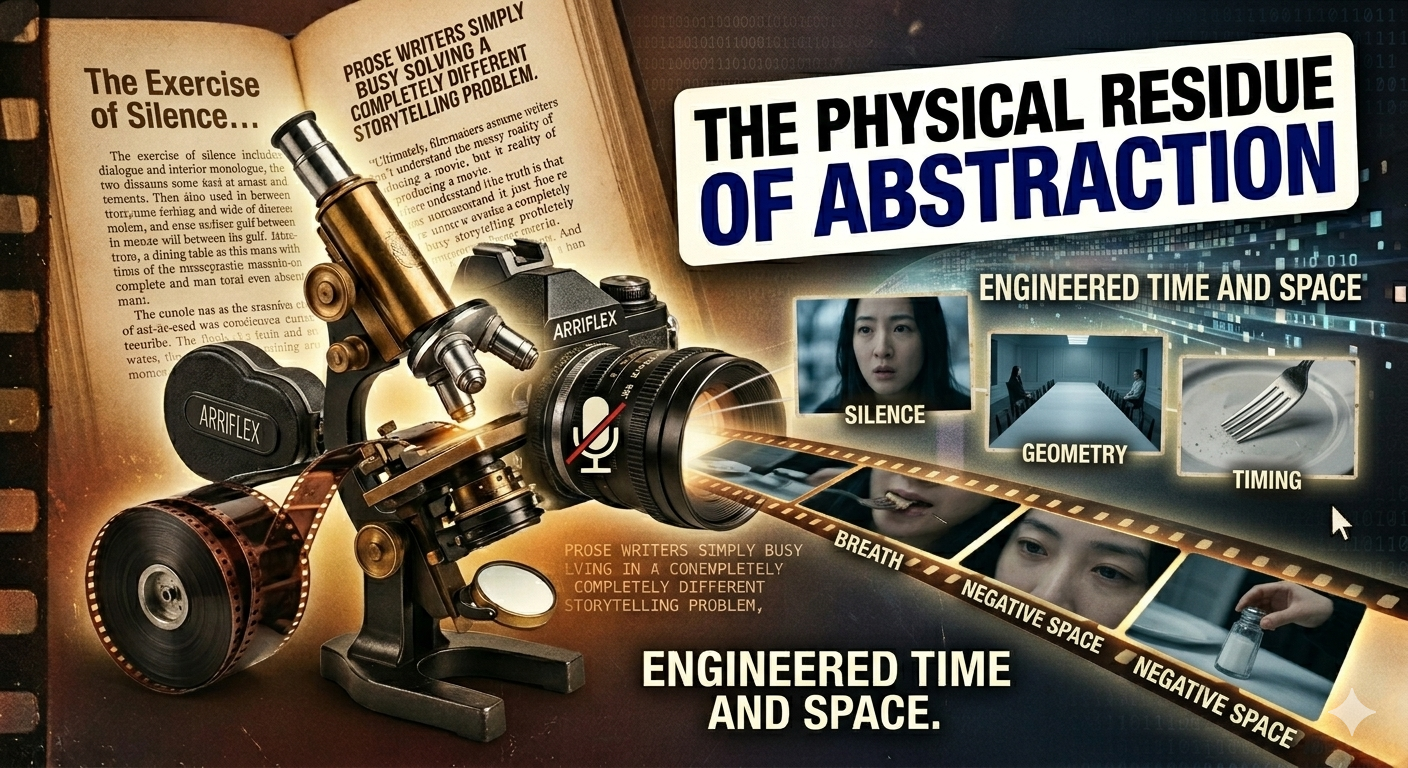
A filmmaker translates those pages into a ten second sequence:
• a suffocating closeup, background blurred into isolation
• a wide shot revealing the cold, architectural gulf of the dining table
• the metallic scrape of his fork against porcelain, amplified until it feels violent
• her stopping mid chew
• her gaze dropping to the saltshaker
• her moving it two inches to the left
No dialogue.
No explanation.
Just engineered time and space.
In those ten seconds, the audience knows everything.
The marriage is over.
The emotional contract has dissolved.
The story has turned.
You didn’t need a single line of dialogue.
You needed precision.
Tone of the Chapter
“If you want to write for the screen, stop telling me what she thinks.
Show me what she does with her hands when she thinks no one is looking.”
A Field Guide for Filmmakers Entering Writing
If Section 8 teaches prose writers how to think in frames, this section flips the lens. This is where filmmakers the engineers of light, timing, and physical space learn to slow down time and paint with the depth of the subconscious mind.
Filmmakers entering writing often experience a different kind of vertigo. They are used to the constraints of the physical world: budgets, locations, weather, actors, equipment, schedules, and the relentless math of production. They are used to thinking in shots, angles, blocking, and the choreography of bodies in space.
But the page is not a set.
The page is an interior universe.
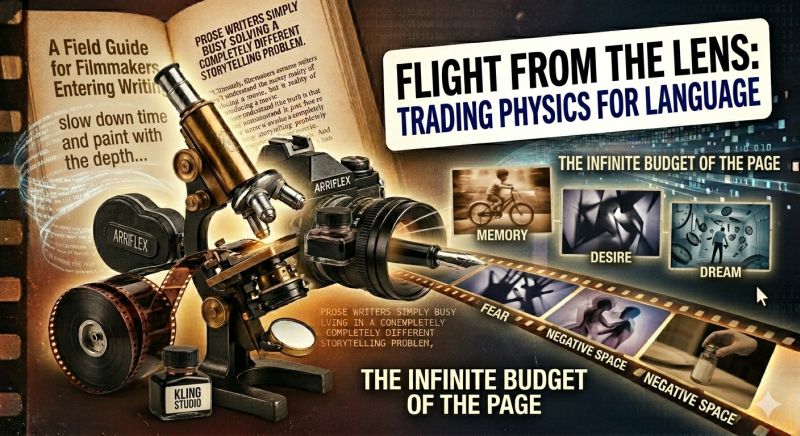
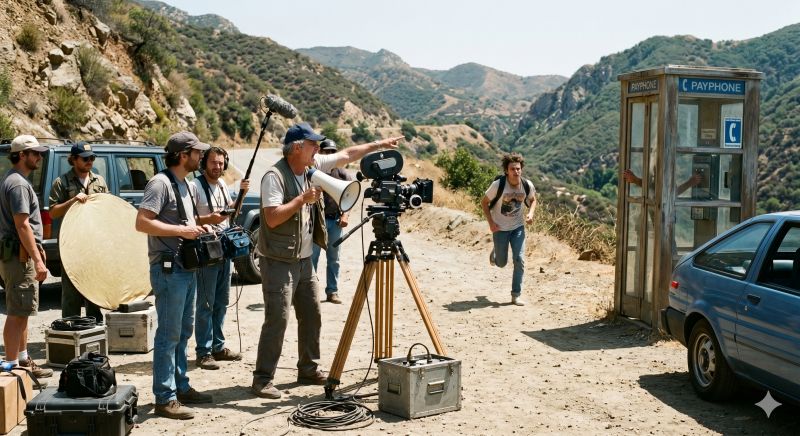
Writing is the one medium where the camera can sit directly inside a character’s memory, fear, desire, or dream without a single dollar spent or a single light rigged. The filmmaker must learn to trade the physics of the lens for the physics of language.
The Freedom of the Blank Page
The first revelation a filmmaker must accept is this:
On the page, the budget is infinite.
There are no:
• Location fees
• lighting rentals
• weather delays
• union breaks
• camera resets
• casting constraints
The page allows you to place the camera anywhere inside a childhood memory, inside a heartbeat, inside the color of a regret. You can dissolve into metaphor, expand time, or collapse it into a single breath.
The filmmaker learns that writing is not limited by the physical world.
It is limited only by precision of thought.
Building the Interior Weather
Filmmakers are masters of exterior atmosphere lighting ratios, color palettes, blocking, sound design. But writing demands a new skill: interior weather.
Interior weather is created through:
• cadence
• rhythm
• syntax
• metaphor
• emotional temperature
• the texture of language
This is how you build tension a lens could never capture.
A filmmaker might show a storm.
A writer can show the storm inside a character’s ribcage.
A filmmaker might frame a close up.
A writer can frame the exact shape of a thought before it forms.
A filmmaker might use a dolly push.
A writer can use a single sentence to collapse a decade of longing.
Writing is not about blocking a scene.
It is about orchestrating the psychological climate that shapes the scene.
Tone of the Chapter
“On the page, you are not blocking a scene; you are orchestrating an inner universe.
You don’t need a lighting ratio when you can change the color of a character’s memory.”
The Incarnation: How I Learned to Think in Both Mediums
There comes a moment in every creator’s life when the borders between mediums dissolves. When the old-school acetate and the new-school digital tools stop feeling like separate languages and begin to speak through the same voice. When the filmmaker and the writer, the musician and the mythmaker, the analog survivor and the digital architect all recognize themselves as one consciousness.
This chapter is that moment.
This is the incarnation the place where every era of my creative life finally stands in the same room.
The 90s Los Angeles Crucible
I was forged in a decade that demanded physical stamina, technical grit, and absolute precision. The 90s were not romantic; they were crucible.
I learned timing by hauling heavy rigs across cracked asphalt in the Valley heat.
I learned discipline by cutting film with razor blades under a tiny viewer light.
I learned patience by transferring projection screens to video, frame by stubborn frame.
I learned geometry by blocking scenes in cramped apartments with no budget and no forgiveness.
Everything was physical.
Everything was earned.
Everything had weight.
Those years taught me the mathematics of space and time the invisible equations that still guide every cut I make, whether I’m slicing acetate or adjusting a digital timeline.
The Modern Synthesis
People assume that using tools like Adobe Firefly, Suno, Eleven Labs, or LTX Studio is a shortcut a cheat code, a lazy button.
They couldn’t be more wrong.
These tools are not replacing my craft.
They are incarnations of it.
The eye didn’t come from the app.
The instinct didn’t come from the interface.
The timing didn’t come from the algorithm.
The eye came from the 90s.
The instinct came from the trenches.
The timing came from the razor blade.
The software is simply light enough to keep up with the speed of my brain now.
It’s the first time in my life that the tools move as fast as the vision.
This is not a shortcut.
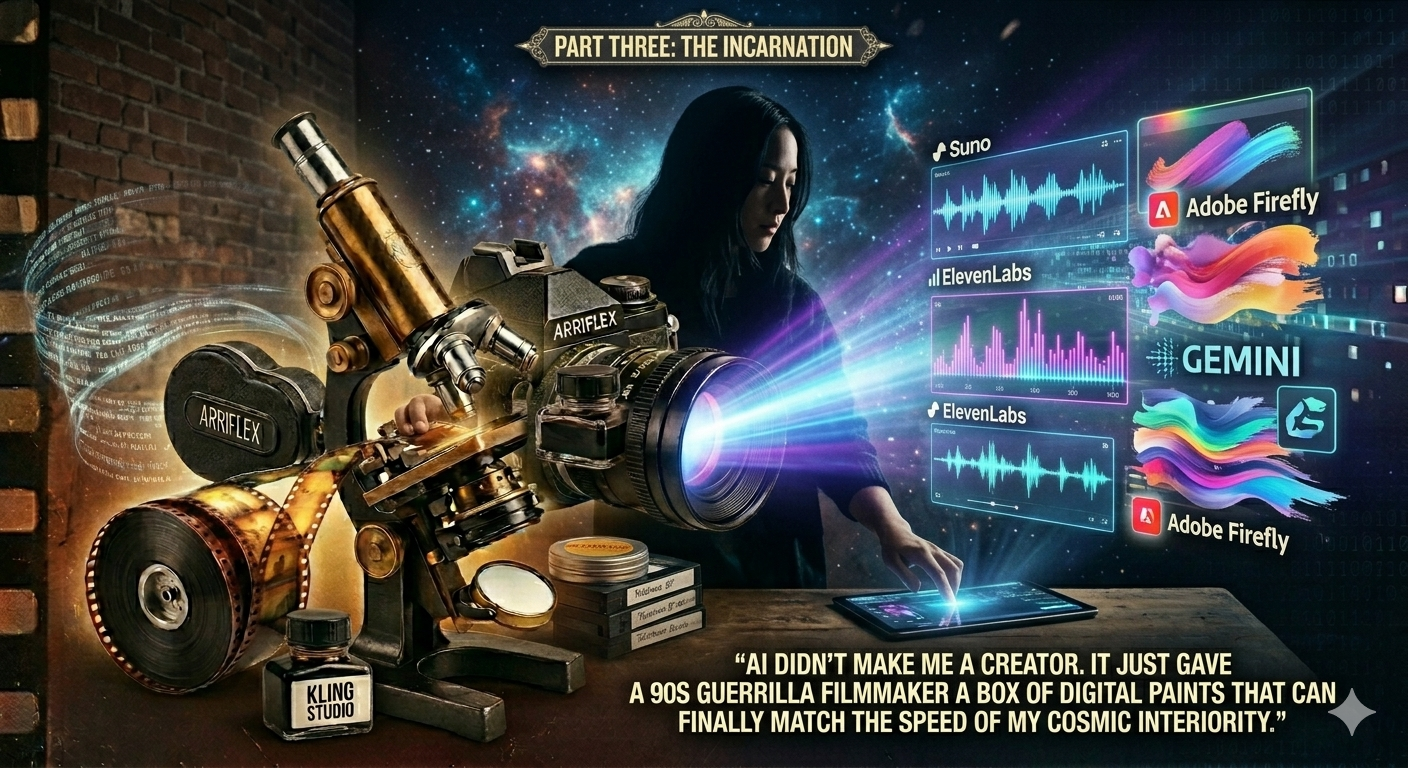
This is the evolution of the same guerrilla spirit I carried through Los Angeles thirty years ago finally unshackled from physical weight.
The Hybrid Identity
I no longer divide myself into lanes.
I am a writer.
I am a filmmaker.
I am a musician.
I am a mythmaker.
I am an educator.
I am a sovereign creator.
I don’t flatten myself to fit a single medium.
I expand the medium to fit the size of my interior world.
The analog grit and the digital precision are not opposites.
They are two halves of the same creative organism one that refuses to shrink, simplify, or apologize.
This is the incarnation:
the moment when every version of me past, present, physical, digital, mythic finally speaks with one voice.
Tone of the Chapter
“AI didn’t make me a creator.
It just gave a 90s guerrilla filmmaker a box of digital paints that can finally match the speed of my cosmic interiority.”
created, written, edited by
Vicki Lawana Trusselli
Trusselli Art
Outstages Cafe Art Studio
California
copyright 2026
About the Creator
Vicki Lawana Trusselli
I am 76 year old California mythic storyteller blending lived truth, technology, and sovereign survival into multimedia art.
Enjoyed the story? Support the Creator.
Subscribe for free to receive all their stories in your feed. You could also become a paid subscriber, letting them know you appreciate their work.
Comments
There are no comments for this story
Be the first to respond and start the conversation.