
One Word, Three Schools, and a Century of Confusion
How “xueyuan” became an independent college, a university department, and a research institute all at once
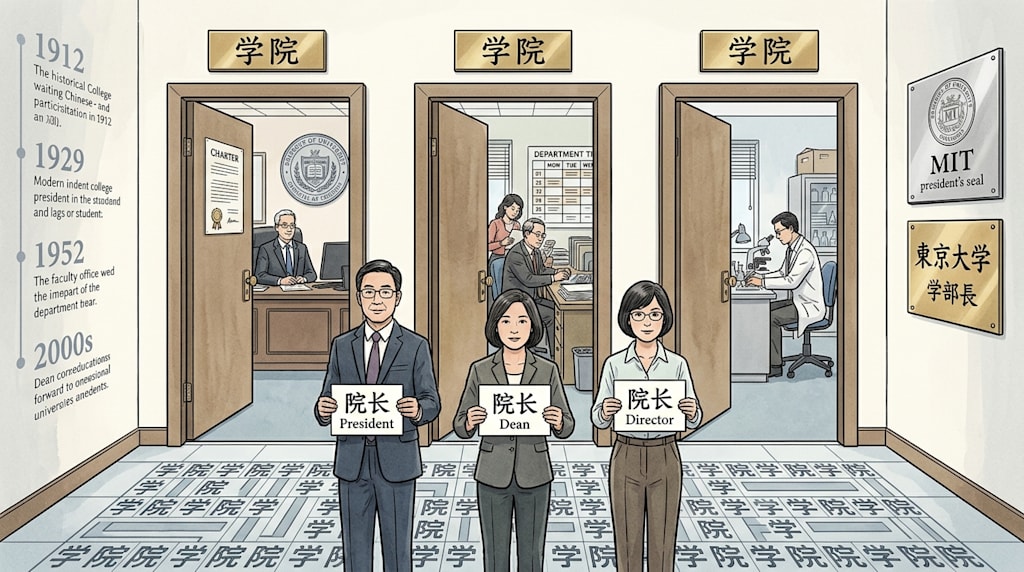
The Chinese word xueyuan (学院) is used for too many things. One xueyuan may be an independent undergraduate college with its own charter, admissions office, and president. Another may be a dean’s office inside a university, a unit that cannot award a degree on its own. A third may be a research institute with no undergraduates. A fourth may be a missionary-era college that once called itself a shuyuan (书院). The sign on the door is the same. The institution behind the door is not.
This is not only a wording problem. It shapes introductions, contracts, conference seating, and university decisions about whether they are upgrading or renaming. It also shapes how Chinese readers understand foreign institutions. The Massachusetts Institute of Technology is called Mazhou Ligong Xueyuan (麻省理工学院) in Chinese. Its leader is a president, usually rendered as xiaozhang (校长). The name says college. The title says university head. That mismatch is old. It is not going away.
People often say the Nanjing government in the late 1920s translated Institute, School, and College all as xueyuan and poisoned the language for a century. That complaint points to a problem. It gets the history wrong. The Nanjing government did not issue a translation decree. It fixed xueyuan as an internal layer of the university. Once that layer existed, it collided with older translations that had already given the same word to independent colleges, research institutes, and foreign schools. The result is a maze.
From Ke-Men to Yuan-Xi
In the Beiyang period, a Chinese university was divided into ke (科), and each ke into men (门). The 1912 University Ordinance listed faculties such as arts, science, law, commerce, medicine, agriculture, and engineering. Under each faculty came men, roughly today’s departments. A 1917 revision allowed single-faculty universities. Alongside these stood specialized schools: law and politics, medicine, engineering, agriculture, commerce, fine arts, music. The names were not simple, but the hierarchy was clear. Ke was the broad teaching division. Men was the unit below it.
The Nanjing government changed the vocabulary. The 1929 University Organization Law said a university should be divided into colleges or schools, xueyuan, in arts, science, law, education, agriculture, engineering, commerce, and medicine. A university needed at least three xueyuan. An institution that did not meet that threshold was an independent xueyuan. Within each xueyuan were departments, xi (系). The head of a xueyuan was a yuanzhang (院长). The head of a department was a xizhuren (系主任). The 1930 University Regulations added details. The university, college, department structure became standard.
That structure lasted. It survived the 1952 departmental adjustments. It expanded during the reform era, when universities created more internal colleges. It hardened during the mergers and expansions of the 1990s and 2000s. Today a Chinese university may have dozens of xueyuan. Each has a yuanzhang. Each yuanzhang may be a dean, a division chief, a research director, or something else. The word did not create the bureaucracy. The bureaucracy made the word necessary.
The Nanjing government gave xueyuan a fixed address inside the university. It did not invent the word. It did not control the translation of foreign institutions. It made college the standard middle layer. That was enough.
Three Translation Sources
The confusion around xueyuan comes from three sources that merged before 1929 and kept flowing afterward.
First, the missionary college. In the late Qing, Western missionaries founded colleges in China. These institutions were often called shuyuan (书院), a term with a long Chinese history. Over time, many changed their names to xueyuan. When Americans spoke of a liberal arts college, Chinese writers reached for xueyuan. The head of such a college might be a president, but Chinese often called him yuanzhang. The word already carried the sense of an independent degree-granting body.
Second, the research institute. Late Qing and Republican China borrowed the word institute for research bodies, translation bureaus, and technical agencies. Some were called xuetang (学堂), some guan (馆), some ju (局), some suo (所). When they were educational, they might be called xueyuan. When they were purely research, they were yanjiusuo (研究所). The line was never clean. An institute could teach. A college could research. The same Chinese word could cover both.
Third, Japanese influence. Modern Chinese academic vocabulary borrows heavily from Japanese coinages. Japan had already developed a clear hierarchy: daigaku (大学), gakubu (学部), gakka (学科), daigakuin (大学院), kenkyuka (研究科), kenkyujo (研究所). Chinese writers borrowed some terms and ignored others. They took xueyuan for gakubu in some contexts and xi for gakka in others. They did not import the whole system. They imported pieces.
By 1929 the word already meant too much. It meant an independent missionary college. It meant a research institute with students. It meant a faculty of a university. It meant a school within a school. The 1929 law did not create the overlap. It made the overlap official.
What Japan Did Differently
Japan’s system is not perfect, but it separates levels more cleanly. Undergraduate teaching is organized into gakubu, faculties or schools, such as the Faculty of Engineering or the Faculty of Law. The head is a gakubucho (学部長). Below the faculty are gakka (学科) and senko (专攻), roughly departments and specializations. The head of a gakka is often a gakkacho (学科長), not a shunin (主任). Graduate education is organized into daigakuin (大学院) and kenkyuka (研究科). The head is a kenkyukacho (研究科長). Research institutes are kenkyujo (研究所), headed by a shocho (所長).
This does not mean Japanese is transparent. Daigakuin is not exactly a graduate school in the American sense. Gakubu is not exactly a college. Kenkyuka is not exactly a department. But the layers have different names. A reader can tell whether the unit teaches undergraduates, grants graduate degrees, or only conducts research.
The Japanese names for American institutions show the difference. MIT is Masachūsettsu Kōka Daigaku (マサチューセッツ工科大学). Caltech is Kariforunia Kōka Daigaku (カリフォルニア工科大学). The Japanese did not translate Institute as gakuin or xueyuan. They translated it as daigaku, university. The head is a gakucho (学長), a university president. Chinese chose xueyuan and then called the head a xiaozhang. The Chinese name says college. The Chinese title says university. Japanese avoided that knot.
Japan also distinguishes gakuen (学園). In Japanese, gakuen usually refers to a school corporation or an educational foundation, not to an internal college. Chinese sometimes borrows xueyuan for the same purpose, which adds another layer of ambiguity.
Chinese should not copy Japanese. A term system works when it separates legal status, degree-granting power, internal level, and function. Japanese does that imperfectly. Chinese does it less.
The Costs
The costs of the maze are practical.
First, legal status becomes blurry. An independent xueyuan is a university-level institution. It has its own charter, its own budget, its own president. An internal xueyuan is a subunit. It has a dean, a budget line, and no independent degree-granting authority. Both are called xueyuan. Both leaders are called yuanzhang. A contract, a memorandum, or a joint program can go wrong when the two sides think they are signing with the same kind of entity.
Second, administrative rank becomes tangled. In the Chinese system, an internal dean may hold a division-level rank. An independent college president may hold a higher rank. When MIT’s president is called yuanzhang in Chinese, the title sounds lower than it is. When a Chinese university’s internal dean is called yuanzhang, the title sounds higher than it is. The word carries no reliable information about authority.
Third, the naming system feeds a cycle of upgrading. A department wants to become a college. A college wants to become a university. A university’s internal college wants to become a xuebu (学部) because xuebu sounds larger. Names inflate. Structures inflate. Committees multiply. The word xueyuan is both a symptom and a tool.
Fourth, international exchange becomes a guessing game. A Chinese scholar visits an American university. She meets the dean of the School of Engineering. She meets the director of a research institute. She meets the president of a small liberal arts college. In Chinese, all three may be introduced as yuanzhang. In English, they are dean, director, and president. The Chinese visitor must decode the institution behind the title. The American host must decode why a dean is meeting a president as an equal.
A Map, Not a Slogan
A better translation system would name institutions by four questions. Is it legally independent? Does it grant degrees? What is its internal level? What does it actually do?
A rough map:
University: daxue (大学). Head: president or chancellor.
Institute of Technology: gongye daxue or ligong xueyuan (工业大学/理工学院). Head: president. MIT and Caltech belong here.
Research Institute: yanjiusuo (研究所). Head: director.
School or Faculty: xuebu or xueyuan (学部/学院). Head: dean.
Department: xi (系). Head: chair.
Independent College: xueyuan (学院). Head: president or dean, depending on charter.
Residential College: shuyuan (书院). Head: master, warden, or president.
Community College: shequ xueyuan (社区学院). Head: president.
This map does not solve every case. Language rarely does. But it gives writers and translators a way to ask what kind of body they are naming. It also gives institutions a way to describe themselves without relying on one overloaded word.
Xueyuan is a useful word. The problem is that it has been asked to do too much. It has to be an independent college, an internal school, a research institute, a faculty, a residential college, and a school corporation. No word can carry that load without cracking.
Same Sign, Three Worlds
At a university building in Shanghai, the directory board lists three units on the third floor.
Room 301: Institute of Advanced Materials. Director: Zhang Wei. In Chinese: Gaodeng Cailiao Yanjiusuo, Suozhang Zhang Wei.
Room 302: School of Materials Science and Engineering. Dean: Li Na. In Chinese: Cailiao Kexue Yu Gongcheng Xueyuan, Yuanzhang Li Na.
Room 303: Materials College. President: Wang Lei. In Chinese: Cailiao Xueyuan, Yuanzhang Wang Lei.
A visiting scholar from Ohio walks to the reception desk. She has a meeting with the dean of the materials college. The receptionist looks at the board. Three names appear. Three titles in Chinese end with the same two characters: yuanzhang. The visitor asks again. The receptionist points to Room 302. The other two doors stay closed. The word on the board has not changed. The institutions behind the doors have.
About the Creator
Jin
Writer of reamstories
https://reamstories.com/jin
Enjoyed the story? Support the Creator.
Subscribe for free to receive all their stories in your feed. You could also become a paid subscriber, letting them know you appreciate their work.
Comments
There are no comments for this story
Be the first to respond and start the conversation.