
Not All Clinical AI Is the Same: How Integrative Clinicians Can Identify Evidence-Based AI Tools
The wrong AI tool in your practice isn't a neutral choice — it affects what gets checked and what reaches your patients

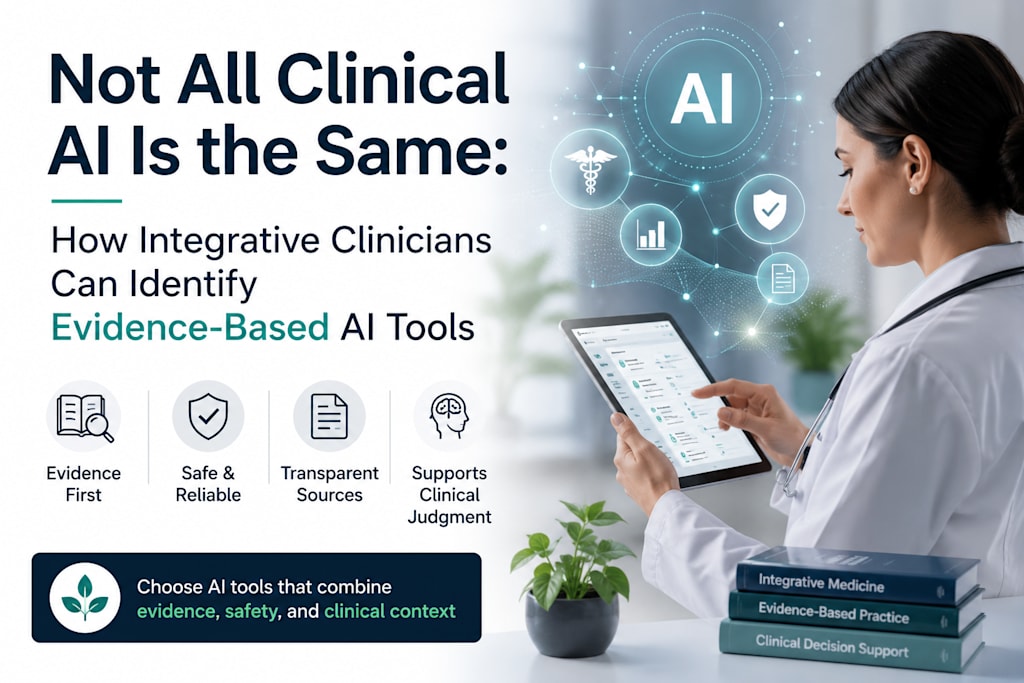
The AI tools flooding your inbox were probably not built for you.
There is no shortage of AI tools competing for clinicians' attention right now. Every week brings a new platform promising to save time, reduce burnout and improve patient outcomes. For integrative and functional medicine practitioners, the noise is especially hard to sort through — because most of what is being built was not designed with your workflows in mind.
The uncomfortable truth: using the wrong AI tool in clinical practice is not a neutral choice. It shapes what gets checked, what gets missed and ultimately what reaches your patients.
So how do you tell the difference between a tool that was genuinely built for integrative medicine and one that was simply marketed toward it?
Why General-Purpose AI Falls Short in Clinical Contexts
Most large language models are trained on broad internet text. They can summarize articles, draft emails, and answer general health questions with reasonable accuracy. What they cannot do reliably is apply clinical judgment to a specific patient case, check a supplement stack against a medication list, or grade evidence the way a trained practitioner would.
When you ask a general AI tool a clinical question, it draws on whatever it was trained on — which may be outdated, unverified, or simply not specific enough to be useful. In a clinical setting, that kind of approximation is not a minor inconvenience. It is a meaningful patient safety risk.
This is the core problem: general-purpose AI was not designed for integrative practice, and the gap shows up quickly in real cases.
The Four Markers of a Trustworthy Clinical AI Tool
Before adopting any clinical AI platform, integrative clinicians should ask four direct questions.
1. Where does the knowledge base come from, and who reviewed it?
There is a meaningful difference between an AI that draws on unverified internet content and one built on clinician-reviewed monographs and maintained evidence summaries. The source of the knowledge base directly determines the reliability of what comes out. If the answer to this question is vague, treat that as a signal.
2. Does it check for drug-nutrient and drug-botanical interactions automatically?
This should not be an afterthought or a separate step. A clinical AI tool worth using surfaces potential conflicts as part of the core workflow — not after you have already generated a protocol. For integrative practitioners managing patients on complex medication and supplement regimens, this is non-negotiable.
3. Are recommendations graded by evidence level, and are sources cited?
An AI that produces recommendations without sourcing them is asking you to take its word for it. That is not a reasonable task in a clinical context. Evidence grading — distinguishing between well-supported interventions and those with limited or preliminary backing — is what separates a useful clinical tool from a sophisticated autocomplete.
4. Can the output be edited before it reaches the patient?
The clinician's judgment should always be the final layer. A good clinical AI tool generates a thorough, evidence-informed starting point — then gets out of the way so you can review, adjust, and personalize before anything goes to the patient. Tools that make this step difficult are not designed with clinical responsibility in mind.
The Real Workflow Problem AI Should Solve
For most integrative clinicians, the bottleneck is not access to information. It is time.
Reviewing the literature, checking interactions, building a personalized protocol, and translating it into something a patient can actually follow — in complex cases, that easily adds up to an hour or more of work after the appointment is already over.
A clinical AI tool that is doing its job well compresses that timeline significantly without cutting corners on rigor. It handles the research and formatting side of protocol building so that you can focus on interpretation, patient conversation, and follow-up care.
That is a meaningful shift. Not replacing clinical judgment — removing the parts of the workflow that do not require it, so the parts that do get the attention they deserve.
What to Look for in Practice
The distinction between general AI and purpose-built clinical AI is easy to understand in theory. In practice, it becomes clear the first time you ask a complex clinical question and compare the outputs.
A tool built for integrative medicine produces a structured protocol with graded evidence, cited sources, and automatic interaction checking. A general AI tool produces a response that sounds plausible but may be drawing on outdated, unverified, or overly generic information — and gives you no way to assess which.
For a deeper breakdown of what separates these tool categories and what questions to ask before committing to any platform, ClarityTx guide on clinical AI for integrative medicine walks through each of these criteria in detail.
The Bottom Line
AI is going to play a larger role in clinical practice. That is not really in question. What is worth being deliberate about is which tools get adopted and why.
The bar for clinical AI in integrative medicine should be high: reviewed sources, built-in safety checks, graded evidence, and a workflow that respects the clinician as the final decision-maker. Tools that meet that bar exist. It is worth taking the time to find them — because the cost of getting this wrong falls on your patients.
About the Creator
Clarity Tx
ClarityTx empowers clinicians with AI-assisted, evidence-synthesized clinical insights and personalized treatment planning across conventional and integrative therapies helping you build safer, research-backed protocols faster.
Enjoyed the story? Support the Creator.
Subscribe for free to receive all their stories in your feed.
Comments
There are no comments for this story
Be the first to respond and start the conversation.