
My Daughter Can't Recognize Letters and Numbers: What Finally Helped (And What Didn't)
I thought flashcards, alphabet songs, and learning apps would solve the problem. They didn't. Here's what I learned about letter recognition, number recognition, and why my daughter's progress finally started making sense.

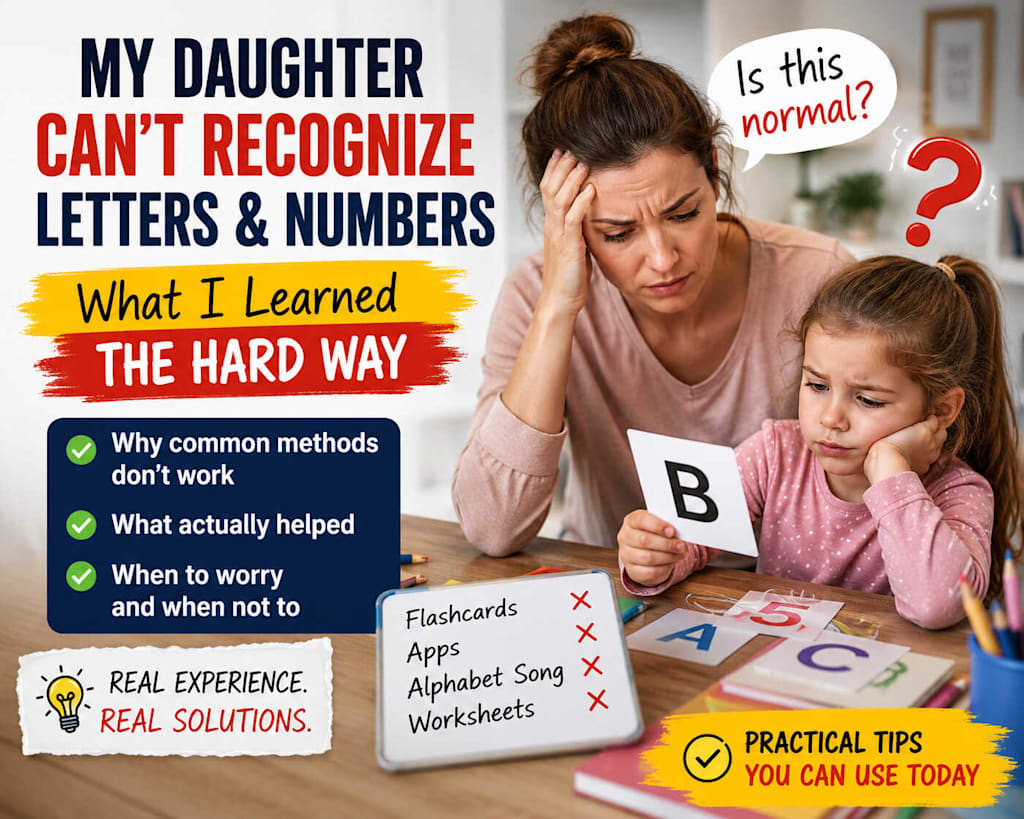
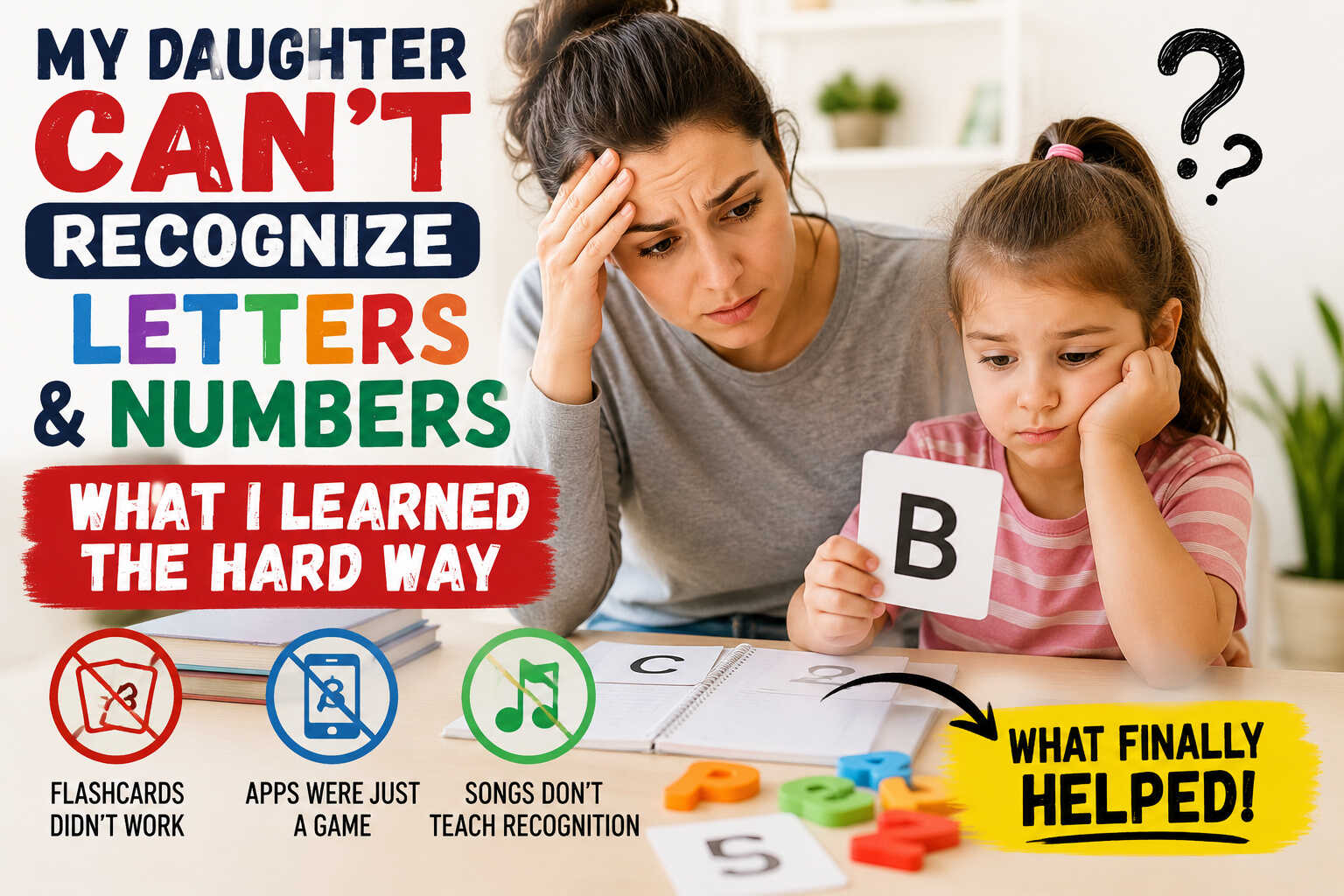
I sat there watching her stare at the letter B. She had traced it yesterday. She couldn't name it today. That was the pattern. My daughter couldn't recognize letters and numbers, and I had no idea what I was doing wrong.
I had downloaded four apps. I bought the workbook every blog recommended. I sang the alphabet song until I hated it. She played the apps. She filled in the worksheets. She sang along. Nothing stuck. I realized later she was just tapping through to the cartoon reward. The worksheets she completed by memorizing the pattern, not reading the letter. The song she sang like any nursery rhyme, with no idea what the sounds meant.
I put the workbook away and didn't open it for a week. I needed to figure out if this was my fault or if something was actually wrong.
I Thought I Was Doing Everything Right
The first thing I tried was flashcards. Every parenting book said repetition works. I held up a card. She guessed. I held up the same card five minutes later. She guessed again. Sometimes right, sometimes wrong, with no pattern I could see. I thought she wasn't paying attention. I got stricter. I added a sticker chart. She started avoiding me when I pulled out the cards. I didn't notice at first. I thought she was being difficult.
The apps were worse. She loved them. She played for twenty minutes. I thought that meant learning was happening. Then I watched her. She was tapping the dancing letter to make the animation play again. She didn't care which letter it was. The app said she was "mastering letter recognition." She wasn't. She was mastering the game.
I tried the alphabet song. She sang it perfectly. I felt relieved until I pointed to a random letter in a book. She didn't know it. She could sing the whole song but couldn't find the letter M in her own name. I didn't understand that the song is a memory trick, not recognition. Her brain had memorized the sequence. It hadn't connected the sound to the shape.
My aunt said her son knew the whole alphabet at three. I smiled and changed the subject. Then I went home and opened the workbook again. That was my mistake. I kept trying harder with methods that weren't working for her brain.
What "Not Knowing Letters" Actually Means
There's a difference between seeing, naming, and knowing. My daughter saw letters all day. She saw them on cereal boxes, on street signs, on her shirt. But seeing isn't naming. Naming isn't knowing. Knowing means the brain has stored the visual shape, the sound it makes, and the connection between them. That's three separate skills. She was struggling with all three at once because I was asking her to do all three at once.
The alphabet song is not letter recognition. I can't say that loud enough. She sang it perfectly. She had no idea that the fourth sound in the song matched the squiggly shape that starts her friend's name Katie. She thought the song was a song. I thought the song was proof she was learning. We were both wrong.
Numbers and letters develop on different tracks. She could count to twenty. She couldn't recognize the number 5 on a die. Counting is a verbal sequence, like the song. Recognizing the symbol is visual memory. She had the verbal part down. The visual part wasn't there yet. I was panicking about both at the same time when they were actually different problems.
The Age Question Everyone Gets Wrong
I thought every kid knew letters by four. That's what the internet suggested. That's what the preschool worksheets implied. That's what the other parents at the playground seemed to expect. I later learned that developmental ranges are wide. Some kids recognize letters at three. Some don't until six. Both can be normal. The panic comes from comparing your child to the earliest developer in the room.
What kindergarten teachers actually expect is broader than ABCs. I emailed my daughter's future teacher. She said they expect kids to recognize their own name, hold a pencil, listen to a story. Letter recognition is helpful but not required. She said they teach letters in kindergarten. That's what kindergarten is for. I had been treating it like a prerequisite.
Some countries wait until age six or seven to teach formal letter recognition. Their literacy rates are fine. Better than ours, in some cases. The research shows that oral language, hearing the sounds in words, and understanding that print carries meaning matter more for long-term reading than early letter naming. I didn't know that. I thought earlier was better. Earlier is just earlier. It isn't always better.
I Tried the Flashcards. She Shut Down.
I didn't understand why traditional methods failed her until I learned about learning styles. She is not a sit-and-memorize kid. She is a touch-everything kid. She is a move-constantly kid. Flashcards ask a child to sit still, stare at a symbol, and pull the name from memory. That works for some brains. It doesn't work for hers. Her brain needs to feel the shape, move through the shape, hear the shape in a context that matters to her.
Her behavior was trying to tell me. She wiggled off the chair during flashcards. She looked out the window. She asked for snacks. I thought she was being defiant. She was being honest. Her brain was saying this method doesn't fit. I wasn't listening. I thought she needed more discipline. She needed a different approach.
What Actually Worked at Our House
The five-minute morning routine changed everything. Not because it was magical. Because it was short enough that she didn't dread it. I stopped asking her to name letters. I started asking her to find them. I put three magnetic letters on the fridge. I said, "Which one looks like a snake?" She found S every time. I didn't ask her to name it. She started naming it on her own after a week. The pressure was gone. The shape was fun.
I turned her obsessions into letter practice. She loved dinosaurs. I wrote D-I-N-O-S-A-U-R in chalk on the driveway. She jumped from letter to letter. She didn't know them all. She knew D because it started her name. She learned the others because she wanted to spell dinosaur. Not because I was teaching. Because she was interested.
When she said "I don't know," I stopped saying "you knew this yesterday." That phrase made her freeze. I started saying, "That's okay. Let's look at it together." I traced it in the air. I made the sound. I didn't ask her to repeat it. I just did it. She started joining in. Not every time. Sometimes she walked away. That was fine. We tried again tomorrow.
The car game was accidental. I pointed to a stop sign. I said, "That sign starts with the same sound as your name. Sssss." She looked. She didn't know the letter. She knew the sound. We started doing that with everything. Cereal. Street names. Store signs. She wasn't being tested. She was just noticing. Noticing is the first step. I had been skipping it.
While Researching Structured Literacy
I kept wondering how professionals organize these skills. I had random activities. I didn't have a progression. While researching structured literacy, I came across an educational guide that broke down how early reading skills are usually sequenced. It explained why some programs start with sounds before letter names, why uppercase often comes before lowercase, and how letter recognition connects to phonemic awareness in a deliberate order. I didn't follow the guide. I just wanted to understand the logic behind the sequence. That logic helped me organize my own kitchen-table attempts. The guide is here if you're curious about how lessons are structured:
After Comparing Several Approaches
After comparing several approaches to structured literacy, I found a review that helped organize how different programs teach the same skills. Some start with letter sounds. Some start with letter shapes. Some use movement. Some use stories. The review laid out the differences without saying one was best. It just showed the options. That helped me stop searching for the "right" program and start thinking about what matched my daughter. She needed movement. She needed context. She needed short sessions. No program was going to change that. I had to match the method to her, not the other way around. The review is here if you want to see how different programs compare:
The Signs That Made Me Call the Pediatrician
I want to be clear about when worry is warranted. I checked her vision first. She squinted at street signs. She sat too close to the TV. I took her to a pediatric optometrist. She needed glasses. That didn't fix everything, but it fixed some of the confusion. Letters stopped swimming together. She could see the difference between b and d more clearly.
Hearing came next. She sometimes didn't respond when I called her from another room. The pediatrician checked. Her hearing was fine. But ruling it out mattered. If a child can't hear the difference between similar sounds, letter recognition becomes harder. It's worth checking.
I asked about dyslexia. The pediatrician said at four and five, it's too early to diagnose. Reversals are normal until age seven. Confusing b and d, writing numbers backward, mixing up the order of the alphabet, these are typical developmental stages. The red flags are different: no progress over months despite varied approaches, family history of reading difficulties, extreme frustration that doesn't ease, avoiding all print-related activities even when presented playfully. My daughter didn't have those. She was slow. She wasn't stuck. That distinction mattered.
What I Wish Someone Had Told Me
Letter recognition is visual memory, not intelligence. My daughter could build complex Lego sets. She could remember every dinosaur name I couldn't pronounce. Her brain worked fine. It just didn't store letter shapes the way it stored dinosaur shapes. Letters were abstract. Dinosaurs were interesting. The brain prioritizes what matters to it.
Oral language matters more than letter names for reading. I spent months trying to get her to name letters. I should have spent more time talking, asking questions, reading stories, having her retell them. Kids who enter kindergarten with strong vocabularies and the ability to hear sounds in words learn to read faster than kids who can name letters but can't express a complete thought. I had the priorities backwards.
My anxiety was making her avoid letters. She could feel my tension. When I pulled out the workbook, my shoulders tightened. She noticed. She started saying "I don't want to" before I even opened it. I had to put the workbook in a drawer for a month. When I came back, I came back casually. That casualness was what she needed.
She'll Get There. Probably Not on Your Timeline.
My daughter is six now. She recognizes most letters. She still mixes up a few. She knows her numbers to twenty. She writes some backward. She is not ahead. She is not behind. She is on her own path. Kindergarten did what it was supposed to do. It taught her in a classroom with other kids, with a teacher who sees this every year, with methods that aren't my kitchen-table panic.
The fact that you're searching means you care. That's what she needs most. Not a perfect parent. Not a perfect method. Just a parent who pays attention, adjusts, and doesn't make her feel broken for developing at her own speed.
Try one thing tomorrow. Not ten. One. Make it short. Make it playful. Make it about her, not about the letters. The letters will come. They always do.
About the Creator
Understandshe
I write about healing, self-growth, and the messy but beautiful journey of becoming. Honest lessons, real stories, and gentle insights you’ll also find on UnderstandShe.
Enjoyed the story? Support the Creator.
Subscribe for free to receive all their stories in your feed.
Comments
There are no comments for this story
Be the first to respond and start the conversation.