
Membrane Switches for Medical Devices: Cleaning, Usability, and Design Considerations
Before selecting membrane switches for medical devices, ask two questions: can the intended operator identify and use the controls correctly, and what evidence will show that the assembled interface remains acceptable after its specified cleaning exposure?

Begin with those questions rather than an attractive overlay or a preferred key feel. A useful specification should connect operator tasks, cleaning instructions, display visibility, enclosure details, and acceptance criteria. This article develops that connection for medical-device OEM teams preparing an interface review. The objective is a reviewable set of design inputs, not a claim that a particular keypad construction is automatically suitable for medical use.
Document the Intended Use and Cleaning Procedure
Start by identifying the intended setting, operator groups, and cleaning responsibilities. A laboratory instrument and a portable device should not receive identical interface requirements simply because both are described as medical equipment. Record where the panel will be positioned, who will operate it, and whether gloves, particular viewing positions, or environmental conditions belong in the use specification. FDA's human-factors overview treats users, environments, and interfaces as connected considerations.
Request the device manufacturer's approved cleaning instructions and revision. For an unreleased device, label proposed instructions as provisional rather than presenting them as validated. FDA's information for reusable-device manufacturers identifies adequate, usable reprocessing instructions as the manufacturer's responsibility. The interface team's role should be to assess compatibility against the applicable instructions, not invent a disinfectant recipe or shorten a required contact period to protect the keypad.
For the compatibility review, record the specified product or medium, concentration, application method, contact time, frequency, temperature where relevant, and any prescribed drying or rinsing stages. Identify which panel areas receive exposure. Ask whether the proposed evidence covers an overlay specimen or an installed assembly; record that distinction alongside the material designation.
Keep the claims separate. CDC distinguishes cleaning, which removes soil, from disinfection and sterilization. Therefore, a wipeable surface or acceptable appearance after exposure should not be presented as proof of antimicrobial performance, sterilizability, or sterility.
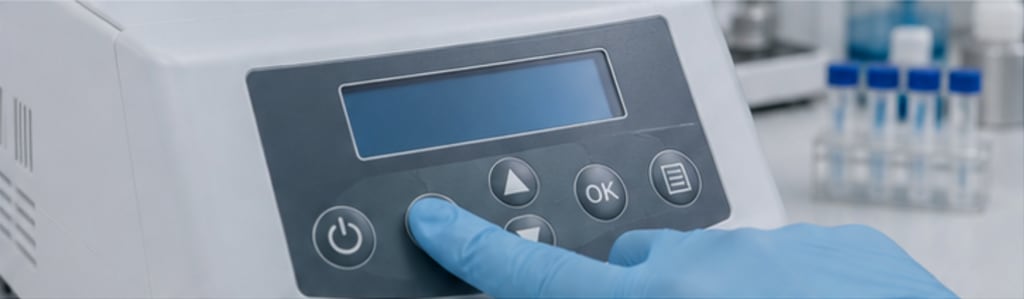
As an illustrative example, consider a benchtop diagnostic instrument with navigation and confirmation keys. Its review package would reproduce the manufacturer's specified wiping exposure and identify the window border and mounting perimeter for examination. This is a requirements example, not a recommended cleaning procedure or a report of test results.
Review Key Identification and Operator Feedback
Develop the key layout around tasks rather than decorative symmetry. For each control, describe the intended action, the information needed before pressing it, and the expected response afterward. Review symbol meaning, label contrast, key location, and visual grouping against those tasks. FDA's human-factors overview includes sensory abilities, lighting, and the timing and form of device feedback among relevant considerations. For this interface review, use those factors to frame questions about legibility and accidental selection.
In the illustrative benchtop example, ask whether an operator can distinguish navigation from confirmation without relying solely on color. Review the artwork at its intended physical size and from the expected viewing position. Where gloves are part of intended use, include the specified glove conditions in prototype evaluations. Investigate ambiguous selections before fixing the artwork and key centers; a neat drawing is not an observation of successful operation.
Evaluate tactile response and device acknowledgement separately. Do not use a perceived snap as the acceptance criterion for firmware recognition of an input. Specify what the operator should feel and what the instrument should display or otherwise communicate after an accepted command. Ask the team to examine repeated presses, uncertain acknowledgement, and neighboring-key selection as potential use problems, rather than assuming that one feedback mechanism resolves all three.
FDA's usability guidance recommends representative intended users and sufficiently realistic simulated-use conditions for human-factors validation. Early prototype evaluations should inform design decisions without being mislabeled as completed validation. When comparing constructions, use JASPER membrane switch assemblies to identify tactile, non-tactile, and embossed options for supplier discussion, then request samples matching the proposed stack-up. Select the construction through the project's usability assessment, not from a structure name alone.
Coordinate Display Windows, Mounting, and Connections
Review the keypad, display window, enclosure, and connection path in one assembly drawing. State whether the window is a transparent region of the overlay or a separate lens, and identify its viewing area, printed border, and adhesive exclusions. Ask for a sample assessment of readability through the final window construction under the intended lighting and viewing conditions. Include that construction in the cleaning-exposure review instead of assessing only the printed key field.
Specify the actual enclosure material and surface finish for adhesive selection. In its surface-energy guidance, 3M explains that wetting allows an adhesive to make intimate contact with a substrate. Its surface-roughness guidance also explains that inadequate flow into surface irregularities can leave reduced contact and trapped air. Accordingly, request bonding evidence on representative production surfaces, not just a smooth demonstration plate. Agree on the applicable preparation, application, and conditioning instructions with the adhesive supplier.
Extend the material review to the complete proposed construction: overlay, surface coating, inks, spacers, rear adhesive, and any window bond or perimeter seal. For every compatibility statement, ask which exact material combination and exposure conditions were evaluated. A film-level report should remain film-level evidence until the project establishes what it supports for the assembly. Document any untested interfaces as open verification questions rather than describing the panel as chemically resistant without qualification.
Finally, review the tail exit, routing clearance, connector orientation, insertion access, and mechanical support. Request construction-specific bending and assembly instructions rather than imposing a generic bend rule. Use the membrane switch design considerations as an organizing reference for these discussions, then record the agreed requirements on the controlled assembly drawing.
Define Project-Specific Verification Requirements
Convert each design input into an evidence request before ordering verification samples. Record the requirement identifier, specimen construction, test conditions, inspection method, and acceptance criteria. Tie the exposure sequence to the manufacturer's applicable instructions and the project's service-life assumptions; justify the selected sequence instead of borrowing an unexplained cycle count. Identify whether samples represent material screening, an assembled interface, or the final device so that conclusions stay within the evidence boundary.
For cleaning compatibility, agree on before-and-after checks for legend readability, window clarity, surface damage, edge lift, and separation between layers. Define observation conditions and measurable limits where appropriate. Add electrical switching checks under agreed circuitry and measurement conditions, together with installed-device acknowledgement checks. Inspect the mounting perimeter and connections after exposure. These are proposed engineering checkpoints, not universal acceptance limits or claims about a particular material.
The following review matrix organizes decisions and evidence requests. It is not a substitute for a project protocol.
Design input
Question to resolve
Evidence to request
Cleaning procedure
What exposure must the interface accommodate?
Controlled instructions and construction-specific compatibility protocol
Identification and feedback
Can intended users select controls and recognize accepted inputs?
Task-based evaluations and separate electrical/function checks
Display window
Is information readable before and after exposure?
Final-window samples and agreed optical inspection records
Mounting and connections
Does the installed construction retain acceptable integrity and function?
Assembly drawing, bonding assessment, and connection inspection records
Project verification
Which requirement does each result support?
Traceability matrix, sample identities, test reports, and deviation decisions
Keep compatibility verification separate from cleaning or disinfection efficacy: showing that a panel still works does not establish that a reprocessing method achieves its intended result. FDA's manufacturer information discusses protocols and complete reports for validating applicable reprocessing instructions. Likewise, a supplier's electrical test cannot replace human-factors validation with representative users.
Before release, assign responsibility for reviewing failures, deviations, and changes. Revisit affected evidence when the cleaning instructions, materials, artwork, mounting, or feedback behavior changes. Maintain the distinction between component verification and the complete device's assessment; neither a supplier brochure nor a component test report should be presented as device approval.
Conclusion
The next step is to assemble one coordinated review package: intended users and tasks, controlled cleaning inputs, interface artwork, window and enclosure details, connection requirements, and an evidence matrix. Resolve uncertain inputs before treating a material or key structure as selected. Ask suppliers to state exactly what their samples and reports demonstrate, and retain open questions for project verification. This approach gives engineering and procurement teams a common basis for comparing proposals while leaving device-level cleaning instructions, usability validation, and release decisions with the responsible OEM team.
About the Creator
Enjoyed the story? Support the Creator.
Subscribe for free to receive all their stories in your feed.
Comments
There are no comments for this story
Be the first to respond and start the conversation.