
Managing Long-Term Sickness and Capability Dismissal
A Legal Guide for UK Employers

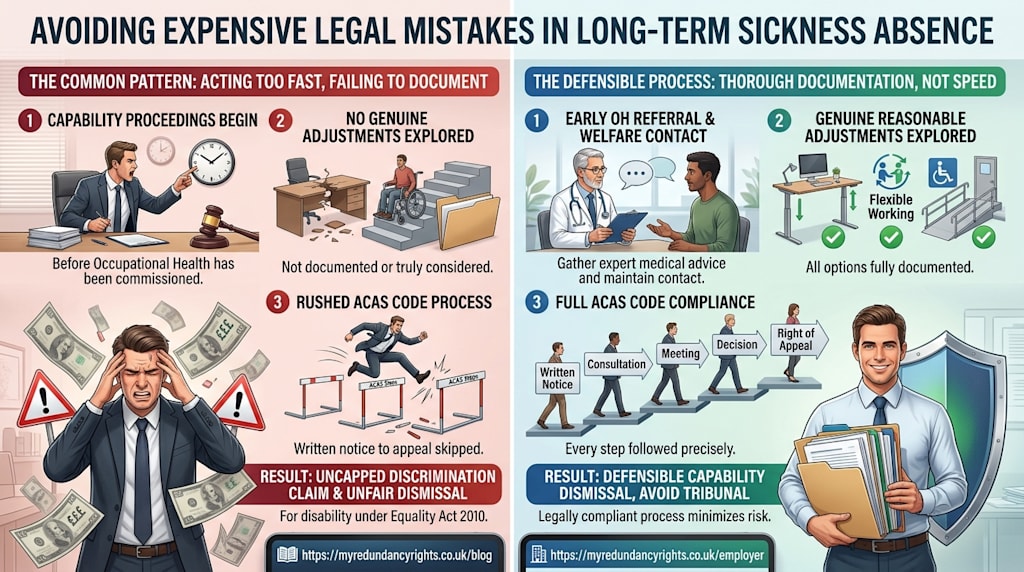
One wrong move with a sick employee could cost your business thousands in an employment tribunal claim. Dismissing staff for prolonged absence is not impossible — but the legal pitfalls are significant, and most employers walk straight into them. Here is the exact legal framework you need to handle long-term sickness correctly, stay compliant, and protect your business at every stage.
The Legal Stakes in 2026
Long-term sickness absence is one of the most complex and high-risk situations a UK employer faces. Get it right and you protect your operations while treating your employee with dignity. Get it wrong and you face claims for unfair dismissal, disability discrimination, or both — with disability discrimination awards uncapped at Employment Tribunal.
According to the Chartered Institute of Personnel and Development (CIPD), long-term sickness — defined as absence lasting four weeks or more — accounts for a disproportionate share of total absence costs for UK businesses. And the legal framework governing how employers respond to it has never been more demanding.
The fine line between compassionate management and accidental discrimination is where most employers lose their cases.
Step One: Early and Consistent Communication
From the first day of absence, establish a pattern of regular, empathetic contact. Welfare check-ins are not harassment — but they must be conducted with care.
The tone must be supportive, not pressurising. The purpose is to stay connected, understand the employee's situation, and plan appropriately — not to push for a return date before the employee is medically fit.
Document every contact. Note the date, the nature of the conversation, and any information the employee provided about their condition or likely return. This record becomes critical if the matter proceeds to capability proceedings.
"We kept in touch throughout — calls, emails, cards," said one HR manager at a manufacturing business. "When the capability process eventually began, we could show the tribunal we had never abandoned our duty of care. It made a significant difference to the outcome."
Step Two: Occupational Health Referral
Where absence extends beyond four weeks, commission an Occupational Health report at the earliest appropriate stage. An independent medical assessment provides objective insight into:
The nature and severity of the condition
Whether a return to work is foreseeable — and on what timescale
Whether the condition may qualify as a disability under the Equality Act 2010
What adjustments or modifications might support a return
This last point is critical. Under the Equality Act, a physical or mental impairment that has a substantial and long-term adverse effect on a person's ability to carry out normal day-to-day activities qualifies as a disability. Long-term is defined as lasting — or likely to last — 12 months or more.
If the condition meets that threshold, the employer's duty to make reasonable adjustments is triggered before any capability process can begin. Proceeding to capability proceedings without first considering adjustments is one of the most common — and most expensive — errors employers make.
Step Three: Reasonable Adjustments
Where the Occupational Health report indicates the employee may have a disability, the employer must actively explore and document reasonable adjustments. These may include:
A phased return to work on reduced hours
Temporary reallocation of duties that the employee cannot currently perform
Flexible or remote working arrangements
Modified targets or reduced workload during recovery
Additional equipment or workspace adaptations
Every adjustment attempted must be documented — including the outcome. Where an adjustment fails or proves insufficient, that documented evidence demonstrates to a tribunal that every alternative was genuinely considered before capability proceedings began.
The reasonable adjustments duty ends only where the adjustment would impose a disproportionate burden on the business — and that burden must be objectively justifiable, not merely inconvenient.
Step Four: Fit Notes, SSP, and the Return-to-Work Framework
A fit note from the employee's GP does not obligate the employer to accept the stated return date or conditions uncritically. Employers may use the fit note as one source of medical evidence — but it is not binding and should be read alongside the Occupational Health report.
Statutory Sick Pay is payable for up to 28 weeks. Once SSP ends, the employer's financial obligation ceases — but the legal obligation to manage the absence fairly continues regardless.
Where a phased return is recommended, structure it formally. Set clear expectations, documented timescales, and review points. A phased return that drifts without structure becomes difficult to manage and harder to bring to a capability hearing if the return ultimately fails.
Step Five: The Formal Capability Process
Where adjustments have been exhausted, a return to work is not foreseeable within a reasonable period, and the business impact is demonstrable — the formal capability process may begin.
Under the ACAS Code of Practice, a fair capability process requires:
Written notification to the employee that a formal capability process is beginning, with reasons
A capability hearing at which the employee has the right to be accompanied
Updated medical evidence considered at the hearing
Clear warnings and reasonable timelines before any dismissal decision is made
A written outcome with reasons and the right of appeal
The tribunal will assess the dismissal against the band of reasonable responses test — whether another reasonable employer in the same circumstances might have made the same decision. The business impact of continued absence, the lack of a foreseeable return date, and the documented exhaustion of alternatives are the three pillars of a defensible capability dismissal.
Step Six: The Dismissal Decision and Post-Termination
Where dismissal is the outcome, the dismissal letter must include:
The reason for dismissal — capability
The notice period or payment in lieu of notice
Any outstanding holiday pay or unpaid wages
The right of appeal and the deadline to exercise it
Dismissing during a live grievance, a whistleblowing disclosure, or a period of maternity or other protected leave dramatically increases legal risk — and may give rise to automatic unfair dismissal claims regardless of the capability process followed.
Your Action Plan
Establish welfare contact from the first day of absence — document every interaction
Commission an Occupational Health report where absence exceeds four weeks
Assess whether the condition may qualify as a disability under the Equality Act 2010
Explore and document every reasonable adjustment before commencing capability proceedings
Follow the full ACAS Code capability process — written notice, hearing, right to be accompanied, written outcome, right of appeal
Ensure the dismissal letter covers notice, outstanding pay, and the appeal right
A robust, compassionate process protects your business and your culture. A rushed or poorly documented one will cost you far more than the absence ever did.
About the Creator
myredundancyrights
Free, plain-English UK employment law guidance — redundancy, unfair dismissal, gross misconduct, PIPs and more. Know your rights before it's too late.
Enjoyed the story? Support the Creator.
Subscribe for free to receive all their stories in your feed.
Comments
There are no comments for this story
Be the first to respond and start the conversation.