
LLM Discovery Intelligence Is What Companies Need Once SEO Analytics Stops Explaining Reality
Why brands need a new measurement model when AI starts shaping the decision before the click


For years, companies knew how to measure digital visibility
Rankings. Clicks. Traffic. Conversions.
That model made sense when discovery started with a search result and ended with a website visit. But LLM Authority Index’s LLM Discovery Intelligence resource argues that AI has changed the competitive surface itself. Users now ask systems for synthesized recommendations, comparisons, and judgments.
The result is not a page of links. It is a compressed interpretation of the market. That is exactly why LLM Discovery Intelligence exists. It is a measurement framework built for response-based discovery, where influence often happens before the click ever occurs.
The old analytics model was built for a different interface
The source article makes the break clear. SEO analytics was designed for a page-based, click-driven environment: query, results, clicks. AI discovery increasingly follows a different structure: prompt, response, decision. Search gives users a menu.
AI gives them a judgment structure. Search expands the choice set. AI compresses it.
That means traditional tools can still show rankings, organic traffic, landing page performance, and post-click behavior, but they cannot reliably show whether AI platforms recommend your company, where you appear in answers, how competitors outrank you, or which source patterns reinforce your position.
That is the real problem.
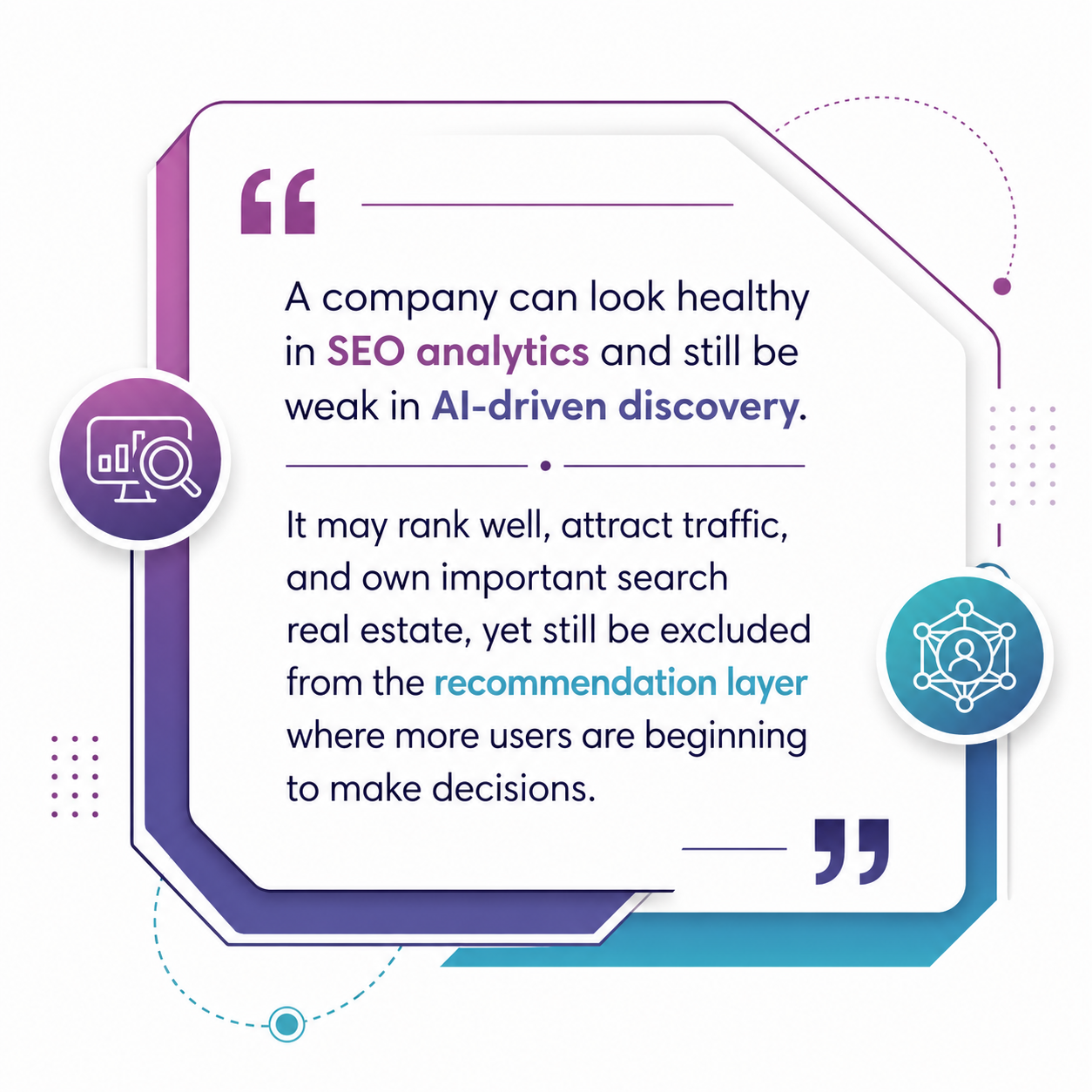
A company can look healthy in old search dashboards and still be weak in the recommendation layer where more decisions are starting to form.
What LLM Discovery Intelligence actually measures
LLM Authority Index defines LLM Discovery Intelligence as the analysis of how AI platforms discover, rank, compare, and recommend companies inside AI-generated responses.
That definition matters because it moves the unit of analysis away from pages and toward entities, prompts, responses, rankings inside answers, and influence before the click.
The framework is designed to answer different questions from classic SEO analytics: How often does the company appear in relevant prompts? Where does it appear inside the answer? Which competitors outrank it? In which use cases is it recommended first? Which source classes seem to strengthen or weaken its position?
That is not just another dashboard.
It is a different way of reading the market.
Watch this video for a quick rundown of the topic:
The five layers that make the framework useful
The source article says a robust LLM Discovery Intelligence model includes five major components: AI Share of Voice, AI Ranking, Prompt Coverage, Citation Architecture, and Competitive Positioning. Share of Voice tells you whether you are showing up at all.
AI Ranking shows how often you occupy top positions inside answers.
Prompt Coverage reveals where you are visible or absent across high-intent prompt clusters. Citation Architecture looks at the source environment repeatedly reinforcing a company’s position.
Competitive Positioning examines how the company is framed relative to rivals, including what strengths, weaknesses, and narratives recur around it.
Taken together, those layers explain something old SEO metrics never could: not just whether you are visible, but whether AI systems are making you easier to choose.
Why simple “AI visibility” is too weak a standard
This is where the related article on The Illusion of AI Visibility sharpens the argument. That piece shows how a company can appear in 60 percent of relevant AI responses and still be commercially weak if it is usually listed third or fourth, framed poorly, or absent from the prompts that matter most.
It defines the deeper problem as visibility without influence: appearing often enough to register in measurement systems, but not prominently or favorably enough to shape real decision-making.
That is why the better question is not “Are we being mentioned?”
It is “How often are we being recommended?”
Why this matters commercially
The source article is blunt about the business stakes. LLM Discovery Intelligence matters because AI increasingly influences choice before traditional analytics systems register the event.
If a user asks which payroll platform is best for a small business, which CRM a mid-market sales team should use, or which tax relief firm is best for a complex case, the AI system is doing more than retrieving pages.
It is narrowing the field and shaping preference. If your company is not mentioned, not well ranked, or not recommended, you are missing commercial consideration, not just awareness.
That point connects directly to AI Discovery Economics, where LLM Authority Index defines Discovery Value as the economic impact of being visible, and preferably recommended, in AI-generated responses to commercially meaningful prompts.
That article also says two factors shape discovery value more than almost anything else: prompt intent and position inside the answer. In other words, visibility alone is not the real unit of value. Recommendation in the right prompt is.
The strategic shift most companies are late to see
The most useful takeaway here is that LLM Discovery Intelligence is not replacing SEO because SEO “stopped working.” It is emerging because SEO analytics was built for a different discovery architecture.
When the answer becomes the primary surface, companies no longer compete only for page visibility. They compete for inclusion, ranking, recommendation frequency, source reinforcement, and stronger framing than competitors.
That is a bigger shift than it first sounds.
About the Creator
Jacqueline Farley
Exploring how AI, search, and public information shape modern brand discovery and trust.
Enjoyed the story? Support the Creator.
Subscribe for free to receive all their stories in your feed.
Comments
There are no comments for this story
Be the first to respond and start the conversation.