
Leading Potash and Phosphate Producers
Balancing growth, efficiency, and sustainability in the global fertilizer industry


Potash and phosphate sit at the center of modern crop nutrition, so the companies that mine and process them still matter enormously to food production, fertilizer pricing, and agricultural supply chains. USGS data shows that world potash consumption rose from 37.5 million tons in 2023 to an estimated 38.8 million tons in 2024 and is projected to reach 40.9 million tons in 2025. On the phosphate side, global phosphate rock mine production increased from 233 million tons in 2023 to an estimated 240 million tons in 2024.
The supply picture is just as important. USGS says world annual potash production capacity was 65.2 million tons in 2024 and could rise to about 76.0 million tons of K2O by 2028. For phosphate, global production capacity in P2O5 terms is projected to rise from 65.0 million tons in 2024 to 70.6 million tons by 2028. That means this market is still growing, but it is also becoming more competitive, more capital-intensive, and more exposed to sustainability scrutiny.
At the country level, Canada remained the largest potash-producing nation in 2024 at an estimated 15.0 million tons, followed by Russia at 9.0 million, Belarus at 7.0 million, China at 6.3 million, Germany at 3.0 million, Israel at 2.4 million, and Jordan at 1.8 million. In phosphate rock, China led 2024 mine production at an estimated 110 million tons, followed by Morocco at 30 million, the United States at 20 million, Russia at 14 million, and Jordan at 12 million.
This article compares five companies that matter in that landscape: ICL Group, Nutrien, The Mosaic Company, K+S Group, and EuroChem Group. They are not identical businesses. Some are stronger in potash, some are more balanced across potash and phosphate, and some compete through specialty downstream products rather than pure commodity scale. That difference is important when comparing “largest potash producers,” since these companies are not interchangeable.
Potash is the umbrella term for water-soluble potassium salts used in fertilizer, including potassium chloride, potassium sulfate, and potassium magnesium sulfate. Phosphate rock is the mined feedstock used to make phosphate fertilizers and other downstream phosphate products.
Global Demand for Potash and Phosphate
The reason the largest potash producers remain so important is simple: potassium and phosphorus are not optional nutrients in commercial agriculture. Potash supports water regulation, stress tolerance, and yield quality in crops, while phosphate is central to root development, energy transfer, and early plant growth. In fertilizer markets, that makes both nutrients structurally important even when short-term prices fluctuate.
USGS notes that potash demand growth in 2024 was strongest in Asia and South America, with good planting weather and stable prices supporting higher use. The same USGS update says world potash production increased in 2024, with Canada and Belarus posting the biggest year-over-year gains. Canada also remained the leading exporter of potash in the world.
Phosphate has its own growth story. USGS projects phosphate production capacity to expand through 2028, with ongoing or expected capacity additions in Brazil, Kazakhstan, Mexico, Morocco, and Russia. The phosphate market is also widening beyond traditional fertilizer demand, because high-purity phosphoric acid is increasingly relevant to lithium iron phosphate battery supply chains. USGS notes that more than 90% of LFP batteries were manufactured in China in 2024.
That matters for company comparisons. A producer with strong potash mines but limited downstream phosphate exposure will look different from a company with balanced phosphate and potash assets. Likewise, a business built around broad commodity tonnage will look different from one that converts mineral resources into specialty crop nutrition products. Those differences shape margins, export exposure, and sustainability priorities. That is an inference based on USGS market trends and each company’s public operating profile.
ICL Group
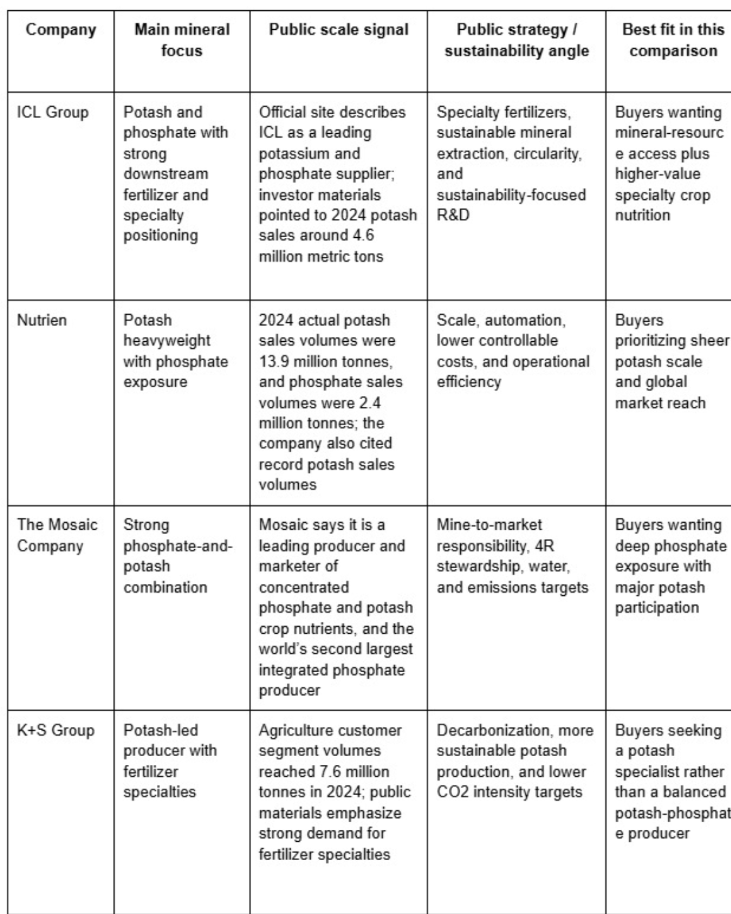
ICL Group stands out in this list because it is not positioned around bulk commodity tonnage alone. Its site describes it as a leading potassium and phosphate supplier, and its agriculture portfolio shows how those mineral resources are converted into downstream fertilizers such as potash products, potassium phosphate, Polysulphate-based blends, and other specialty offerings. Investor guidance in late 2024 pointed to roughly 4.6 million metric tons of potash sales for the year, placing ICL within the group of globally relevant potash producers.
This positions ICL as a value-added mineral company rather than a pure volume producer. The company is closely associated with specialty crop nutrition and sustainability-focused product development, alongside standard MOP-based offerings. Public materials also emphasize sustainable potash mining and circular-economy approaches in fertilizer production.
Nutrien
On the potash scale, Nutrien is the clearest leader within this group. Its official 2024 results show potash sales volumes of 13.9 million tonnes, phosphate sales volumes of 2.4 million tonnes, and record potash sales volumes for the year. The company also reported its highest annual production levels on record while reducing controllable potash cash costs per tonne.
This scale gives Nutrien a distinct position in the market. It is not only a producer with strong potash exposure, but also one of the largest participants in the global potash trade. Its reported volumes place it well above the rest of this comparison group.
The Mosaic Company
The Mosaic Company combines significant potash activity with strong phosphate integration. Its sustainability disclosure describes Mosaic as a leading producer and marketer of concentrated phosphate and potash crop nutrients and the second largest integrated phosphate producer in the world. The company also reports serving customers in approximately 40 countries and operating across the full mine-to-market value chain in phosphate and potash systems.
This combination positions Mosaic differently from Nutrien. While Nutrien leads this group in potash scale, Mosaic maintains a more balanced profile across both phosphate and potash. Its integrated structure across mining, processing, and distribution supports its role in both nutrient segments.
K+S Group
K+S Group is a potash-focused producer within this comparison, with limited exposure to phosphate relative to companies such as Mosaic or EuroChem. Its 2024 annual materials report 7.6 million tonnes of agriculture customer segment sales volumes and highlight continued demand for fertilizer specialties.
This focus positions K+S primarily as a potash specialist rather than a balanced potash-and-phosphate producer. Its public positioning emphasizes premium fertilizer specialties alongside standard grades, reflecting a more targeted role within the broader potash market.
EuroChem Group
EuroChem is a diversified nutrient producer within this group. Its official product materials state that it manufactures nitrogen, phosphate, potash, and complex fertilizers, while company disclosures reflect expanding capacity in both phosphate and potash. EuroChem’s 2024 annual review reports that fertilizer and feed phosphate production increased 8% to 13.6 MMT, and its Brazil phosphate complex at Serra do Salitre began fertilizer production ramp-up in April 2024. On the potash side, the company continues to expand Usolskiy and other potash assets.
This structure positions EuroChem as an integrated mine-to-farm platform, combining upstream resource development with downstream fertilizer production. Its expansion across multiple nutrient segments reflects a strategy focused on capacity growth, diversification, and vertical integration.
Sustainability in Mineral Fertilizer Production
Sustainability in mineral fertilizer production is no longer a side topic. It now affects access to capital, regulator scrutiny, customer preference, and corporate credibility. In potash and phosphate specifically, the most important indicators usually include energy use, emissions intensity, water management, tailings or residues handling, logistics efficiency, and how clearly a company discloses its progress. That framework is an inference from the public reporting priorities used by Mosaic, K+S, EuroChem, Nutrien, and ICL.
Nutrien’s public 2024 results give a practical example of how productivity and sustainability can overlap. The company said it mined 35% of its potash ore tonnes using automation in 2024, which it linked to efficiency, flexibility, safety benefits, record production levels, and lower controllable manufacturing cash costs per tonne. That is not the same thing as a headline emissions target, but it is a meaningful operating signal in mining and processing.
Mosaic is one of the strongest companies in this comparison when it comes to transparent sustainability metrics. Its 2024 disclosure says it is targeting a 20% reduction in freshwater use per tonne of product by 2025 and had achieved a 12% reduction from baseline by the end of 2024. The same disclosure reports direct and indirect GHG intensity of 0.235 metric tonnes CO2e per tonne of finished product in 2024 and says 4R Nutrient Stewardship practices were implemented on approximately 15.8 million acres in North America.
K+S is notable for tying potash production directly to a decarbonization roadmap. Its 2024 annual report says the Werra 2060 project is intended to make domestic potash production more sustainable and competitive and identifies concrete targets, including a 25% reduction in absolute CO2 emissions by 2030. The same report shows a target to reduce specific CO2 emissions to 254.6 kg per tonne by 2027, with 2024 actual specific CO2 emissions at 262.2 kg per tonne.
EuroChem’s Serra do Salitre operation provides one of the clearest site-level sustainability examples in this group. EuroChem says the facility recycles 35 billion liters of water each year, generates 40% of its own energy from heat recovered during sulfuric acid production, and has operated on a zero-landfill basis since August 2024. Those are unusually concrete operating disclosures for a phosphate complex and make EuroChem’s sustainability case easier to evaluate than a generic ESG statement.
ICL Group stands out in this list because it is not positioned around bulk commodity tonnage alone. Its site describes it as a leading potassium and phosphate supplier, and its agriculture portfolio shows how those mineral resources are converted into downstream fertilizers such as potash products, potassium phosphate, Polysulphate-based blends, and other specialty offerings. Investor guidance in late 2024 pointed to roughly 4.6 million metric tons of potash sales for the year, placing ICL within the group of globally relevant potash producers.
This positions ICL as a mineral producer with a stronger focus on downstream and specialty fertilizers than pure volume-based peers. Its portfolio reflects an emphasis on specialty crop nutrition and sustainability-oriented product development, alongside standard MOP-based offerings. Public materials also highlight sustainable potash mining and circular-economy approaches in fertilizer production.
Conclusion
The phrase largest potash producers may suggest a simple ranking, but the market is more nuanced than tonnage alone. Nutrien is the clearest scale leader in this five-company set. Mosaic combines significant potash participation with strong phosphate integration. K+S remains a potash-focused specialist. EuroChem represents an integrated N-P-K growth platform. ICL Group combines potash and phosphate resources with a downstream specialty-fertilizer strategy.
The most useful comparison is not limited to production scale, but to how each company is positioned across key dimensions such as bulk potash capacity, phosphate integration, specialization, sustainability disclosure, and downstream value. This perspective provides a more complete view of the sector.
About the Creator
J. weizenblut
Jacobo Weizenblut is the CEO of TradingADR.com. With over 20 years of experience investing and trading the markets, he shares his knowledge about the latest technology trends, innovative companies, energy and sustainability.
Enjoyed the story? Support the Creator.
Subscribe for free to receive all their stories in your feed.
Comments