
Japan's Halal Industry in 2026: A Market That Can No Longer Be Ignored
How tourism, immigration, and Indonesia's new halal law are quietly turning Japan into one of the world's most important halal markets.

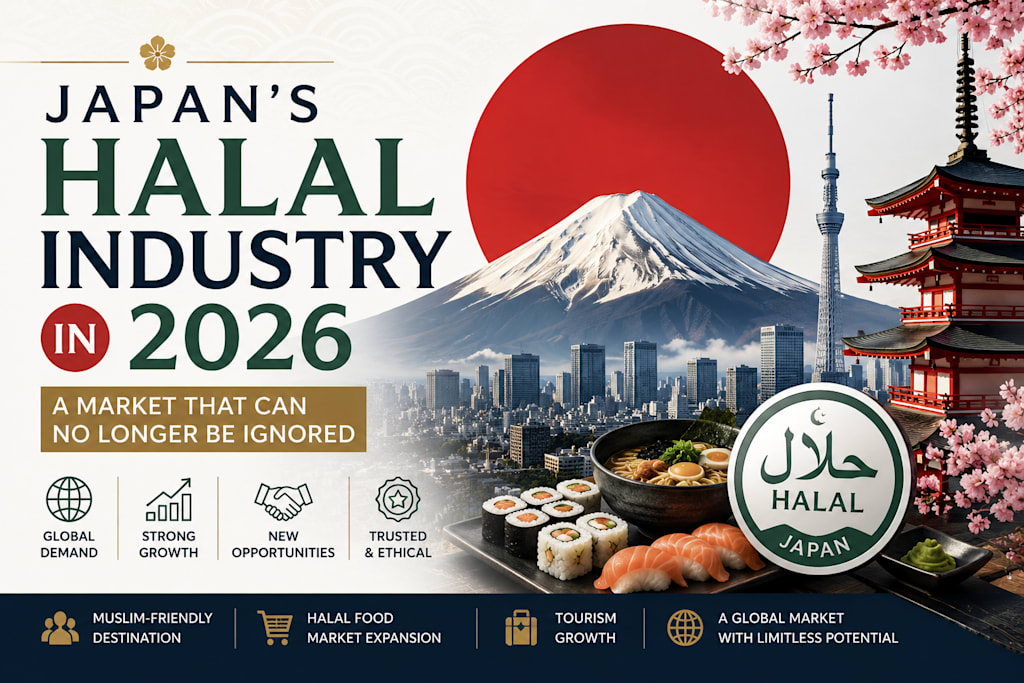
Walk into Narita Airport today and you'll find a dedicated prayer room with a qibla marker pointing toward Mecca — and halal sushi just a few steps away. Ten years ago, that sentence would have seemed far-fetched. Today, it's just Tuesday in Japan.
The country that was once considered one of the most difficult markets for Muslim travelers and residents has been quietly, steadily, building something significant. Japan's halal industry is not a niche curiosity anymore. It is a structured, growing, and increasingly export-driven sector that is drawing attention from investors, governments, and food manufacturers around the world.
Here is what the numbers — and the people behind them — are actually telling us in 2026.
The Population Driving the Demand
Japan does not count religion in its national census, so any Muslim population figure requires some detective work. The most rigorous estimate, published by researcher Hirofumi Tanada in mid-2025 and based on immigration data from Japan's Immigration and Residence Management Agency, puts the total Muslim population at approximately 363,000 foreign Muslims and 55,000 Japanese Muslims — a combined figure of roughly 418,000 people as of early 2026.
To put that in perspective: in 1990, the total was fewer than 30,000. The community has grown more than fourteenfold in 35 years.
The nationalities driving that growth tell their own story. Indonesia leads the resident Muslim community by a significant margin. Bangladeshis and Pakistanis rank second and third among immigrants from Muslim-majority countries, with the Pakistani community officially at 29,647 as of December 2024. Nepalis — while majority Hindu — number 273,000 and include a meaningful Muslim segment. The broader South and Southeast Asian workforce is, collectively, reshaping the demographic texture of cities like Tokyo, Nagoya, and Osaka.
And then there are the tourists.
Muslim visitor arrivals exceeded 1.5 million annually in 2024–2025, growing at 15–20% per year since the post-pandemic reopening. In the first half of 2024 alone, halal tourism bookings in Japan rose 5.7% compared to the previous year. Aichi Prefecture, which will co-host the 2026 Asian Games from September 19 to October 4, is already preparing for a concentrated influx of Muslim visitors — an event that industry insiders expect to accelerate halal infrastructure development across the Nagoya region significantly.
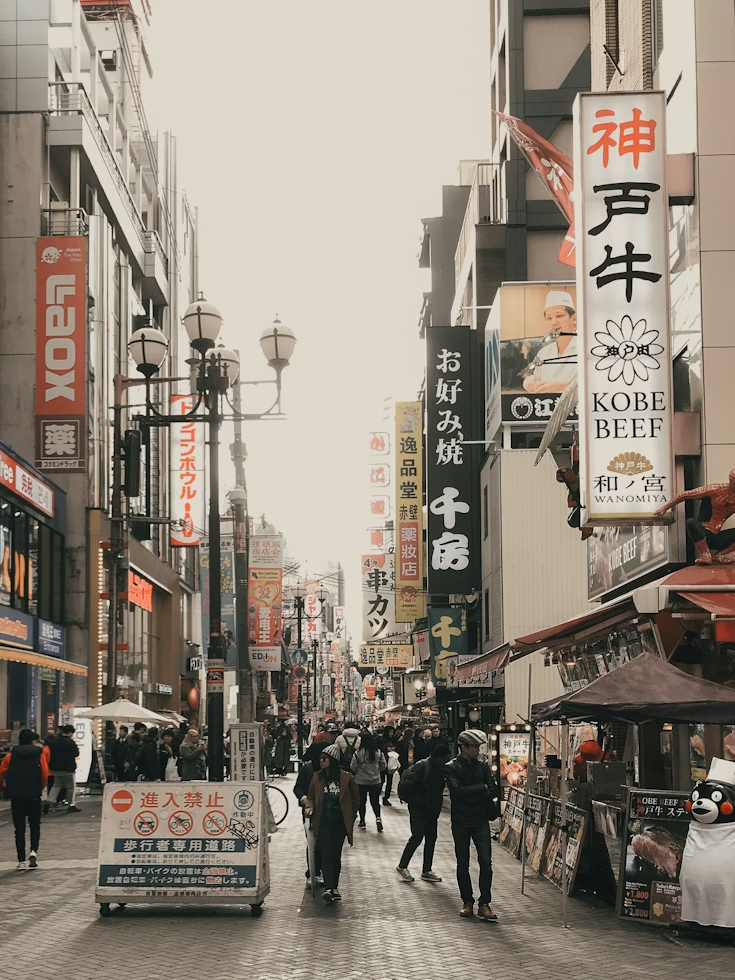
This dual demand base — a growing resident community plus high-value tourist arrivals — is what makes Japan's halal market structurally different from most non-Muslim countries. You are not building for a single customer type. You are building for residents who need everyday groceries, tourists who want an authentic Japanese dining experience without compromising their faith, and increasingly, Japanese companies that want to export to the Islamic world.
Market Size: Where Things Stand in 2026
Japan's halal food market is estimated at USD 1.2 to 1.5 billion in 2026, measured at wholesale value. That sounds modest — and in absolute terms, it is — representing roughly 0.3–0.4% of Japan's total food and beverage market. But the growth rate is anything but modest.
The market has expanded at 9–12% annually from 2020 to 2025, at a time when Japan's broader food market grew at less than 1% per year. That is not a coincidence. It reflects a structural shift, not a trend.
Forecasts project the market reaching USD 2.8 to 3.5 billion by 2035, representing a compound annual growth rate of 8–10% over the next decade. For context, Japan's overall food industry is largely stagnant due to population decline. The halal segment is one of the few areas of genuine organic growth.
Japan also sits within the broader global picture. The global halal food and beverage market was valued at approximately USD 1.97 trillion in 2025 and is projected to reach USD 2.24 trillion in 2026, growing at a CAGR of 13.4%. Japan accounts for a meaningful slice of Asia-Pacific's share — approximately 8% of the region's halal meat market alone, driven by tourism and growing urban Muslim communities.
What Japan Is Actually Selling (and to Whom)
Here is a detail that surprises most people: Japan's halal industry is not primarily about feeding Muslims in Japan. A significant portion of it is about exporting to Muslim-majority countries.
According to Hind Remon, chairperson of the Japan Halal Association (JHA), there are currently more than 1,000 halal-certified companies in Japan, and most of them are focused on exports. Raw materials used in food, cosmetics, and pharmaceuticals now account for 60–70% of Japan's halal-certified exports — a figure that reflects the quiet but important role Japanese chemical and biochemical manufacturers play in global halal supply chains.
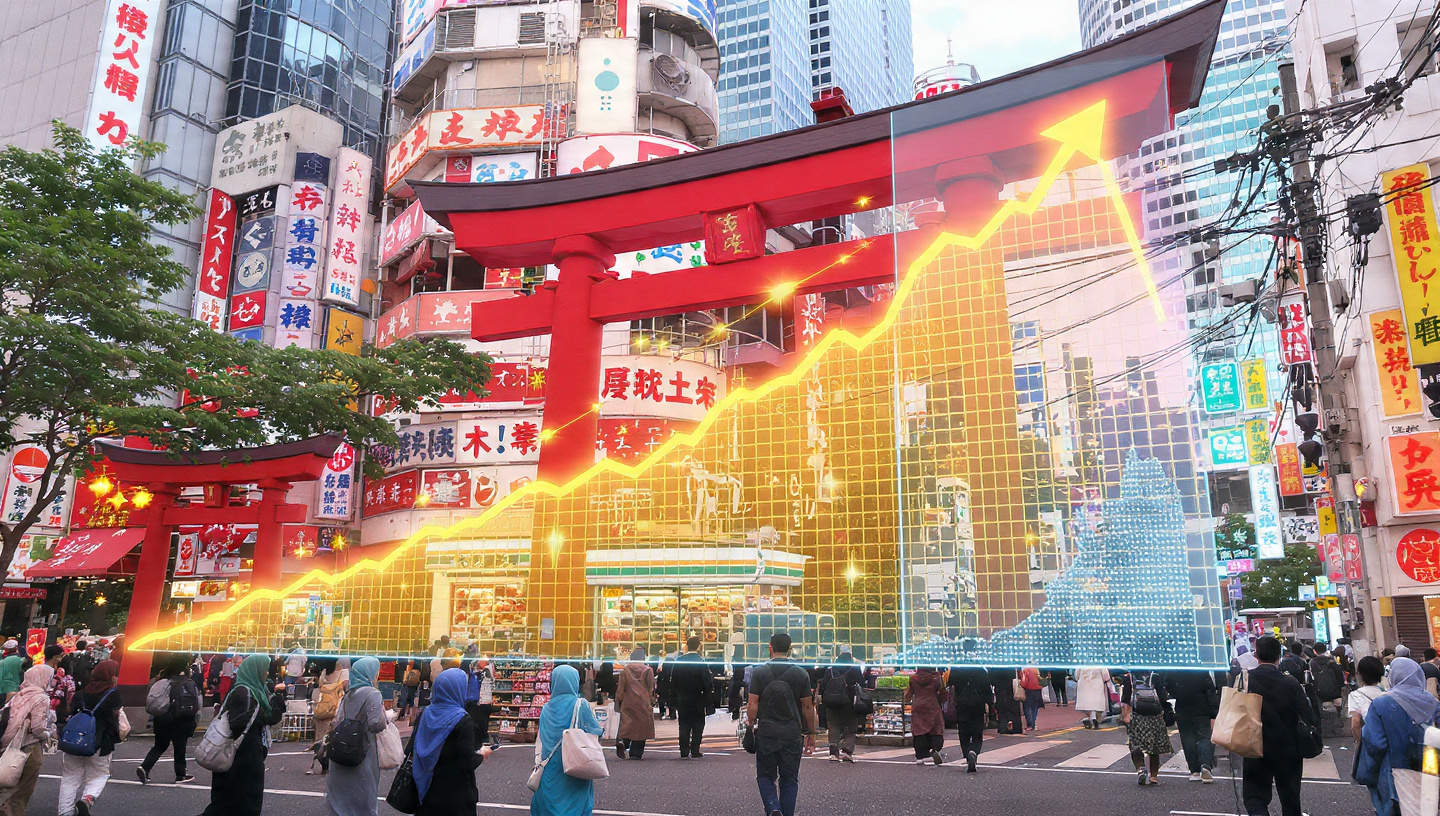
Indonesia's halal product assurance law is a key factor here. The law will soon require mandatory halal certification for all imported goods, including non-food items. The deadline for cosmetic raw materials falls in October 2026 — which is why Japanese ingredient suppliers have been racing to get certified. For companies that sell emulsifiers, enzymes, gelatin alternatives, and cosmetic raw materials to Indonesian manufacturers, halal certification is no longer optional. It is a market access requirement.
On the consumer side, halal-certified Wagyu beef exports to Malaysia and Indonesia are rising. Malaysian food services provider Brahim, which partnered with Japanese retailer Muji in 2020 to sell halal-certified ready meals across more than 400 outlets, opened its fourth food outlet in Japan in April 2025 — a signal that the domestic consumer market is also maturing.
The Infrastructure: Mosques, Restaurants, and the Retail Gap
The physical infrastructure supporting Japan's Muslim community has expanded considerably. As of mid-2025, Japan has nearly 150 mosques — a number that would have seemed implausible a decade ago. Tokyo's Ueno district has become a notable hub for halal dining, particularly its popular halal yakiniku restaurants. Kyoto, Osaka, and Hokkaido have all seen meaningful growth in Muslim-friendly hospitality.
Hospitals, universities, and corporate cafeterias in major cities are increasingly offering halal meal options for international students, researchers, and workers. Institutional catering is, in fact, one of the fastest-growing channels for halal food consumption in Japan — a segment often overlooked in favor of the more visible restaurant and tourism angle.
The retail picture is more complicated. Outside of major metropolitan areas, halal-certified products remain genuinely hard to find. Most supermarket chains carry between 50–100 halal-certified SKUs at best, concentrated in international food aisles. Forecasts suggest this will improve significantly — expanding to 200–400 SKUs per store by 2030 — but right now, the gap between tourist-facing Tokyo and everyday retail life in smaller cities is significant.
This is where halal online Ecommerce fills a critical gap. Platforms specializing in halal groceries — delivering across Japan — have become an essential lifeline for Muslim residents in cities without dedicated halal stores. The Japan Halal Association has noted that with the spread of online shops, "it has become possible to procure halal meat with a single mobile phone," a shift that has fundamentally changed what daily life looks like for Muslim families outside the major urban centers.
The Real Challenges: Certification, Cost, and Cultural Awareness
Japan's halal industry faces real structural obstacles, and acknowledging them honestly matters.
Certification fragmentation is the most persistent issue. Unlike Malaysia, which has JAKIM as a government-backed single certifying authority, Japan has more than 30 different halal certification bodies, with no central government-approved system. This creates confusion — for Japanese businesses trying to understand which certification will be recognized overseas, and for Muslim consumers trying to assess which certification to trust domestically.
Cost is a related barrier. Halal certification in Japan can be expensive and complicated for small food businesses, particularly restaurants that need to source certified ingredients from scratch. The research literature consistently identifies the dearth of certified halal ingredients in Japan's domestic supply chain as a bottleneck for restaurant operators who want to obtain certification.
Consumer awareness among Japanese people remains limited. As one industry analyst put it: "Many Japanese consumers have heard the word 'halal,' but their understanding remains limited. They tend to choose restaurants based more on taste and quality than on whether the food is halal-certified." This is not a criticism — it is a realistic assessment of where Japan's mainstream consumer culture currently stands. The opportunity for crossover consumption exists, particularly as Asian cuisines become more popular domestically, but it has not materialized in volume yet.
There is also a critical data problem. The JHA's Hind Remon has been direct about this: "While we observe these trends through our daily activities, having accurate statistics is essential for broader understanding and informed policymaking." Without reliable national data, planning at the government and business level remains partly guesswork.
The Future: What 2035 Could Look Like
The trajectory from here to 2035 depends on a few key variables, but the baseline case is genuinely optimistic.
Muslim visitor arrivals are projected to reach 3–4 million annually by 2035, up from 1.5 million today. That is a doubling to tripling of the tourist base alone. Japan's labor shortage — projected to reach 6 million workers by 2040 given a birth rate of 1.26 and a population that is 28.9% over 65 — will almost certainly drive continued immigration from Muslim-majority countries in South and Southeast Asia. The resident Muslim community will grow accordingly.
The industrial food manufacturing segment is forecast to grow at 10–12% annually, driven by Japanese processors seeking halal certification for export. The ingredients and additives segment follows at 9–11% annually. These are not consumer-facing numbers — they are business-to-business growth rates in a sector Japan already has structural advantages in: food technology, precision manufacturing, and a global reputation for quality.
The Japan Halal Association's long-term vision is more ambitious still — a self-sustaining ecosystem where halal certification generates waqf funds that finance Islamic schools, scholarships, halal slaughterhouses, and supermarkets, creating the conditions for Muslims in Japan to live with genuine stability and dignity. Whether that vision is fully realized or not, the direction of travel is clear.
What This Means for Businesses Operating in This Space
If you are already in Japan's halal supply chain — whether as a retailer, an importer, a logistics provider, or an online grocery platform — the structural tailwinds are real and they are multi-year. The demand is not going away. The population is not shrinking. The regulatory pressure from Indonesia alone will push more Japanese companies into halal certification in the next 18 months.
The opportunity that remains most underserved is everyday retail for residents — not the tourist-focused restaurant and hospitality segment, which has received most of the attention, but the unglamorous, necessary business of making it easy for a Bangladeshi factory worker in Aichi or a Pakistani student in Sapporo to buy the groceries they need, at a reasonable price, with confidence about what they are purchasing.
That gap is where the real, durable market lies. And in 2026, it is still wide open.
Sources: IndexBox Japan Halal Food Market Report (2026); Japan Halal Association (JHA); Salaam Gateway; Future Market Insights Japan Halal Tourism Market Report; Tanada H., Muslim Population in Japan (2025 estimate); Immigration and Residence Management Agency of Japan; Gulfood Market Insights; Fortune Business Insights Halal Meat Market Report; The Halal Times.
About the Creator
Juliana Ericson Tan
Blogger and internet geek. Ten years in Japan. Came from Singapore, stayed for reasons I'm still trying to explain to my family. I write about life in Japan the way it actually feels — not the cherry blossom version
Enjoyed the story? Support the Creator.
Subscribe for free to receive all their stories in your feed.
Comments
There are no comments for this story
Be the first to respond and start the conversation.