
Global Halal Food Market Forecast 2026–2034: Rising Muslim Population and Ethical Food Trends Drive Massive Industry Growth
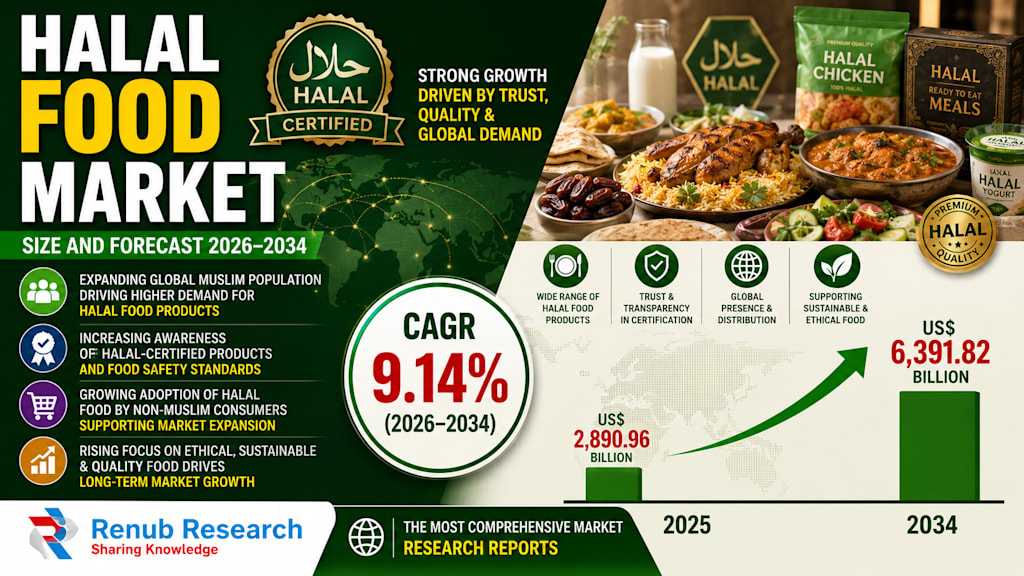
The global halal food industry is expanding rapidly as demand rises for certified, hygienic, and ethically sourced food products. According to Renub Research, the halal food market is projected to grow from US$ 2,890.96 Billion in 2025 to US$ 6,391.82 Billion by 2034, registering a CAGR of 9.14% during 2026–2034.

The global food industry is experiencing a major transformation as consumers increasingly prioritize quality, transparency, hygiene, and ethical sourcing in their food choices. Among the fastest-growing segments within this evolving landscape is the halal food market. Once primarily associated with religious dietary requirements for Muslim consumers, halal food has now become a mainstream global industry supported by growing awareness of food safety, ethical production standards, and premium-quality assurance.
Halal food refers to products prepared and processed according to Islamic dietary laws outlined in the Quran. The term “halal” means “permissible,” covering everything from ingredient sourcing and slaughter methods to hygiene practices and supply-chain management. Products containing prohibited substances such as pork, alcohol, or certain additives are excluded from halal certification.
What makes the halal food industry particularly powerful today is its appeal beyond religion. Increasingly, non-Muslim consumers are also choosing halal-certified products because they associate them with cleaner processing, better traceability, higher food safety standards, and ethical sourcing practices.
According to Renub Research, the global halal food market is expected to rise from US$ 2,890.96 Billion in 2025 to US$ 6,391.82 Billion by 2034, growing at a CAGR of 9.14% during the forecast period from 2026 to 2034.
This remarkable growth highlights how halal food is evolving from a niche religious segment into one of the most influential sectors in the global food economy.
The Expanding Muslim Population Is Driving Long-Term Demand
One of the strongest growth drivers behind the halal food market is the rapid expansion of the global Muslim population. Muslim consumers represent one of the fastest-growing demographic groups worldwide, creating sustained demand for halal-certified products across food categories including meat, beverages, snacks, dairy, confectionery, and convenience foods.
According to information highlighted in the Renub Research report, the global Muslim population is expected to rise from approximately 1.6 billion people in 2010 to nearly 2.8 billion by 2050. Muslims are projected to account for around 30% of the global population by that time.
Urbanization, rising disposable incomes, and changing lifestyles among younger Muslim consumers are also contributing to higher consumption of packaged and processed halal foods. Today’s consumers increasingly seek ready-to-eat meals, frozen foods, beverages, snacks, and restaurant options that meet halal standards while also matching modern convenience expectations.
As halal consumption becomes more mainstream globally, food manufacturers and retailers are expanding their halal-certified product portfolios to meet rising demand in both Muslim-majority and non-Muslim countries.
Halal Food Is Becoming Popular Beyond Religious Boundaries
One of the most important trends shaping the market is the growing acceptance of halal food among non-Muslim consumers. Increasingly, halal certification is viewed not only as a religious requirement but also as a symbol of food quality, safety, cleanliness, and ethical sourcing.
Many consumers perceive halal food production methods as more carefully regulated because halal guidelines emphasize hygiene, animal welfare, ingredient transparency, and strict processing standards. This perception is helping halal-certified products gain traction in Europe, North America, and Asia-Pacific markets.
The market is also benefiting from broader interest in ethical and traceable food sourcing. Modern consumers want greater transparency about how food is produced, processed, and transported. Halal certification systems often provide that added layer of assurance, making these products attractive to a wider audience.
Renub Research notes that nearly 30% of non-Muslim consumers in a U.S. survey reported trying halal-certified food products within the previous year.
As awareness continues growing, halal food is increasingly positioned as a premium-quality category rather than solely a religious dietary segment.
Halal Certification Is Strengthening Global Trade
The expansion of halal certification systems and global distribution networks is playing a major role in supporting market growth. Certification helps build consumer trust by ensuring products comply with established halal standards related to sourcing, processing, transportation, and storage.
Governments, private organizations, and certification bodies are investing heavily in halal ecosystems that include logistics, industrial parks, traceability systems, and export infrastructure. This development is especially important because halal food products are increasingly traded internationally across the Middle East, Southeast Asia, Europe, and North America.
The growth of e-commerce and modern retail channels is also improving access to halal products worldwide. Consumers can now purchase certified halal foods through online marketplaces, supermarket chains, convenience stores, and specialty retailers more easily than ever before.
In Japan, Nippon Express expanded its halal-certified domestic air cargo transport services to strengthen halal logistics capabilities, highlighting the increasing importance of specialized halal supply chains.
As certification processes become more standardized and internationally recognized, manufacturers are gaining greater opportunities to scale production and enter new export markets.
Halal Meat Remains the Largest Market Segment
The halal meat segment continues to dominate the global halal food market because meat products are among the most strictly regulated categories under Islamic dietary laws. Halal meat must come from permissible animals slaughtered according to religious guidelines emphasizing cleanliness, ethical treatment, and food safety.
Rising global meat consumption, increasing awareness of halal certification, and growing Muslim populations are all supporting strong demand for halal poultry, beef, mutton, and lamb products.
Halal meat products are increasingly available in fresh, frozen, and processed formats, allowing manufacturers to target modern retail and convenience-focused consumers. The development of cold-chain logistics and international trade infrastructure has also improved product availability across non-Muslim regions.
Beyond religious compliance, many consumers perceive halal meat as cleaner and more ethically sourced, strengthening its appeal across broader demographics.
As global demand for traceable and ethically produced meat products increases, the halal meat segment is expected to remain one of the strongest pillars of the industry.
Processed Foods and Confectionery Are Growing Rapidly
The halal confectionery segment is emerging as one of the fastest-growing categories within the market. Products such as chocolates, candies, desserts, gums, and snacks often contain ingredients like gelatin, emulsifiers, and flavoring agents that require halal verification.
As Muslim consumers become more informed about ingredient sourcing, demand for certified confectionery products is increasing steadily. Manufacturers are responding with product innovation, premium packaging, and wider flavor selections to attract both Muslim and non-Muslim buyers.
Processed fruits and vegetables are also becoming increasingly important within the halal market. Although fresh produce is naturally halal, certification is becoming more valuable for packaged and processed products where additives, preservatives, or processing methods require compliance verification.
The expansion of convenience foods, frozen products, ready-to-cook meals, and packaged snacks is helping diversify the halal food industry far beyond traditional meat-based categories.
Retail Expansion Is Increasing Consumer Access
Retail infrastructure plays a critical role in the expansion of the halal food market. Hypermarkets, supermarkets, convenience stores, and online retail platforms are increasingly dedicating shelf space to halal-certified products.
Large supermarket chains now offer halal meat, frozen foods, dairy products, beverages, confectionery, and private-label halal ranges to attract diverse consumer groups. Dedicated halal sections within supermarkets help improve product visibility and consumer confidence.
Convenience stores are also becoming important distribution channels, particularly in urban areas where consumers seek quick and reliable halal meal options. Franchise-based halal convenience chains and foodservice outlets are expanding rapidly in metropolitan regions with large Muslim populations.
The growth of digital commerce is further accelerating accessibility. Online grocery platforms and food delivery services now make halal-certified products available to consumers even in areas where traditional halal retail infrastructure is limited.
As retail modernization continues globally, access to halal food products is expected to improve significantly across both developed and emerging markets.
Challenges Continue to Affect Market Standardization
Despite impressive growth, the halal food industry still faces several challenges. One of the biggest issues is the lack of unified global halal standards. Certification requirements vary across countries and organizations, creating complexity for manufacturers operating internationally.
Differences in halal interpretations can lead to higher compliance costs, trade barriers, and confusion among consumers and exporters. Companies often need multiple certifications to access different markets, which can slow international expansion.
Supply-chain integrity is another major challenge. Maintaining halal compliance throughout production, transportation, storage, and distribution requires strict segregation and traceability systems. Any contamination involving non-halal substances can damage consumer trust and brand reputation.
As global halal trade expands, strengthening certification consistency and supply-chain transparency will become increasingly important for the industry.
Regional Markets Continue Expanding Strongly
The United States halal food market is growing steadily due to increasing Muslim populations and broader consumer interest in ethical food products. Restaurants, specialty retailers, supermarkets, and online platforms are all expanding halal offerings. In January 2025, Shah’s Halal Food announced expansion into Washington, D.C., marking another milestone in the growing popularity of halal food chains in the U.S.
The United Kingdom remains one of Europe’s most developed halal food markets, supported by a strong retail infrastructure and growing demand for halal-certified convenience products. Major supermarket chains increasingly offer private-label halal food ranges to cater to diverse consumer needs.
India is a major halal food producer and exporter due to its large food-processing industry and strong export connections with Middle Eastern and Southeast Asian markets. Government-backed halal export policies are strengthening the country’s role in global halal trade.
Saudi Arabia represents one of the world’s most important halal food markets because halal compliance is mandatory throughout the food industry. The country’s dependence on food imports also makes international halal certification and supply-chain management critically important. In January 2026, JBS announced an USD 85 million investment aimed at expanding halal production capabilities in Saudi Arabia.
Final Thoughts
The global halal food market is entering a period of extraordinary expansion as demographic growth, ethical food preferences, and modern retail systems reshape consumer behavior worldwide. According to Renub Research, the market is expected to grow from US$ 2,890.96 Billion in 2025 to US$ 6,391.82 Billion by 2034, registering a CAGR of 9.14% during 2026–2034.
This growth is being driven not only by rising Muslim populations but also by increasing global interest in food safety, ethical sourcing, hygiene standards, and product transparency. Halal certification is evolving into a broader symbol of quality assurance that appeals across cultural and religious boundaries.
Although challenges related to certification standardization and supply-chain integrity remain important, the long-term outlook for the industry remains highly positive. As global food systems continue evolving toward greater transparency and accountability, halal food is expected to become an increasingly influential part of the international food economy.
About the Creator
Enjoyed the story? Support the Creator.
Subscribe for free to receive all their stories in your feed.
Comments
There are no comments for this story
Be the first to respond and start the conversation.