
I’ve Taught for 30 Years. The Teacher Crying in the Office Had It Backward.
He thought the student had rejected his care. A drawer full of unsent notes told another story.
I have taught for thirty years. Care matters. So does correction. What ruins both is a weak boundary. With a weak boundary, the action bends. Help starts to feel like control. A student’s refusal starts to feel like a verdict on the teacher.
A younger teacher told me his story. He had spent months on one student. Reminders, corrections, extra comments, phone calls home, a folder of work samples. The student ignored him. One afternoon the teacher pulled the boy into the corridor and criticized him there. He called the parent and demanded that someone come to school immediately. Then he shut himself in the office and cried.
I handed him a tissue. I did not tell him that crying was shameful. I said, “Crying in the office is a signal. You are running on empty. But your actions changed shape before you cried.”
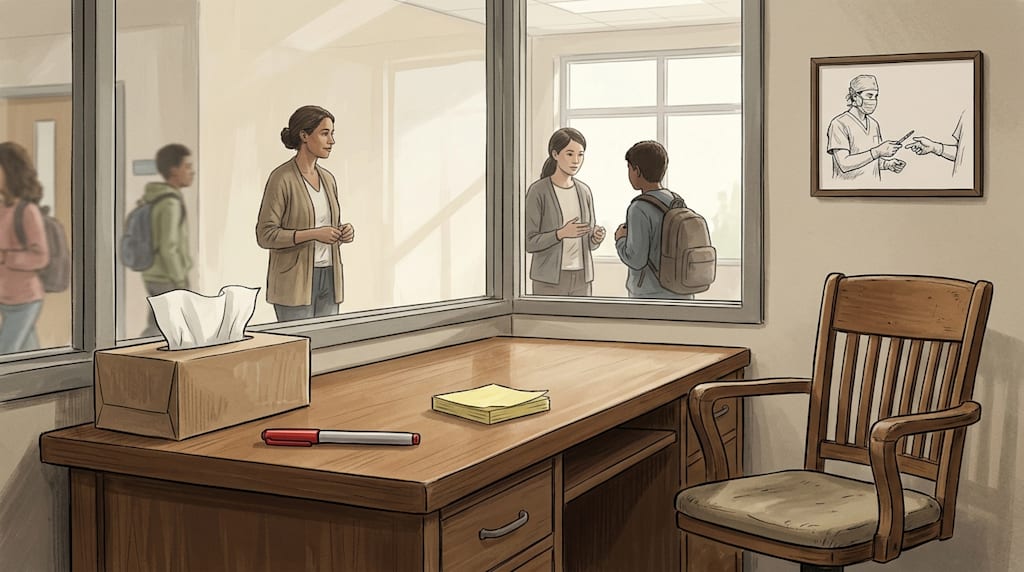
He had a stack of sticky notes in his desk drawer. Each one was addressed to that student and never sent. His phone held photographs of every assignment the boy had turned in. When he described the corridor scene, he was still holding a red pen. He did not say, “I have invested too much.” The drawer, the phone, and the pen said it for him.
The first thing I told him was to use the smallest intervention that restores order. Do not turn a classroom problem into a public shaming. Keep the lesson moving. Say the shortest sentence that stops the behavior. Then deal with the student alone after class. Describe the behavior. Describe its effect. State the next step. Call the parent according to school procedure: behavior, measures already taken, request for cooperation. Do not call at the peak of your anger. A call made at the peak is discharge, not communication. After discharge, the student is more defensive, the parent more opposed, and the teacher more exhausted.
The second thing I told him was to find the trigger. “What hurt you: the student’s refusal that afternoon, or the thought that your effort had been refused?” Those are different events. A student’s disapproval belongs to the student. A judgment that I am not good enough belongs to me. A teacher who cannot separate those two will keep escalating the action to repair a wound the action cannot reach.
The third thing I told him was to build a boundary. A boundary is not coldness. It puts responsibility back where it belongs. I can prepare the lesson, speak patiently, give feedback, follow the procedure, and record what I have done. I cannot require every student to change at once. I cannot require every parent to understand me. I cannot require the school to stand on my side every time. Education is slow, limited, and often unfinished. A teacher who bets his whole value on a student’s immediate response will be emptied.
I remind myself every day that the teacher and the student are separate people. The student will become what the student decides to become. What I can do is keep reminding him, correcting him, and saying the important thing once more within my authority. I have that phrase on a sticky note beside my computer: within my authority. It is not resignation. It is a working limit.
People sometimes hear “helper” and think “bystander.” A helper is not a bystander. A helper knows what to handle, what can be handled, and how far the handling can go. The rule must be stated. The behavior must be corrected. The parent must be contacted when procedure requires it. The record must be kept. But the helper does not make the student’s final decision, and the helper does not carry the student’s final outcome as a personal verdict.
I often think of the old saying that a doctor does not treat his own family. A surgeon scrubs in for a patient and needs cold, clear judgment. When the patient is his own child, his hand shakes over the consent form. He signs, then passes the pen to a colleague. From the outside, doctors can look bloodless. The bloodlessness is a way of keeping feeling from wrecking judgment. The surgeon does not love his family less because he asks someone else to operate.
But the comparison has a limit. Education is not surgery. A doctor avoids treating family because objectivity and ethical risk matter. A teacher cannot be emotionally sterile, because education runs on relationship. A cold teacher may keep order, but he will not reach anyone. The better phrase is not “too much feeling.” The better phrase is professional feeling: warm and firm, governed by rules, procedure, and self-awareness. Warmth lets the student know he has not been abandoned. Firmness lets him know the rule will not change because the teacher is upset. Procedure keeps the teacher from acting out of the peak of emotion. Self-awareness tells the teacher when he has been triggered and when he must stop the action.
The same pattern appears between parents and children. “Deep love, sharp reproach,” people say. Many parents cannot draw the boundary between themselves and the child. They want the child to understand their sacrifice. The child does not. So the parent adds more: more lectures, more anger, more sacrifice. The action bends. The child learns to defend, not to listen. Teachers do the same thing. We say, “I am doing this for your good,” and forget that “for your good” still needs measure, method, and respect for a separate person.
I have learned in thirty years that education is limited intervention. A teacher is a significant person in a student’s life, not the author of that life. We can light a lamp. We cannot walk the road for them. We can say the important thing again. We cannot require them to understand it this afternoon. We can correct behavior within our authority. We cannot turn correction into emotional punishment. A clear boundary protects the student from the teacher’s overflow, and protects the teacher from tying his whole worth to a student’s reaction.
So if I had to sum up my advice to that crying teacher, I would say: your problem was not that you cared too much. Your problem was that the boundary was too weak. You did not fail because the student refused you. You failed to separate “the student does not approve of me” from “I am not good enough.” Separate the educational responsibility from the student’s life. Separate professional feeling from emotional discharge. Handle what must be handled. Say what must be said. Follow the procedure that must be followed. Release what must be released.
Love can be deep. Reproach can be sharp. Action still needs measure.
This morning I pulled my chair back half a step before I handed a tissue to a student. I did not wipe her tears for her. I put the tissue box on the shelf, one inch from the edge. The bell rang. I capped the red pen and put it down.
About the Creator
Jin
Writer of reamstories
https://reamstories.com/jin
Enjoyed the story? Support the Creator.
Subscribe for free to receive all their stories in your feed. You could also become a paid subscriber, letting them know you appreciate their work.
Comments
There are no comments for this story
Be the first to respond and start the conversation.