
I Thought I Was Helping My First Grader With Homework. I Was Teaching Her to Fear My Cough.
It took me three years to learn the difference between sitting with her and watching her.
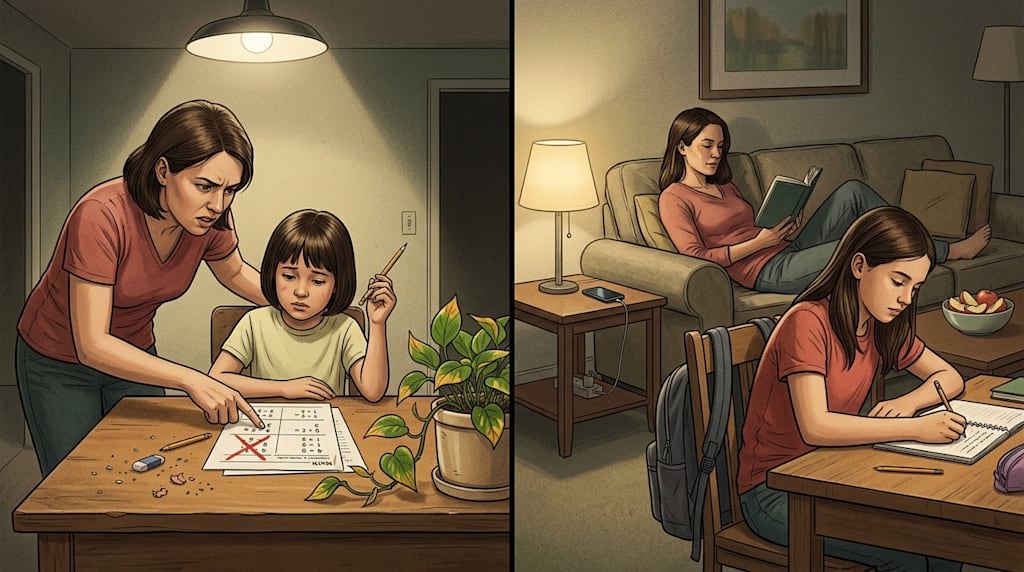
At the start of first grade, the quietest place in the house was the desk. I turned on the lamp. My older daughter and I sat on opposite sides. She took out her pinyin workbook. I put my phone face down on the table. She read “b-ang-bang” as “b-ang-ban.” I coughed once. Her pencil stopped in midair. Eraser crumbs were piled by her thumb. She looked up at me, looked down, and erased the “ban.” She rubbed a hole in the workbook.
Back then, I called it sitting with her while she did homework. She later called it surveillance.
She couldn’t tell initials from finals, or front nasal sounds from back nasal sounds. She was still trying to remember how the teacher had read it in class. I spoke first: “You can’t even do this?” She said nothing. She wrote “b” as “d” and “p” as “q.” I tapped the workbook with my pencil: “Look carefully. Is the half circle on the left or the right?” She picked up the eraser and rubbed harder. The tip of a pothos leaf on the corner of the desk was yellow. I didn’t notice. I only noticed how many she got wrong.
Math word problems were worse. An addition problem, and she set it up as subtraction. I asked, “Are you even listening in class?” She said, “I listened.” I said, “You listened, and this is the result? You can’t tell addition from subtraction?” She lowered her head. Her fingernail scraped the eraser. Eraser crumbs covered the table. She said quietly, “The problem said ‘bought more,’ so I thought I had to subtract.” I didn’t hear it. I only saw the red X.
That year, I closed the door and sat with her every day. The younger one was in the living room with my mother-in-law. In my head, I kept score: I had given up time with the younger one, and she still couldn’t do it. If I coughed once, she tensed. My cough became a signal: she was wrong again. She was too tense to start, and I was still beside her saying, “Don’t dawdle. Write.” She wrote more slowly. The hole in the workbook grew bigger.
In second grade, I made three rules for myself. Shut my mouth. Still my hands. Check my heart.
Shut my mouth. While she did homework, she played with her eraser, cutting it into small pieces. I sat beside her. My throat itched. I wanted to say, “Stop playing.” I picked up my water glass and took a sip. The water was cold. I swallowed. She looked up at me. I said, “Write first. Circle the ones you don’t know. We’ll look at them together at the end.” She said, “Oh,” and kept writing. That day she circled three problems. At the end, she read them to me one by one. I didn’t say, “It’s this easy.” I only asked, “Read it once. Where are you stuck?” She pointed to “in total” and “left.” I said, “Draw a circle.” She drew one. She worked it out. I signed my name.
Still my hands. Before, when I sat with her, my phone was always in my hand. She asked, “Mom, this problem?” My eyes were still on the screen. I said, “Wait a minute.” She waited. I finished one video before I went over. She had forgotten what she wanted to ask. Later I left my phone in the living room to charge. The screen lit up. A work group. I didn’t answer. I sat across from her with a book. She wrote; I read. When she asked, I put the book down. When she finished, I picked it up. She asked, “You’re not looking at your phone?” I said, “It’s charging.” She said, “Oh.” She kept writing.
Check my heart. While she did homework, I wanted to cut fruit for her. I cut an apple and left it in the living room. She didn’t say she was hungry, so I didn’t bring it in. She wrote for twenty minutes. The timer went off. She ran out, ate two slices of apple, drank water, and ran back. I didn’t hand her milk while she did homework. I didn’t sharpen pencils while she did homework. The pencil broke. She called, “Mom, the pencil broke.” I said, “There are sharpened ones in the cup. Get one yourself.” She did. She wrote. I sat at the dining table, editing a spreadsheet. A little dust had settled on the keyboard cover. I wiped it off with my finger.
Sitting with her was about building habits, not finishing homework. I made a small list for my older daughter: write for twenty minutes, rest for five; after Chinese, you can have a snack; do the ones you know first, leave the ones you don’t know for last; when you finish, check it yourself, then I’ll spot-check; when you finish, pack your bag, sharpen pencils, get your things ready for tomorrow.
Her favorite was number three. Do the ones you know first. Circle the ones you don’t. Look at the circled ones together at the end. Once, the last problem on a math test was blank. She circled it with a big circle. I asked, “Why did you circle it?” She said, “I don’t know how.” I said, “Read it once.” She read. When she got to “There were 8, and 5 more were bought,” she stopped. I said, “Draw 8 circles.” She drew them. I said, “5 more were bought. Where do you draw them?” She drew them beside the others. She counted. She said, “13.” She wrote it down. I didn’t say, “See, you can do it.” I said, “You got stuck on ‘bought more.’” She nodded. She put the test in her backpack. She pulled the zipper shut.
By third grade, I began to retreat to the living room. She wrote in her room. I folded clothes in the living room. She came out: “Mom, I’m not sure about one math problem.” I said, “Did you check it?” She said, “I checked, but I’m not sure.” I said, “Read it to me.” She read. I nodded. She said, “I’ll ask the teacher tomorrow.” She went back to her room. I kept folding clothes. I rolled socks into balls and put them in the drawer. I didn’t cough. She didn’t stop writing.
First grade, first half: I stayed in the same room, said little, helped her break down tasks, read problems, make lists. First grade, second half: same room, different table. She wrote; I read. Second grade: she wrote on her own. I looked over at set times. Third grade: she finished on her own, checked on her own. I only signed. Before I signed, I asked, “Did you check it? Which one are you least sure about?” She pointed. I signed. I didn’t take out a red pen.
Now, when she does homework, I still sometimes sit nearby. I hold a book, or copy notes. She writes; I do my own things. When she needs me, I show up. When she doesn’t, I don’t interrupt. I changed the water for the pothos on the corner of the desk. Some leaves were still yellow. I cut the yellow ones off. She looked up: “Mom, are you cutting the pothos?” I said, “Yes.” She said, “Don’t cut too much.” I said, “Okay.” She kept writing. I kept cutting.
At nine thirty, she packs her backpack. The pencils go back into the pencil case. The zipper closes. She puts the homework notebook on the corner of the desk. The alarm will go off at seven tomorrow morning. I turn off the desk lamp. The room goes dark. The clock in the living room ticks once.
About the Creator
Jin
Writer of reamstories
https://reamstories.com/jin
Enjoyed the story? Support the Creator.
Subscribe for free to receive all their stories in your feed. You could also become a paid subscriber, letting them know you appreciate their work.
Comments
There are no comments for this story
Be the first to respond and start the conversation.