
I Spent Hours Trying to Find the Original Source of a Viral Video
The deeper I searched, the more I realized how easily viral videos lose their original context after being reposted across the internet.

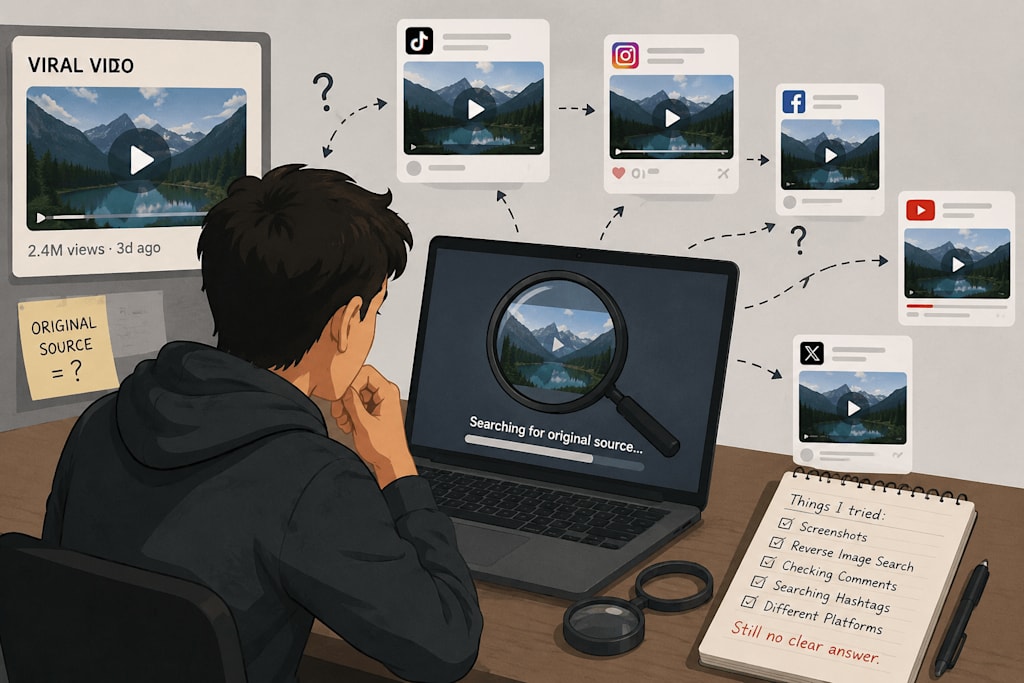
It started with a random video on my feed.
The clip had millions of views already, and people in the comments were arguing about whether it was real.
Some users claimed the video came from TikTok.
Others said it was originally uploaded on Instagram years ago.
A few people even believed it was AI-generated.
At that point, I got curious.
Not because the video itself was shocking, but because nobody seemed to know where it actually came from.
So I decided to try finding the original upload myself.
I honestly thought it would take five minutes.
Instead, I spent nearly two hours falling into one of the strangest internet rabbit holes I’ve seen in a long time.
The Same Video Was Everywhere
The first thing I noticed was how many times the video had been reposted.
I found:
- cropped versions
- low-quality versions
- mirrored uploads
- reposts with fake captions
- clips with removed watermarks
The same video was spreading across TikTok, Instagram Reels, X, Facebook, and YouTube Shorts at the same time.
Every upload told a different story.
That’s when I realized something interesting about the internet today.
Once a video goes viral, the original source almost disappears.
The reposts become bigger than the original upload itself.
Screenshots Didn’t Help Much
At first, I tried the old method most people use.
I paused the video and took screenshots.
Then I uploaded those screenshots into reverse image search tools.
The results were frustrating.
Some searches showed unrelated images.
Others only showed newer reposts instead of the original source.
One screenshot even matched a meme page that had clearly stolen the clip from somewhere else.
I kept repeating the process with different frames from the video, but it still felt messy and unreliable.
That’s when I realized videos behave very differently from images online.
A single screenshot rarely tells the full story.
Small Details Matter More Than You Think
After looking through dozens of reposts, I started paying attention to tiny details.
One version had background music that another upload removed.
Another clip still contained part of a username hidden near the corner.
One repost was uploaded several months earlier than the others.
Those little clues slowly helped me build a timeline.
It almost felt like digital detective work.
The deeper I searched, the more reposts I discovered.
And honestly, it became obvious how easy it is for videos to lose their original context online.
Why I Started Using Reverse Video Search Tools
After manually searching for so long, I wanted a faster way to compare uploads and trace older versions of videos.
That’s when I started experimenting with reverse video search workflows.
Recently, I’ve been using Revideo.io because it helps surface duplicate uploads and similar video matches much faster than manually searching screenshots one by one.
What I like most is that it reduces the guessing part of the process.
Instead of trying random screenshots, I can quickly compare matching uploads and track where videos appeared earlier online.

It makes the whole workflow much less frustrating.
Viral Videos Change Every Time They Get Reuploaded
This was probably the most surprising thing I noticed.
Every repost slightly changes the video.
Someone crops the frame.
Another account changes the caption.
Someone else removes the watermark.
Another user edits the audio.
After enough reposts, the original version becomes almost impossible to recognize.
And yet millions of people keep sharing the newer versions without questioning where they came from.
The Internet Has a Huge Repost Problem
I don’t think most people realize how much recycled content exists online now.
The same clips constantly move between platforms.
TikTok videos appear on Instagram.
Instagram Reels show up on YouTube Shorts.
Facebook pages repost content from everywhere.
Sometimes the original creator gets completely erased from the process.
And once a fake caption gets attached to a viral clip, people usually believe it without checking.
I See Viral Videos Differently Now
After spending hours tracing one single video, I started noticing this problem everywhere online.
Now, whenever I see a viral clip, I automatically wonder:
- Is this the original upload?
- Has this been reposted before?
- Is the caption even accurate?
- Where did this video actually start?
Most of the time, there’s a much bigger story hiding behind the reposts.
Final Thoughts
I used to think finding the source of a viral video would be simple.
Now I know it’s surprisingly difficult once reposts start spreading across the internet.
But I also think reverse video search tools will become much more important over the next few years.
Especially as short-form content continues taking over social media.
The internet moves fast.
Context disappears even faster.
And sometimes the hardest part isn’t finding the viral video.
It’s finding the truth behind it.
About the Creator
Jan Smith
With over 7 years of experience in the field, Jan Smith is a seasoned content writer known for his ability to craft compelling and engaging content across a variety of industries.
Enjoyed the story? Support the Creator.
Subscribe for free to receive all their stories in your feed.
Comments
There are no comments for this story
Be the first to respond and start the conversation.