
How to Use Blockchain Technology to Secure Electronic Health Records
Strengthening healthcare data security, transparency, and patient control through blockchain innovation

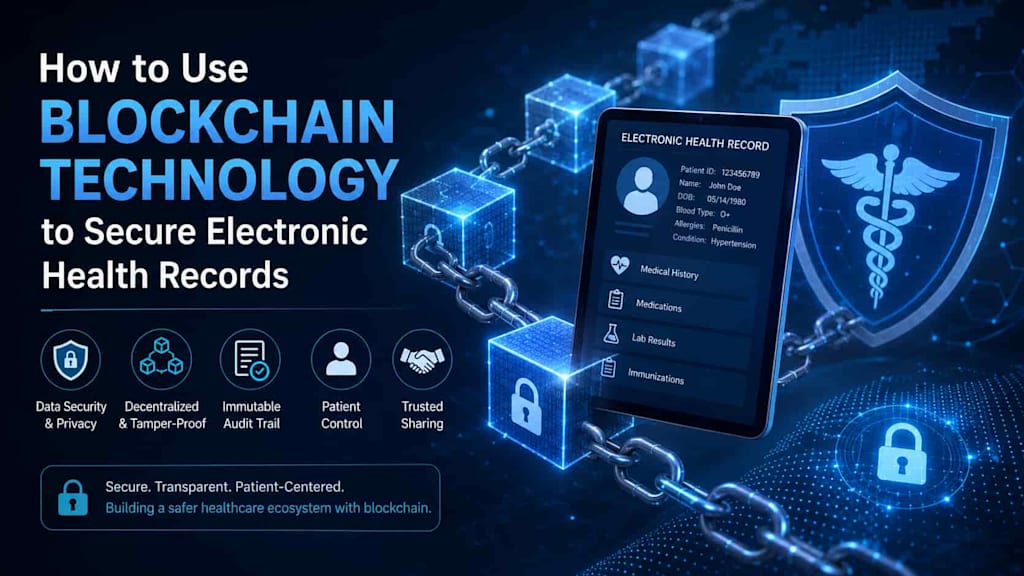
Healthcare organizations generate and manage enormous volumes of sensitive patient information every day. Electronic Health Records (EHRs) have transformed healthcare delivery by enabling faster access to medical histories, diagnoses, treatment plans, and test results. However, the digitization of health data has also increased the risks associated with cyberattacks, unauthorized access, data breaches, and data manipulation.
As healthcare systems become more interconnected, protecting patient information has become a strategic priority. Traditional databases often rely on centralized architectures, making them attractive targets for hackers. This challenge has led healthcare providers, technology companies, and regulators to explore new methods of safeguarding medical data. Among the most promising solutions is blockchain technology.
By offering decentralized storage, cryptographic security, and immutable record-keeping, blockchain can significantly improve the protection and management of electronic health records. This article explores how healthcare organizations can use blockchain technology to secure EHRs while maintaining efficiency, transparency, and compliance.
Understanding Blockchain and Its Value in Healthcare
Blockchain is a distributed ledger technology that records transactions across multiple nodes within a network. Instead of storing data in a single centralized database, blockchain distributes information among authorized participants, making unauthorized modifications extremely difficult.
Each block contains a set of validated transactions linked to the previous block through cryptographic hashes. Once recorded, information becomes nearly impossible to alter without consensus from the network. This characteristic provides a high level of trust and data integrity.
The adoption of blockchain in healthcare is growing because the technology addresses several long-standing challenges, including fragmented patient records, limited interoperability, insufficient transparency, and cybersecurity vulnerabilities. Healthcare providers can use blockchain to create secure audit trails, verify data authenticity, and enable controlled sharing of medical information between hospitals, clinics, laboratories, insurers, and patients.
One of the key advantages of blockchain is patient empowerment. Rather than relying solely on healthcare institutions to manage records, patients can gain greater control over who accesses their information and for what purpose. This patient-centric approach aligns with modern healthcare trends that prioritize transparency and informed consent.
Additionally, blockchain can improve trust among stakeholders. Since every transaction is recorded and traceable, organizations can monitor data access and identify suspicious activities more effectively than with conventional systems.
Key Components of a Blockchain-Based EHR System
Implementing blockchain for electronic health records requires careful planning and architectural design. Healthcare organizations must balance security, scalability, privacy, and usability.
A blockchain-based EHR ecosystem typically includes several essential components:
Distributed Ledger
The distributed ledger serves as the foundation of the system. Instead of storing complete medical records directly on-chain, many healthcare organizations store encrypted references or hashes of records while maintaining the actual files in secure off-chain repositories. This approach reduces storage demands and improves performance.
Identity and Access Management
Strong identity verification mechanisms are critical in healthcare environments. Blockchain solutions often integrate multi-factor authentication, digital identities, and cryptographic keys to ensure that only authorized users can access patient information.
Smart Contracts
Smart contracts are self-executing programs that automate predefined actions when specific conditions are met. In healthcare, smart contracts can manage consent, automate record-sharing permissions, and enforce data access policies without requiring manual intervention.
Interoperability Frameworks
Healthcare data often resides across multiple systems. Blockchain platforms can facilitate interoperability by creating standardized methods for exchanging information between providers while preserving data integrity.
Governance Structure
Successful implementation requires clear governance policies. Defining the core roles in team responsible for blockchain deployment is essential. Stakeholders may include healthcare executives, cybersecurity specialists, blockchain developers, compliance officers, data architects, and clinical representatives. Effective collaboration among these professionals helps ensure that both technical and operational requirements are met.
Organizations that establish strong governance structures are better positioned to manage network participation, security protocols, and ongoing system maintenance.
How Blockchain Enhances EHR Security
The primary reason healthcare organizations consider blockchain technology is its ability to strengthen data security. Several blockchain features directly contribute to the protection of electronic health records.
Data Integrity and Immutability
One of blockchain's strongest security benefits is immutability. Once information is validated and recorded, altering it becomes exceptionally difficult. This reduces the risk of unauthorized modifications, fraud, and accidental data corruption.
Medical professionals can trust that patient information has not been tampered with, which is particularly important when making treatment decisions.
Enhanced Auditability
Every transaction recorded on a blockchain creates a permanent audit trail. Healthcare administrators can easily track who accessed a record, when the access occurred, and what actions were performed.
This level of transparency improves accountability and simplifies investigations into security incidents or unauthorized access attempts.
Decentralized Security
Traditional centralized databases often represent a single point of failure. If a cybercriminal compromises the central server, large volumes of sensitive information may be exposed.
Blockchain's decentralized architecture distributes data across multiple nodes, reducing the likelihood of catastrophic breaches. Even if one node is compromised, the integrity of the overall network remains protected.
Cryptographic Protection
Blockchain systems rely on advanced encryption methods to secure data. Sensitive patient information can be encrypted before storage, ensuring that only authorized individuals with the appropriate credentials can access the records.
This layered security approach significantly reduces the risk of data theft and unauthorized disclosure.
Improved Consent Management
Patients increasingly expect greater control over their personal information. Blockchain-based consent management systems allow patients to grant, modify, or revoke access permissions in real time.
This capability improves transparency while helping organizations maintain compliance with privacy regulations and ethical standards.
Implementation Challenges and Best Practices
Although blockchain offers significant advantages, healthcare organizations must address several challenges before deployment.
Scalability Concerns
Healthcare systems generate massive amounts of data, including imaging files, laboratory results, and clinical documentation. Storing all information directly on a blockchain can create performance bottlenecks.
Many organizations address this challenge through hybrid architectures that combine blockchain verification with secure off-chain storage.
Integration with Legacy Systems
Most healthcare providers already operate complex EHR platforms. Integrating blockchain solutions with existing infrastructure requires careful planning to minimize disruption and maintain continuity of care.
Organizations should conduct comprehensive assessments of current systems before beginning implementation.
User Adoption
Technology adoption often depends on user acceptance. Physicians, nurses, administrators, and patients must understand how blockchain systems function and how they improve existing workflows.
Training programs and intuitive user interfaces can help accelerate adoption while minimizing resistance to change.
Following Development Standards
Successful blockchain implementation depends on adhering to best practices for software development throughout the project lifecycle. Security-first design principles, regular code reviews, penetration testing, continuous monitoring, and rigorous quality assurance processes help reduce vulnerabilities and improve system reliability.
Healthcare organizations should also work with experienced blockchain developers who understand both distributed ledger technologies and healthcare-specific requirements.
Risk Management
Comprehensive risk assessments should be conducted before deployment. Organizations must evaluate technical, operational, legal, and cybersecurity risks while establishing contingency plans for potential disruptions.
Continuous monitoring and periodic security audits help ensure that systems remain resilient as threats evolve.
Compliance, Privacy, and the Future of Blockchain-Powered EHRs
Data security alone is not sufficient in healthcare. Organizations must also satisfy numerous legal and regulatory obligations designed to protect patient privacy.
Meeting regulatory requirements and compliance standards remains a critical consideration for any blockchain-based EHR initiative. Healthcare providers must ensure that their solutions align with regional and international privacy regulations governing patient data collection, storage, sharing, and retention.
Blockchain implementations can support compliance efforts by providing transparent audit trails, secure access controls, and detailed records of data-sharing activities. However, organizations must carefully design systems to accommodate legal requirements related to data deletion, consent management, and cross-border data transfers.
Many healthcare technology vendors are now developing HIPAA- and GDPR-compliant healthcare applications that leverage blockchain while maintaining alignment with privacy frameworks. These solutions demonstrate how decentralized technologies can coexist with strict regulatory expectations.
Looking ahead, blockchain may play an increasingly important role in healthcare innovation. Future applications could include secure health information exchanges, pharmaceutical supply chain verification, clinical trial data management, remote patient monitoring, and decentralized patient identity systems.
As artificial intelligence, Internet of Things (IoT) devices, and telemedicine continue to expand, blockchain can serve as a trusted infrastructure layer that supports secure and transparent data sharing across healthcare ecosystems.
Conclusion
Blockchain technology offers a powerful approach to securing electronic health records in an era of increasing cybersecurity threats and growing data privacy concerns. By providing decentralized storage, immutable audit trails, strong cryptographic protection, and enhanced patient control, blockchain addresses many of the weaknesses associated with traditional healthcare databases.
However, successful implementation requires more than technology alone. Healthcare organizations must establish effective governance structures, define clear responsibilities, follow robust development methodologies, and maintain compliance with applicable regulations. When implemented strategically, blockchain can strengthen trust, improve interoperability, and create a more secure foundation for modern healthcare systems.
As digital healthcare continues to evolve, blockchain has the potential to become a key enabler of safer, more transparent, and patient-centered electronic health record management.
About the Creator
Markus Koch
I am a professional IT consultant with 5+ years of experience.
Enjoyed the story? Support the Creator.
Subscribe for free to receive all their stories in your feed.
Comments
There are no comments for this story
Be the first to respond and start the conversation.