
How to Transition Legacy Healthcare Systems to Cloud-Based Platforms Without Service Interruptions
A Step-by-Step Guide to Seamless Cloud Migration in Healthcare IT

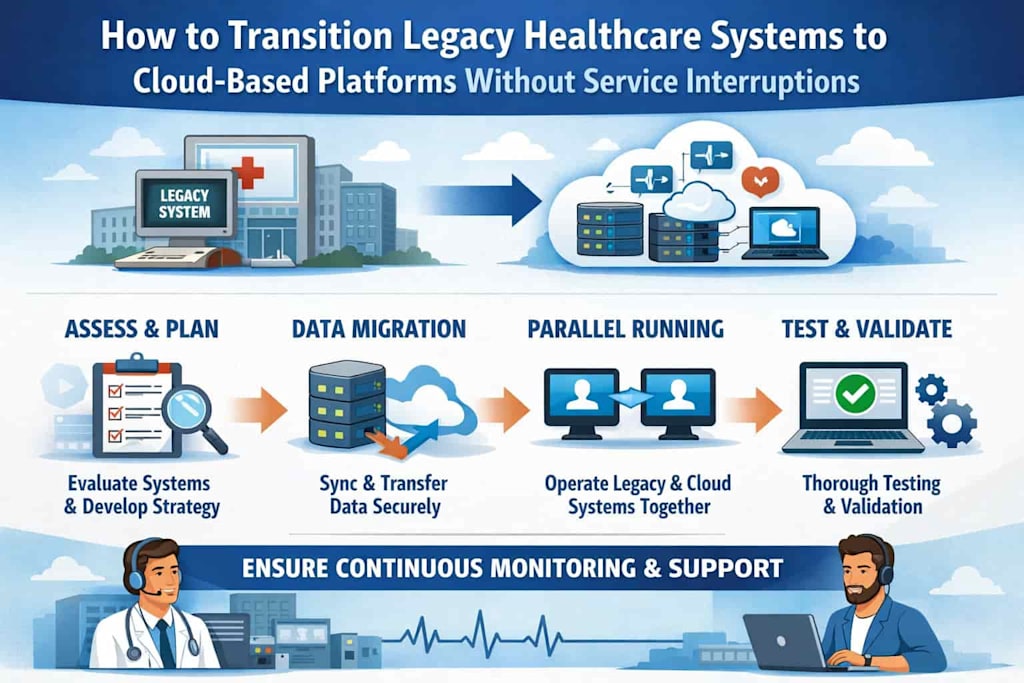
Healthcare organizations are under increasing pressure to modernize their IT infrastructure while maintaining uninterrupted clinical and administrative operations. Many hospitals and clinics still rely on legacy systems—often monolithic, on-premise applications built decades ago—that were never designed for interoperability, scalability, or cloud environments. Yet replacing or migrating these systems is not simply a technical upgrade; it is a mission-critical transformation where downtime can directly impact patient care, safety, and regulatory compliance.
Transitioning legacy healthcare systems to cloud-based platforms without service interruptions requires a disciplined, phased strategy that balances modernization with operational continuity. It demands architectural foresight, rigorous risk management, and a deep understanding of healthcare workflows.
This article outlines a structured approach to achieving a seamless migration, focusing on practical methodologies, architectural patterns, and governance practices that minimize disruption while enabling long-term digital transformation.
1. Understanding the Complexity of Legacy Healthcare Systems
Before any migration effort begins, organizations must fully understand what they are dealing with. Legacy healthcare systems are often characterized by:
- Monolithic architectures with tightly coupled components
- Outdated programming languages or proprietary frameworks
- Limited interoperability with modern standards such as HL7 or FHIR
- Embedded business logic tied directly to clinical workflows
- Dependence on on-premise infrastructure and local databases
These systems are typically stable but fragile. They may run critical functions such as electronic health records (EHR), laboratory information systems (LIS), or billing platforms. Any interruption can cascade across departments.
A key challenge is that these systems were often evolved incrementally over decades, accumulating technical debt and undocumented dependencies. As a result, migration is not a simple “lift-and-shift” operation—it is a controlled decomposition and reconstruction of functionality in a new environment.
2. Defining Clear Migration Objectives
Successful cloud migration begins with clarity of purpose. Healthcare organizations must define what “success” looks like beyond simply moving infrastructure to the cloud.
Common objectives include:
- Ensuring zero or near-zero downtime during migration
- Improving system scalability and performance
- Enabling interoperability between clinical systems
- Enhancing data security and compliance (HIPAA, GDPR equivalents)
- Reducing long-term operational costs
- Supporting real-time analytics and decision-making
These objectives shape architectural decisions and determine whether a system should be rehosted, replatformed, refactored, or fully rebuilt.
In healthcare, continuity of care is non-negotiable. Therefore, migration strategies must prioritize operational stability above speed.
3. Choosing the Right Migration Strategy
There is no single approach to migrating legacy systems. Instead, organizations typically combine several strategies:
a. Rehosting (Lift and Shift)
This involves moving applications to cloud infrastructure with minimal changes. While fast, it does not fully leverage cloud-native capabilities. It is often used as an initial step to reduce on-premise dependencies.
b. Replatforming
Slight modifications are made to optimize applications for the cloud, such as moving databases to managed services. This offers better performance without full redesign.
c. Refactoring
Applications are re-architected into modular or microservices-based systems. This is the most transformative but also the most complex approach.
d. Replacement
In some cases, legacy systems are replaced entirely with modern cloud-native healthcare platforms.
Most healthcare organizations adopt a hybrid approach, gradually refactoring critical components while rehosting less sensitive services.
4. Establishing a Parallel Running Environment
One of the most important techniques for avoiding service interruptions is parallel running. In this model, legacy and cloud systems operate simultaneously for a defined period.
During this phase:
- Both systems process real-time or mirrored data
- Outputs are continuously compared for consistency
- Clinical users gradually validate cloud system reliability
- Failover mechanisms ensure immediate fallback to legacy systems
This dual-running architecture reduces risk significantly. It allows organizations to detect discrepancies early without disrupting clinical workflows.
However, it also requires robust synchronization mechanisms to ensure data consistency across systems.
5. Data Migration: The Core Challenge
Data is the most critical asset in healthcare systems. Migrating it safely is often the most complex part of the transition.
Key considerations include:
a. Data Integrity
Patient records, diagnostics, and treatment histories must remain accurate and uncorrupted during transfer.
b. Data Synchronization
Real-time or near-real-time synchronization is required during parallel operations to avoid divergence between systems.
c. Data Standardization
Legacy systems often store data in proprietary formats. Migration requires normalization into standardized healthcare data models such as FHIR.
d. Security and Compliance
Encryption in transit and at rest is mandatory, along with strict access controls and audit logging.
A phased data migration strategy is typically used, starting with non-critical datasets before moving to sensitive clinical records.
6. Microservices and API-Driven Architecture
One of the most effective ways to modernize legacy healthcare systems is through incremental decomposition into microservices.
Instead of replacing the entire system at once, specific functionalities—such as appointment scheduling, billing, or lab reporting—are extracted and rebuilt as independent services.
These services communicate through APIs, often using standards like REST or FHIR.
Benefits include:
- Reduced system coupling
- Independent deployment cycles
- Improved fault isolation
- Easier scalability of individual components
This architecture enables healthcare providers to modernize gradually without disrupting core operations.
7. Ensuring Interoperability Across Systems
Healthcare environments are inherently heterogeneous. Hospitals often operate multiple systems from different vendors, each with its own data model.
To ensure seamless integration during migration, interoperability standards are essential:
- HL7 for clinical data exchange
- FHIR for modern, API-based interoperability
- DICOM for medical imaging data
Middleware platforms or integration engines are often used to bridge legacy and cloud systems. These act as translators, ensuring that data flows consistently between old and new environments.
Without strong interoperability, migration efforts can result in fragmented systems that reduce rather than improve efficiency.
8. Continuous Testing and Validation
Testing in healthcare migration is not a one-time phase—it is continuous.
Key testing layers include:
a. Functional Testing
Ensures that clinical and administrative workflows operate correctly in the cloud environment.
b. Data Validation
Confirms that migrated data matches source systems exactly.
c. Performance Testing
Evaluates system responsiveness under peak loads, such as emergency department surges.
d. Failover Testing
Simulates system failures to ensure continuity mechanisms work as expected.
Validation should involve real clinical users whenever possible, as technical correctness alone does not guarantee usability in healthcare contexts.
9. Monitoring and Real-Time Observability
Once systems are running in parallel or partially migrated, continuous monitoring becomes essential.
Cloud-based observability tools provide:
- Real-time system performance metrics
- Error tracking and anomaly detection
- Patient data flow monitoring
- Security incident detection
In healthcare environments, monitoring is not just about uptime—it is about ensuring that clinical workflows remain uninterrupted and data remains trustworthy.
Alerting systems must be carefully tuned to avoid noise while still detecting critical issues immediately.
10. Change Management and Clinical Adoption
Technical migration alone is not sufficient. Healthcare staff must adapt to new workflows, interfaces, and processes.
Effective change management includes:
- Structured training programs for clinicians and administrators
- Gradual rollout of new systems by department or function
- Feedback loops to capture user experience issues
- On-site or virtual support during transition phases
Resistance to change is common in healthcare environments due to high stakes and established routines. A poorly managed transition can lead to workarounds that undermine system integrity.
11. Risk Mitigation Strategies
Given the critical nature of healthcare systems, risk mitigation must be embedded into every phase of migration.
Key strategies include:
- Maintaining rollback capability to legacy systems
- Using blue-green deployment models for controlled releases
- Implementing strict access controls during transition
- Conducting phased cutovers instead of big-bang migrations
- Establishing disaster recovery environments in parallel clouds
The guiding principle is simple: at no point should patient care depend on a single point of failure.
12. Post-Migration Optimization
Migration is not the final step. Once systems are stable in the cloud, organizations can begin optimization:
- Auto-scaling infrastructure for cost efficiency
- Implementing advanced analytics and AI for diagnostics support
- Enhancing patient portals and digital engagement tools
- Decommissioning legacy infrastructure gradually
At this stage, healthcare organizations begin to realize the full value of cloud adoption: agility, scalability, and innovation capacity.
Conclusion
Transitioning legacy healthcare systems to cloud-based platforms without service interruptions is one of the most complex transformations in enterprise IT. It requires far more than technical execution—it demands strategic planning, architectural discipline, and a deep commitment to operational continuity.
The most successful migrations are not abrupt replacements but carefully orchestrated evolutions. By combining parallel running environments, incremental refactoring, strong interoperability standards, and rigorous validation processes, healthcare organizations can modernize safely while preserving uninterrupted patient care.
Ultimately, cloud transformation in healthcare is not just about infrastructure—it is about enabling a more resilient, connected, and intelligent healthcare ecosystem.
About the Creator
Chudovo
Chudovo is a custom software development company, focused on complex systems implementation.
Enjoyed the story? Support the Creator.
Subscribe for free to receive all their stories in your feed.
Comments
There are no comments for this story
Be the first to respond and start the conversation.