
How to Teach a 5 Year Old to Recognize Letters: What Actually Works at Home
Simple everyday habits that helped my five-year-old notice letters naturally without turning learning into another stressful homework session.

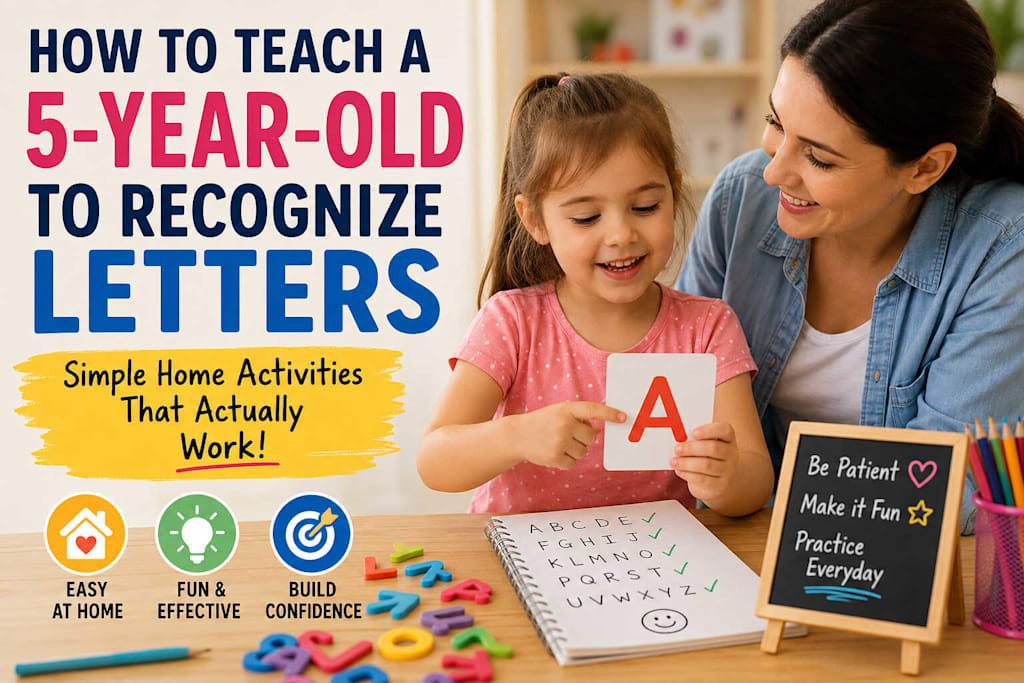
My daughter pointed at the cereal box one morning and said, "That one is mine." She meant the M. Not the whole word. Just the M. She had no idea what Cheerios spelled, but she knew that M belonged to her name. I almost missed it. I was too busy thinking about whether we should be doing flashcards that week, whether she was behind, whether I should have started earlier. She was five. She was supposed to know more letters by now. At least that is what the internet kept telling me.
But there she was, standing on a kitchen chair, cereal box in hand, picking out her own letter like she had discovered something nobody else noticed. And she had. She just did not discover it from anything I had tried to teach her.
Why Repeating Flashcards Wasn't Working
For months I sat across from her at the dining table with a stack of alphabet flashcards I bought at a dollar store. I showed her A. She said A. I showed her B. She said B. I showed her A again. She stared at it like she had never seen it before. We went through the whole deck. She got maybe four right. The next day we did it again. Same four. Sometimes three. Sometimes she mixed up M and W, which made sense to me because they look like flipped versions of each other, but she also mixed up O and Q, which made no sense at all. I kept pushing. She kept forgetting. I started dreading those sessions. She started dreading them too. I could see it in her face. The way she would fidget with her socks. The way she would look at the window instead of the card. The way she would say "I don't know" before I even flipped the next one over.
I thought repetition was the answer. More practice. More drilling. More flashcards. I was wrong. The problem was not that she was not trying. The problem was that the letters meant nothing to her. They were just shapes on cards. Abstract. Disconnected. Boring. And when something is boring to a five-year-old, their brain checks out. It is not defiance. It is self-preservation.
What My Child Responded To Instead
The cereal box moment changed everything. Not because I had some big realization. Because I finally paid attention to what she was already doing. She did not care about flashcards. She cared about her name. She cared about the letters she saw on her juice cup, on the mailbox, on the sign at the park that said "SLOW." She cared about letters that showed up in places she already went, attached to things she already liked.
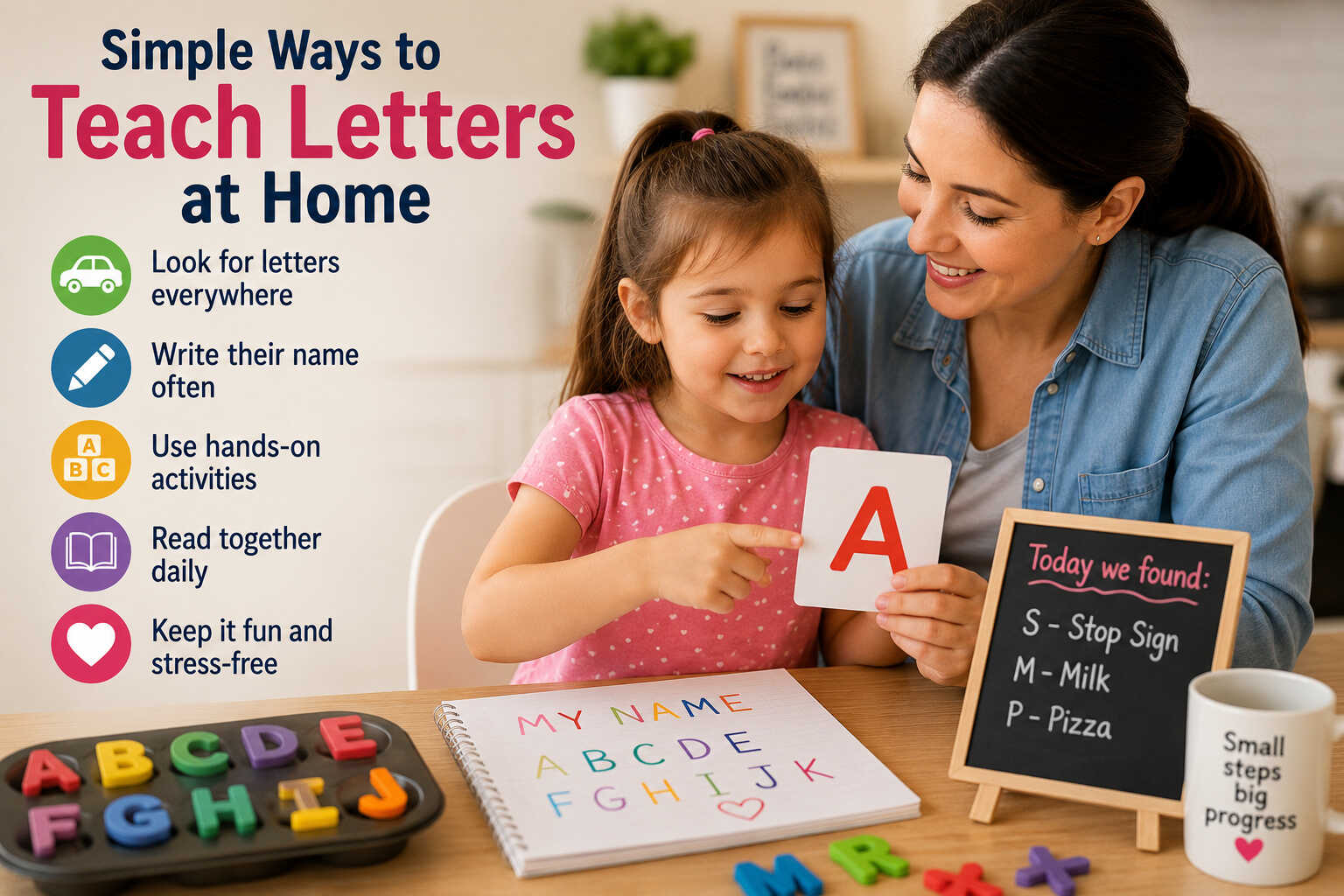
So I stopped the flashcards. I stopped the worksheets. I started paying attention to where letters already existed in her world. The stop sign on our street became "our" sign because she recognized the S and the T. The pizza place down the road had a big red P in the window, and she started pointing it out every time we drove by. Not because I quizzed her. Because she noticed it herself.
I started writing her name on everything. Her lunch bag. Her water bottle. Her drawings. I did not make a big deal out of it. I just wrote it. She started recognizing the letters in her name first, which is exactly how most kids learn. Around age two or three, children typically start recognizing the letters in their own name before any others. It is personal. It matters to them. That is the whole point.
Everyday Moments That Became Reading Lessons
The car became our best classroom. Not because I planned it that way. Because she was trapped in a car seat with nothing else to look at. She started reading signs out loud. Not reading, exactly. Recognizing. "There is the S again." "That one has a circle." "That is the letter from my name." I did not correct her when she got one wrong. I just said what it actually was and moved on. No pressure. No quiz. No "good job" every five seconds. Just a normal conversation about letters we happened to pass.
The grocery store was another goldmine. She started pointing at labels. The big K on the ketchup bottle. The M on the milk carton. The C on the cereal. I did not turn it into a lesson. I just answered when she asked. Sometimes she asked. Sometimes she did not. That was fine too. The point was that letters were everywhere, not just on flashcards I pulled out at 4 PM because I felt guilty about not doing enough.
Bath time worked too. I bought foam letters for two dollars and threw them in the tub. She played with them like they were toys. She stuck the B on the wall. She made the A float. She lined them up and knocked them down. Sometimes she said the letters out loud. Sometimes she did not. But she was touching them, moving them, seeing them from different angles. That is multisensory learning, and it works way better than staring at a card. When kids can feel the shape of a letter, trace it with their finger, manipulate it with their hands, it sticks in a different way than visual memorization alone.
Making Letter Recognition Feel Natural
The biggest shift was internal. I had to stop treating letter recognition like a checklist and start treating it like a slow, natural process that happens in the background of normal life. I stopped asking "What letter is this?" I started saying things like "Look, the pizza place starts with the same letter as your name." I stopped testing. I started pointing.
I also stopped worrying about uppercase and lowercase at the same time. That is a trap a lot of parents fall into. We think they need to know both immediately. They do not. Most kids learn uppercase letters first because they are easier to distinguish. Lowercase letters have more visual similarities. B and D and P and Q all look like variations of the same shape with different tails. That is confusing for a five-year-old brain. So I focused on uppercase at first. When she had those down, we talked about lowercase. But not before.
I also stopped expecting her to know a letter permanently once she learned it. She would recognize M on Monday and forget it by Wednesday. That is normal. Five-year-olds are still building working memory. They are still figuring out how to store and retrieve information. Forgetting and relearning is part of the process. It does not mean she is not smart. It does not mean I am failing. It means she is five.
The biggest mistake I made was comparing her to other kids. My friend's daughter knew all her letters at three. My neighbor's son was reading simple words before kindergarten. I kept measuring my daughter against them and coming up short. But kids develop at different rates. Some know the alphabet song at two but cannot identify a single written letter. Some recognize half the letters at four and then suddenly get the rest in a few months. There is no universal timeline. The only timeline that matters is hers.
When I Stopped Guessing And Started Looking For Structure
After a few months of this natural approach, my daughter was doing better. She recognized most uppercase letters. She knew the letters in her name without hesitation. She was pointing out letters in the wild like a little detective. But I started wondering if there was a more structured way to build on what we had started. Not to replace the everyday learning. To support it.
I wanted to understand how the lessons were actually organized week by week before I formed any opinion about whether a program would fit our routine. Reading through a curriculum breakdown that mapped out the phonics sequence made it much easier to see what parents were expected to teach at each stage. That helped me understand the difference between programs that just drill letters and ones that actually teach reading as a system. I did not sign up for anything. I did not need to. But seeing the structure laid out helped me see what I was already doing right and what I could improve.
I also spent time looking into different ways parents build structured reading routines at home. I came across Reading Head Start because it followed a step-by-step phonics approach instead of random daily activities. The thing that stood out to me was the sequencing. It was not just "here are some letters, learn them." It built skills in a specific order, starting with phonological awareness and moving into letter-sound connections. That made sense to me because my daughter had already shown she learned better when things felt connected, not isolated.
The limitation I noticed was that Reading Head Start, like any structured program, works best when a parent is already engaged in the process. It is not a babysitter. It is not something you hand to a five-year-old and walk away. The parent still has to be involved, still has to reinforce the lessons in real life, still has to make the connection between the program and the world the kid actually lives in. If you are looking for something that does the work for you, this is not it. Nothing is.
What Actually Matters
If I could go back and tell myself one thing, it would be this: stop making it harder than it is. Your kid does not need a curriculum at five. They need you to notice what they already care about and attach letters to it. They need to see letters in places that matter to them. Their name. Their favorite cereal. The stop sign on the way to the park. The pizza place. The mailbox. The world is already full of letters. You do not need to create artificial learning environments. You need to point at the real ones.
Do not quiz them. Do not test them. Do not make them perform. Just talk about letters like you talk about anything else. "Oh look, that sign says stop. S-T-O-P." Not "What letter is this?" Not "Can you read this?" Just normal conversation. They will absorb it. They will start noticing on their own. And when they do, let them lead. Let them point. Let them ask. Let them be wrong without correcting them like a teacher. Just say the right thing and move on.
The other thing I learned is that consistency matters more than intensity. Ten minutes of natural letter talk spread throughout the day beats thirty minutes of forced flashcard practice. A comment at breakfast about the cereal box. An observation in the car about a street sign. A foam letter in the bath. That is it. That is the whole system. It does not need to be elaborate. It needs to be regular and low-pressure.
And if your kid knows the alphabet song but cannot identify the letters, do not panic. That is incredibly common. The alphabet song is just a song. It is auditory memorization. It has nothing to do with visual recognition. Kids can sing the whole thing and still not know what an A looks like. That is not a problem. That is just two different skills. One is easier than the other. They will get there.
Before I fully made up my mind about whether a structured program was worth considering, I wanted to read something that looked at both sides instead of repeating marketing claims. A longer discussion from another parent who had done the same kind of digging helped me feel less alone in the confusion. Every parent I know has hit the same wall at some point. The difference is whether you keep banging your head against it or find a door.
Final Thoughts
Teaching a five-year-old to recognize letters is usually less about finding the perfect activity and more about building consistent, low-pressure moments throughout the day. The flashcards did not fail because my daughter was slow. They failed because they had nothing to do with her actual life. The letters on the cereal box, the stop sign, the pizza place, her own name on her water bottle, those worked because they were already part of her world.
She is six now. She reads simple words. Not because I pushed her. Because I stopped pushing and started noticing. Because I let her find letters in places she already went instead of forcing her to sit at a table and memorize shapes she did not care about. Because I accepted that forgetting is part of learning and that every kid moves at their own pace.
If your five-year-old is struggling with letter recognition, you are not behind. You are not failing. You are just looking in the wrong places. Put down the flashcards. Look at the world your kid already lives in. The letters are already there. You just have to point them out.
About the Creator
Understandshe
I write about healing, self-growth, and the messy but beautiful journey of becoming. Honest lessons, real stories, and gentle insights you’ll also find on UnderstandShe.
Enjoyed the story? Support the Creator.
Subscribe for free to receive all their stories in your feed.
Comments
There are no comments for this story
Be the first to respond and start the conversation.