
How to Stop Low Energy Ruining Your Relationship When You’re Always Tired
No fights. No drama. Just distance you can’t explain.

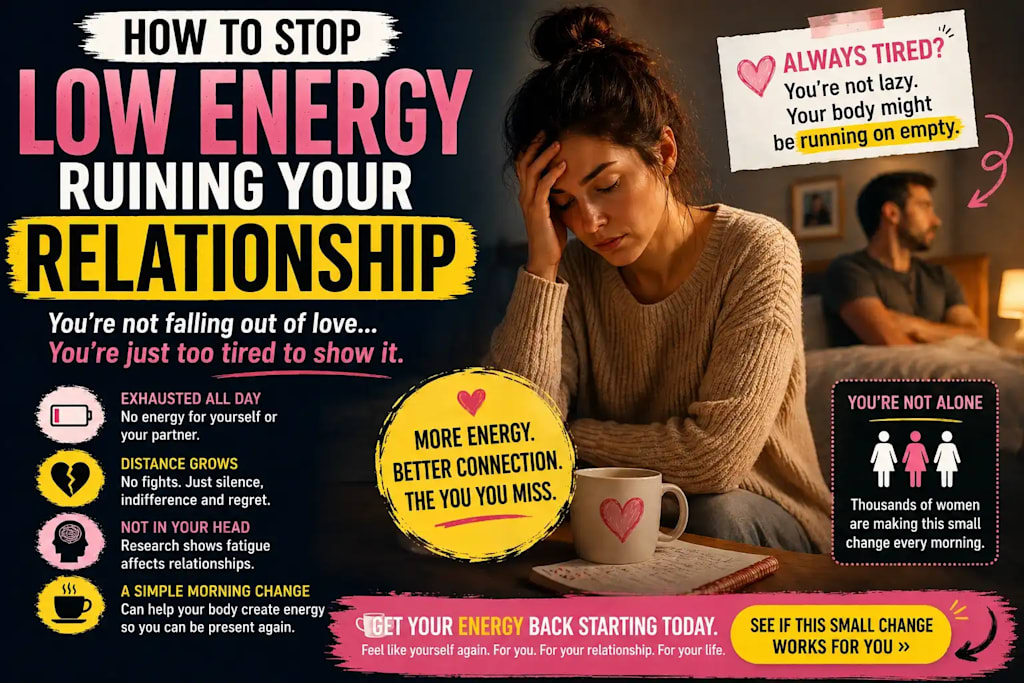
My friend Sarah had been married to Tom for eight years when I noticed something had gone quiet between them. Not the kind of quiet you get after a fight. The kind of quiet that builds up slowly, day after day, until you stop noticing it at all.
She told me about it one evening over coffee. She'd come home from work, changed into sweats, and collapsed on the bed. Tom came in to talk about his day. She stared at the ceiling, half-listening, waiting for him to finish so she could close her eyes. He sat on the edge of the mattress for a minute, then got up and left the room. She heard the TV turn on in the living room. That was it. No argument. No drama. Just another night where she had nothing left to give him.
This went on for months. She'd wake up already tired. Get through work somehow. Come home and want to disappear into the couch. Tom would try to be near her, put his hand on her shoulder, ask if she wanted to watch something together. She'd shrug him off. Not because she was angry. Because even a conversation felt like climbing a mountain. She'd tell him she was fine, just tired, and he'd nod and back off. She could see the confusion on his face. He didn't know what he'd done wrong. Neither did she, really.
They stopped touching. Not all at once. It just kind of faded out. A kiss on the cheek became a wave from across the room. Sitting together on the couch became sitting in separate chairs. She'd go to bed early, he'd stay up late. The distance grew without either of them naming it. She felt guilty about it, but guilt takes energy too, and she didn't have any of that either.
She told me she started wondering if she was just lazy. Or if she'd fallen out of love. She'd look at Tom sometimes and feel nothing, which scared her. She'd think, maybe this is what happens after eight years. Maybe the spark dies and this is just how it is. She'd scroll through her phone at night, see other couples posting date nights and adventures, and feel like she was failing at the most basic part of being a wife.
One Saturday morning, Tom made breakfast for both of them. Pancakes, which he never does. He set the plate down in front of her and said, quiet, "I miss you." That's all. Three words. She looked at him and realized she missed herself too. The version of her that used to laugh at his jokes, that used to reach for his hand without thinking, that used to have something left at the end of the day.
She started paying attention after that. Noticing how she felt. And what she noticed was that she wasn't just tired. She was drained. All the time. Mentally, physically, in a way that sleep didn't fix. She'd get eight hours and wake up feeling like she'd been hit by a truck. She'd drink coffee after coffee and still feel foggy. She'd snap at Tom over small things, then feel terrible, then have even less energy to make it right.
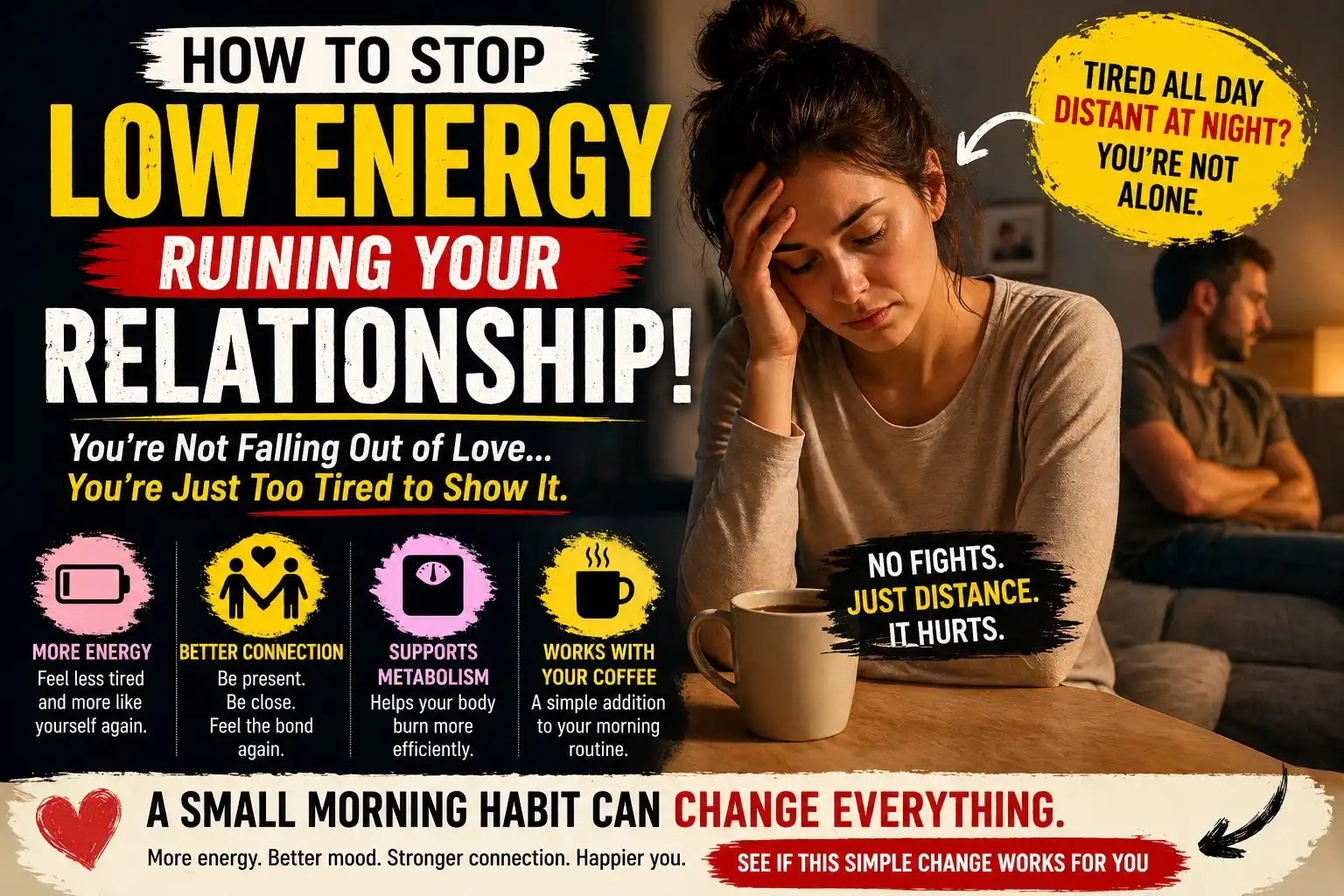
I later read that chronic fatigue can actually reduce emotional connection between partners. There's research from Harvard Health showing that when one partner is constantly depleted, it doesn't just affect them. It changes how the whole relationship functions. The tired partner pulls back. The other partner feels rejected. Nobody talks about it because it doesn't look like a problem. It looks like someone being quiet, someone being distant, someone being "fine."
Sarah started looking into what was actually going on with her body. She'd always assumed it was just work stress, or getting older, or maybe she wasn't exercising enough. But the more she read, the more she saw that fatigue in women, especially married women in their thirties and forties, often has deeper roots. Hormonal shifts, cortisol dysregulation, thyroid issues, iron deficiency. Things that don't show up on a basic blood panel but slowly drain you over years.
She went to her doctor. Got some tests. Found out her cortisol was through the roof in the morning and flatlined by afternoon. Her vitamin D was low. Her iron was borderline. Nothing dramatic, nothing that would put her in the hospital. Just a body running on empty, trying to keep up with a life that demanded more than it had to give.
The doctor told her to manage stress, sleep more, eat better. Standard advice. She tried. She really did. She cut back on work where she could. She started going to bed earlier. She meal-prepped on Sundays. And some days were better. But most days, she still felt like she was dragging herself through molasses. The distance with Tom didn't close. She still had no energy for husband-level connection at the end of the day. The low energy marriage problems kept sitting there, unspoken, growing.
She told me she hit a point where she didn't know what else to do. She'd tried the obvious stuff. She'd tried talking to Tom about it, but "I'm tired" only goes so far before it sounds like an excuse. She'd tried pushing through, faking energy, going on date nights when all she wanted was to be alone in a dark room. That made it worse. The faking exhausted her even more.
Then she found something that helped. Not a miracle. Not some dramatic transformation. Just a small morning habit she added to her routine. Something that supported her metabolism and helped her body actually use the energy she was putting into it. She'd read about how some women her age were dealing with similar fatigue, and a few of them mentioned this simple thing they did first thing in the morning. She was skeptical. She'd tried everything. But she figured, what was one more thing.
She started doing it. Nothing fancy. Just a small addition to her morning coffee. A few weeks in, she noticed she wasn't crashing at 2 PM anymore. She wasn't snapping at Tom over the dishwasher. She wasn't counting down the minutes until she could be alone. She had enough energy to actually listen when he talked. To sit next to him on the couch without feeling like it was a chore. To reach over and touch his hand, just because.
It wasn't like they suddenly became a different couple. The eight years of quiet didn't disappear overnight. But she had enough energy to start closing the gap. To say yes to a walk after dinner instead of heading straight to bed. To laugh at something he said instead of just nodding. To remember why she'd wanted to be near him in the first place.
I asked her what changed the most. She said it wasn't the habit itself. It was that she finally felt like herself again. Not the exhausted, guilty, distant version of herself. The version that had energy to be a person, not just a body getting through the day.
If you're reading this and you're always tired in relationship, if you're wondering why am I always tired in my relationship even when nothing seems wrong on paper, you're not broken. You're not lazy. You're not falling out of love. Your body might just be running on fumes, and nobody told you that's a real thing that happens.
I came across something that actually explained this in a way I couldn’t before. Not diet stuff… more like what really changes in your body after marriage.
Harvard Health has also written about how chronic fatigue affects relationships and mental health, which helped Sarah stop blaming herself:
The thing Sarah realized, and what I think a lot of women need to hear, is that low energy isn't a character flaw. It's not something you fix by trying harder or wanting it more. It's a physical state that affects everything, including your marriage, including your ability to connect, including how much of yourself you have left to give to the person you love.
She didn't fix her marriage by having a deep conversation or going to therapy or reading a relationship book. She fixed it by fixing her energy first. By getting her body back to a place where it could show up. Everything else followed from there.
If something small could give you your energy back, something you could add to your morning without changing your whole life, you'd probably try it. Not for him. Just for yourself. Because being tired all the time isn't a personality trait. It's a signal. And Sarah finally learned to listen to it.

She still has tired days. Everyone does. But now she knows the difference between normal tired and the kind of tired that swallows your whole life. She catches it earlier. She adjusts. And Tom notices. He doesn't say much, but she sees it in how he looks at her now. Like she's back in the room. Like she's actually there.
That's the thing about low energy marriage problems. They don't look like problems. They look like someone being quiet, someone pulling away, someone who doesn't care anymore. But underneath, it's usually just a person who's running on empty, trying to hold up a relationship with nothing left to hold it up with.
Sarah figured out how to get energy back in marriage. Not through some big gesture or dramatic change. Through a small, consistent thing that reminded her body how to function again. And from there, everything else got easier. Not perfect. Easier. Which, if you've been where she was, is more than enough.
About the Creator
Understandshe
I write about healing, self-growth, and the messy but beautiful journey of becoming. Honest lessons, real stories, and gentle insights you’ll also find on UnderstandShe.
Enjoyed the story? Support the Creator.
Subscribe for free to receive all their stories in your feed.
Comments
There are no comments for this story
Be the first to respond and start the conversation.