
How to Scale a Node.js Backend Without Rebuilding the Entire Application
Practical strategies for increasing Node.js backend capacity while preserving the existing architecture and minimizing disruption.

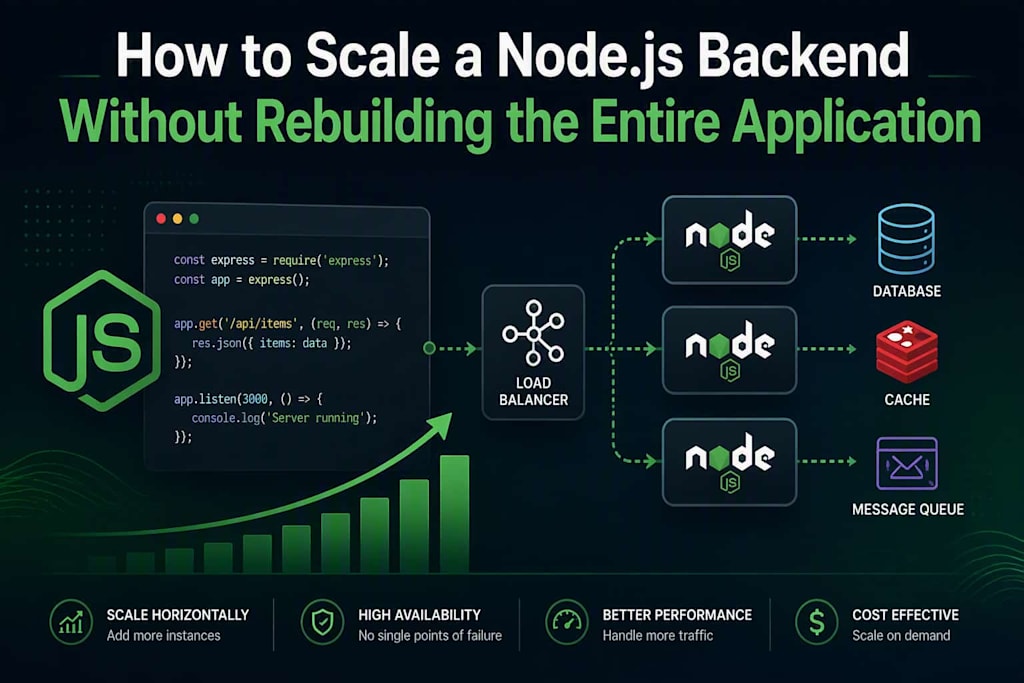
A Node.js application can support substantial growth without requiring a complete rewrite. As traffic increases, however, an existing backend may begin to experience slower response times, higher resource consumption, database bottlenecks, or unstable performance during traffic spikes. These problems can make teams consider rebuilding the application from scratch when the real issue may be specific architectural or infrastructure limitations.
Scaling an established Node.js backend is often a matter of identifying the actual bottlenecks, improving individual components, and gradually introducing more capacity. This approach can reduce technical risk while allowing the application to continue serving users during the modernization process.
Start by Finding the Real Bottleneck
Before changing the architecture, it is important to understand what is preventing the backend from handling more traffic.
A Node.js application can be constrained by different parts of the system. CPU-intensive operations may slow down the event loop, while inefficient database queries can cause requests to remain open for too long. Excessive memory usage, external API calls, network latency, and poorly optimized caching can create additional limitations.
Monitoring should therefore come before major architectural changes. Useful metrics include response times, error rates, CPU and memory utilization, database query duration, request throughput, event-loop lag, and the number of active connections.
Application performance monitoring and centralized logging can help reveal whether the primary problem is in the application code, database layer, infrastructure, or an external dependency.
Once the bottleneck is understood, the team can address the specific limitation instead of rebuilding components that are already performing adequately.
Optimize the Node.js Application Layer
Node.js is particularly effective for I/O-intensive applications, but inefficient application code can still create performance problems.
One common issue is performing expensive synchronous operations inside request-handling code. Because Node.js relies heavily on an event-driven architecture, blocking the event loop can affect many concurrent requests.
Teams can review synchronous filesystem operations, CPU-heavy transformations, inefficient loops, unnecessary serialization, and other expensive tasks. Long-running calculations may be moved to worker threads or separate services when appropriate.
Another opportunity is reducing unnecessary work. An endpoint that repeatedly processes large datasets or makes multiple redundant service calls may be optimized without changing its public API.
Profiling can help identify functions that consume significant CPU time or memory. Instead of rewriting the application, developers can focus optimization efforts on the specific operations responsible for the performance problem.
Introduce Caching Where It Makes Sense
Caching can significantly reduce the amount of work a backend performs for frequently requested data.
For example, product catalogs, configuration information, frequently accessed content, and expensive database queries may be suitable for caching. Depending on the requirements, an application can use an in-memory cache, distributed caching, or a dedicated system such as Redis.
The important consideration is deciding what can safely be cached and for how long. Highly dynamic information may require short expiration periods, while relatively stable data can remain cached longer.
Caching should also be introduced with an invalidation strategy. Otherwise, the application may return outdated information or create difficult-to-debug inconsistencies.
When implemented selectively, caching can increase throughput without requiring fundamental changes to the backend.
Improve Database Performance
As an application grows, the database frequently becomes one of the most important scaling constraints.
Developers should examine slow queries, missing indexes, excessive joins, inefficient pagination, and unnecessary data retrieval. An endpoint that requests thousands of records when the client only needs twenty is creating avoidable database and network work.
Connection management also matters. A properly configured connection pool can help the application handle concurrent database operations more efficiently.
For larger systems, read replicas can reduce pressure on the primary database by handling appropriate read workloads. Database partitioning or sharding may eventually become relevant, but these are more substantial architectural decisions and should generally follow careful performance analysis.
In many cases, query optimization and better data-access patterns can provide significant improvements before more complicated infrastructure changes become necessary.
Scale Node.js Processes Horizontally
Node.js applications can often scale horizontally by running multiple application instances.
Instead of depending on a single server, several instances can process requests behind a load balancer. As traffic increases, additional instances can be added without fundamentally changing the application's business logic.
For this model to work effectively, the application should avoid relying on local process memory for state that must be shared between instances. Sessions, queues, caches, and other shared data may need external infrastructure.
Containerization can also simplify horizontal scaling. Docker and orchestration platforms can make it easier to deploy multiple consistent instances and adjust capacity according to demand.
This approach allows infrastructure capacity to grow while keeping the existing application largely intact.
Move Heavy Background Work Out of Requests
Not every operation needs to happen while the user waits for an HTTP response.
Email delivery, report generation, image processing, data imports, notifications, document conversion, and other time-consuming tasks can often be handled asynchronously.
A queue-based architecture can separate these background jobs from the main request-processing path. The API accepts the request and places a job on a queue, while dedicated workers process the task separately.
This reduces pressure on the web servers and can make response times more predictable.
It also creates an additional scaling option: if background jobs become the bottleneck, more workers can be added without increasing the number of API servers by the same amount.
Strengthen API and Service Boundaries
An existing Node.js application does not necessarily need to become a collection of microservices simply because it needs to scale.
Breaking a monolithic backend into many services can introduce additional networking, deployment, monitoring, and operational complexity. Instead, teams can first establish clearer internal boundaries within the existing application.
Modules can be separated according to business responsibilities, dependencies can be reduced, and interfaces between components can be made more explicit.
If one part of the system later becomes a clear scaling bottleneck, that component can potentially be extracted into an independent service.
This gradual approach makes architectural change more targeted. Rather than rebuilding the entire backend, organizations can evolve the system component by component.
Choose Experienced Specialists When Necessary
Scaling an established backend often requires a combination of application development, infrastructure knowledge, database optimization, and performance engineering.
When internal developers do not have experience with these areas, bringing in Node.js expertise for scaling existing backends can help identify practical improvements without unnecessarily replacing working parts of the system.
External specialists can analyze the architecture, review performance data, identify bottlenecks, and propose incremental changes. Their role does not have to involve taking over the entire project. In some cases, a focused architecture review or performance audit is enough to establish a roadmap for the internal team.
The goal should be to address actual scaling constraints rather than introduce technology simply because it is newer.
Scale Gradually and Measure Every Change
Scaling should be treated as an iterative process.
A team can establish baseline metrics, introduce one improvement, and measure its impact. For example, developers might optimize a database query and then compare response times, database load, and throughput before and after the change.
Load testing can help determine whether the system can handle expected traffic levels. Stress testing can reveal what happens when demand exceeds normal capacity.
This measured approach makes it easier to determine which changes are producing meaningful results. It also prevents teams from making several architectural changes simultaneously and then struggling to identify which one caused an improvement or introduced a new problem.
When outside assistance is required, it can be useful to work with teams with proven Node.js experience that can evaluate the current architecture rather than assuming a complete rebuild is necessary.
Plan for Scaling Before the Next Traffic Spike
A backend should not be optimized only after a production incident. Once the main bottlenecks have been addressed, teams can establish capacity targets and monitor trends.
Useful questions include how much traffic the current infrastructure supports, which components approach their limits first, how quickly additional instances can be deployed, and which dependencies could become bottlenecks as usage grows.
Autoscaling can help infrastructure respond to changing demand, while alerts can notify teams when resource consumption or latency exceeds established thresholds.
Documentation is equally important. Future developers need to understand why specific caching strategies, database configurations, queues, or scaling mechanisms were introduced.
Conclusion
Scaling a Node.js backend does not automatically require rebuilding the entire application. In many cases, performance problems can be addressed through targeted improvements to application code, database queries, caching, background processing, infrastructure, and deployment architecture.
The most practical approach is to measure first, identify the actual bottlenecks, and introduce changes incrementally. Horizontal scaling can add capacity, queues can remove heavy work from request paths, caching can reduce repeated processing, and database optimization can improve the performance of existing functionality.
A gradual scaling strategy also preserves the value of the existing system. Instead of replacing working business logic simply because traffic has increased, organizations can evolve the backend around its real requirements and introduce larger architectural changes only when the evidence supports them.
About the Creator
Chudovo
Chudovo is a custom software development company, focused on complex systems implementation.
Enjoyed the story? Support the Creator.
Subscribe for free to receive all their stories in your feed.
Comments
There are no comments for this story
Be the first to respond and start the conversation.