
How to Reduce Decision-Making Delays in Complex Software Projects
Practical strategies for establishing clear decision ownership, accelerating approvals, and improving project governance without compromising technical quality or business control.


Complex software projects rarely slow down because of a single technical problem. More often, progress is limited by decisions that take too long to make. A development team may be ready to implement a feature, but the required approval is still pending. Internal stakeholders may disagree about priorities, technical specialists may wait for clarification, or managers may struggle to determine who has the authority to resolve an issue.
These delays become particularly expensive when multiple departments, external development teams, and business stakeholders participate in the same project. Even relatively minor decisions can affect several interconnected activities, creating dependencies that extend delivery timelines and increase costs.
For CTOs, CIOs, and IT decision-makers, reducing these delays requires more than additional meetings or stricter deadlines. Businesses need a structured approach to decision ownership, approval processes, technical governance, and escalation mechanisms.
Identify Where Decision-Making Bottlenecks Occur
Before changing project governance, organizations need to understand where and why decisions are delayed. Not every approval process creates unnecessary friction. Some decisions require careful evaluation because they affect security, compliance, system architecture, or long-term operating costs.
The challenge is distinguishing necessary reviews from avoidable administrative delays.
A useful starting point is to examine the project's decision history. Project managers should identify recurring situations in which development activities were interrupted while waiting for information, authorization, or agreement between stakeholders.
Common bottlenecks include:
Requirements that remain unapproved because several departments must agree.
Technical changes awaiting authorization from senior engineers or architects.
Budget adjustments that require multiple management approvals.
Unclear responsibilities when internal and external teams share technical dependencies.
Conflicting priorities between business units.
Escalations that reach decision-makers without sufficient context.
Organizations should also measure decision latency: the time between identifying an issue and reaching an actionable decision.
Tracking this metric across different decision categories helps identify systemic problems. For example, if security approvals consistently take five working days while routine technical decisions take several hours, management can investigate the specific process responsible for the difference.
The objective is not to eliminate every approval step. It is to remove unnecessary waiting while preserving appropriate controls.
Establish Clear Decision Ownership
One of the most common reasons for delayed decisions is the absence of a clearly designated owner. Project participants may understand that a decision is necessary but remain uncertain about who has the authority to make it.
This problem becomes more complicated when responsibilities overlap between business stakeholders, internal IT departments, project managers, and external developers.
A practical solution is to establish a decision ownership framework before significant development activities begin. Every important decision category should have one accountable owner, even when several specialists contribute information or recommendations.
For example, business requirements may belong to a product owner, architectural decisions to a designated technical authority, and budget approvals to an executive sponsor.
A responsibility matrix can make these relationships explicit:
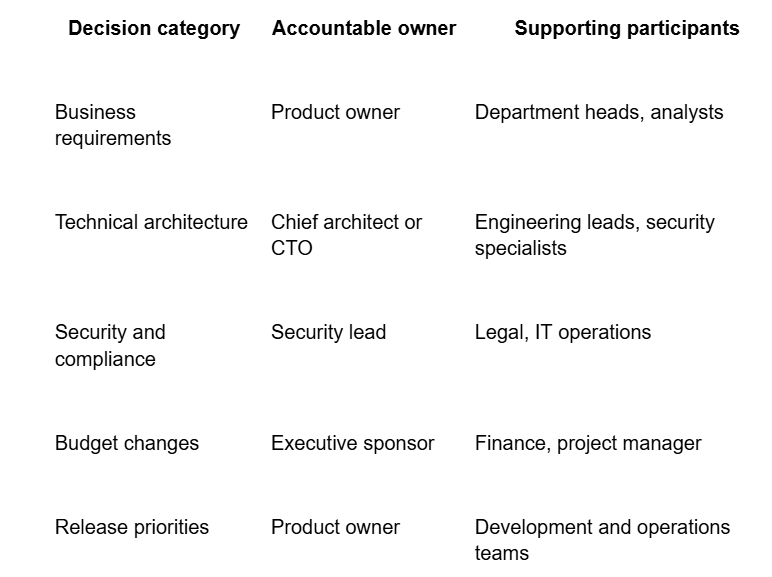
The distinction between responsibility and participation is essential. Several people may provide input, but one person should be accountable for the final decision.
Organizations should also define decision boundaries. Technical leads, for instance, may be authorized to approve implementation details within an agreed architecture without requesting executive approval for every adjustment.
This reduces unnecessary escalation and allows management to concentrate on decisions with meaningful business or financial consequences.
Reduce Dependencies Between Internal and External Teams
Complex software projects frequently involve several teams that depend on one another's decisions. An external development team may need access to internal infrastructure, clarification from a business department, or approval from the client's security specialists.
When these dependencies are not managed explicitly, delays spread across the project.
For example, a developer may complete an integration component but cannot proceed with testing because the internal infrastructure team has not approved access permissions. The development team then waits, the project manager reports a delay, and the next dependent activity is postponed.
Resolving such situations requires a shared view of decision dependencies.
Project managers should maintain a decision register that records:
The decision that needs to be made.
The person responsible for making it.
The teams or activities affected.
The required information and supporting evidence.
The target decision date.
The consequences of a delayed response.
This register should be accessible to both internal and external participants.
Regular coordination meetings can then focus on unresolved decisions rather than repeating general status updates. Participants should arrive with the necessary information, and each discussion should conclude with a documented outcome, an accountable owner, and a deadline.
Clear dependency management is particularly important when resolving technical blockers in software delivery requires input from several organizational units. In such cases, identifying the technical issue is only the first step. The project must also establish who can authorize the proposed solution and which dependent activities can proceed in parallel.
Shorten Approval Cycles Without Weakening Control
Many organizations introduce additional approval layers to maintain quality and reduce operational risk. However, excessive approval requirements can create administrative bottlenecks without improving the quality of decisions.
The solution is to differentiate decisions according to their impact and risk.
Routine implementation choices should not follow the same approval process as changes affecting security architecture, regulatory compliance, or major financial commitments.
A tiered approval framework can help:
Low-impact decisions: Engineering leads or product owners approve routine adjustments within previously agreed boundaries.
Medium-impact decisions: Relevant technical and business stakeholders review changes affecting several teams, system components, or project milestones.
High-impact decisions: Senior management approves changes involving substantial budget increases, strategic priorities, security exposure, or significant architectural consequences.
Organizations should also introduce explicit response-time expectations. For example, routine approvals might require a response within one working day, while complex architectural decisions may receive a three-day evaluation period.
These deadlines should reflect actual complexity rather than arbitrary administrative targets.
Another effective measure is to standardize approval requests. Instead of sending lengthy discussions through email, teams can use a short decision template containing the problem, available options, expected costs, risks, and recommended action.
This allows decision-makers to evaluate proposals without repeatedly requesting missing information.
Importantly, shorter approval cycles should not mean automatic approval of high-risk changes. Quality and control remain protected through predefined review criteria, documented exceptions, and clear accountability.
Improve Technical Decision-Making and Escalation
Technical decisions often become bottlenecks when organizations lack an agreed authority structure. Different engineering teams may have competing architectural preferences, while senior specialists become involved in decisions that could be resolved at a lower level.
This situation can be especially problematic in projects involving distributed engineering teams or specialized delivery arrangements. For example, a forward deployed engineering model may involve technical contributors working closely with business stakeholders, but organizations still need to define which architectural and operational decisions remain subject to internal governance.
A technical decision framework should distinguish between local implementation choices and decisions with broader consequences.
Engineering teams should be able to select appropriate implementation details within established standards. However, changes affecting shared infrastructure, data ownership, security requirements, or long-term maintainability should involve designated technical authorities.
An Architecture Decision Record (ADR) can help document important choices. Each record should explain the problem, alternatives considered, selected approach, expected consequences, and responsible decision-maker.
This creates an accessible history of technical decisions and reduces the likelihood that the same questions will be reopened repeatedly.
Escalation processes require similar clarity. Organizations should define when an issue must be escalated, who receives it, and how quickly a response is expected.
A practical escalation sequence may involve:
The responsible engineering lead attempts to resolve the issue within the team's authority.
If the issue affects other teams, the project manager coordinates the relevant participants.
If technical or business authority is required, the issue goes to the designated decision owner.
Strategic, financial, or high-risk conflicts are escalated to the executive sponsor.
Escalation should not simply transfer responsibility upward. The person raising an issue must provide sufficient context and a clear recommendation so that the next decision-maker can act.
Make Governance Consistent Across Project Structures
Different software delivery arrangements create different coordination requirements, but decision ownership should remain explicit regardless of the organizational structure.
When evaluating forward deployed engineering vs. traditional outsourcing, businesses should avoid allowing terminology or contractual arrangements to replace practical governance rules. The important question is whether decision-making authority is clearly assigned across the people responsible for business priorities, technical direction, and operational risk.
Similarly, understanding the differences between forward deployed engineering and outsourcing should not distract decision-makers from establishing consistent approval criteria and escalation responsibilities.
Every project should have a documented governance model that specifies who can make decisions, which matters require consultation, and which changes need formal authorization.
This framework should also be reviewed when the project expands, new departments become involved, or responsibilities change. A governance structure that works for a small development team may become ineffective when several vendors and internal business units participate.
Measure Decision-Making Performance
Improving decision efficiency requires measurable indicators. Without consistent monitoring, organizations may reduce meeting frequency or introduce new approval rules without knowing whether these changes actually improve delivery.
Several indicators can provide useful insight:
Average decision time: Measures the time between identifying an issue and reaching a decision.
Approval cycle duration: Tracks how long formal requests remain pending.
Escalation frequency: Shows how often decisions exceed the authority of their original owners.
Reopened decisions: Identifies cases where previous agreements are repeatedly reconsidered.
Blocked working days: Measures the time development activities are delayed by unresolved decisions.
Decision-related rework: Tracks additional work caused by unclear or inconsistent approvals.
These indicators should be reviewed alongside delivery quality, defect rates, security compliance, and budget performance.
A reduction in decision time is not necessarily an improvement if it produces more errors or expensive rework. The objective is to make appropriate decisions faster, not simply to increase the number of approvals completed.
Management should review these metrics regularly and investigate recurring patterns. If architectural decisions remain slow, the organization may need clearer technical authority. If business approvals dominate delays, decision ownership may need to move closer to the relevant departments.
Conclusion
Decision-making delays in complex software projects are often organizational problems rather than purely technical obstacles. Unclear ownership, excessive approval layers, dependencies between teams, and ineffective escalation processes can prevent development activities from progressing even when the necessary technical expertise is available.
CTOs, CIOs, and project leaders can address these problems by assigning accountable decision owners, defining approval boundaries, documenting dependencies, and establishing predictable escalation procedures.
The most effective governance structures balance speed with accountability. Routine decisions should be made close to the teams performing the work, while strategic, financial, and high-risk matters receive appropriate management oversight.
Ultimately, successful decision management is not about eliminating control. It is about ensuring that the right people make the right decisions at the right time, with sufficient information and clearly defined responsibility.
About the Creator
Chudovo
Chudovo is a custom software development company, focused on complex systems implementation.
Enjoyed the story? Support the Creator.
Subscribe for free to receive all their stories in your feed.
Comments
There are no comments for this story
Be the first to respond and start the conversation.