
How to Publish a Mystery Puzzle Book Without Creating Another Generic Puzzle Collection
Why clue chains, ciphers, and connected puzzles create a completely different publishing experience.
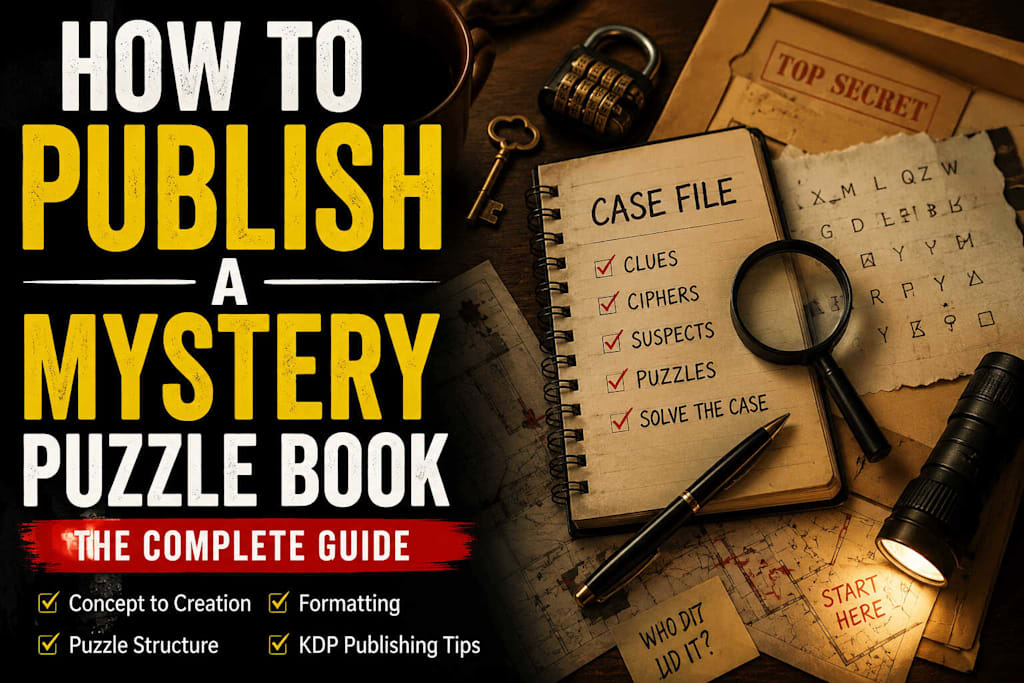
I started where most people do. I opened a notebook, sketched out some grid ideas, and thought about publishing puzzle books on Amazon KDP. Word searches felt approachable. Sudoku templates were everywhere. Crosswords and fill-in puzzles had proven audiences. The logic seemed sound: people buy these books, the formats are understood, and the production process is straightforward.
But something kept bothering me. The more puzzle books I flipped through both physical copies and digital previews the more they blurred together. A hundred pages of disconnected grids, random word lists, number placements that started on page one and ended on page one. There was nothing wrong with these books exactly. They just felt interchangeable. As a reader, I could finish page twelve and never think about it again. As a creator, I wasn't sure I wanted to add another identical volume to that pile.
That restlessness pushed me toward a question I couldn't shake: what if a puzzle book could feel like an experience instead of a collection?
The Moment Mystery Puzzle Books Clicked
I started searching for puzzle formats that broke the mold, and that's when I discovered how wide the mystery puzzle category actually runs. Detective puzzle books where readers investigate cases instead of just filling in grids. Clue hunt books that send you searching through previous pages for evidence you missed. Code breaker puzzle books built around cipher systems where solving one puzzle gives you the key to the next. Secret message books where the answers spell out hidden communications. Escape room books that replicate the pressure and progression of a real locked-room challenge. Spy puzzle books where the reader becomes the operative, working through missions that demand both logic and lateral thinking.
These formats felt fundamentally different. Not just in content, but in intention. A word search exists on its page and stays there. A mystery puzzle book builds. Each page earns its place in a larger architecture. The reader isn't just completing puzzles they're advancing something. A case. A mission. A storyline that only resolves if they pay attention.
That distinction changed how I thought about publishing entirely.
Why Mystery Puzzle Books Demand a Different Kind of Planning
The more I studied these formats, the clearer it became that mystery puzzle books require more than a folder of puzzle templates and a cover design. Story structure matters. Not necessarily a novel-length narrative, but enough architecture that the reader understands why they're solving what they're solving. Clue chains matter each puzzle needs to deliver something the next one requires, whether that's a code fragment, a location, a suspect's alibi, or a piece of evidence that suddenly recontextualizes everything that came before.
Progression matters too. Mystery puzzle books live or die by their pacing. If the first ten pages are too easy, experienced solvers check out. If the difficulty spikes too hard too fast, casual readers abandon the book before they get invested. Reader motivation needs constant attention. Someone working through a detective puzzle book needs to feel like they're genuinely assembling a case, not just grinding through unrelated brain teasers. Case solving and investigation mechanics need to feel coherent. Hidden information needs to be discoverable not unfair, not obvious, but earned.
I spent weeks sketching out these structures before I touched a single page layout. The planning phase felt closer to designing a board game than publishing a conventional puzzle book. One thing that helped me understand puzzle progression better was watching how escape-room designers build clue chains and player flow. Mystery puzzle books use many of the same ideas, especially when puzzles depend on previous discoveries.
That surprised me. I had assumed the hard part would be puzzle creation. It turned out the hard part was connection.
What Publishing Actually Looks Like in Practice
Once I started building, the practical challenges surfaced fast. Creating connected clues sounds elegant on paper but demands relentless consistency. If puzzle seven reveals a three-digit code that unlocks puzzle twelve, those numbers need to be correct everywhere they appear. One typo doesn't just break a puzzle it breaks the chain. Maintaining consistency across a hundred pages of interdependent content taught me why so many puzzle books stay strictly modular. Modularity is safer. Connection is harder.
Balancing difficulty became another obsession. I tested early sections with friends who ranged from casual magazine-puzzle solvers to dedicated escape room enthusiasts. Their feedback was blunt and invaluable. A puzzle I thought was clever went completely unnoticed because the setup didn't signal its importance. Another puzzle I considered easy stalled three different people for twenty minutes because I had assumed knowledge I never explained. Keeping readers engaged in a mystery puzzle book isn't just about entertainment value. It's about clarity of purpose. Every page needs to earn the reader's trust that the book knows where it's going.
Testing puzzle flow turned out to be the phase I hadn't budgeted enough time for. I would work through my own book, find a dead end, trace back three puzzles, realize the error originated seven pages earlier, and rebuild the chain from there. It was tedious. It was also where the book finally started to feel alive. When the flow worked when a solved cipher revealed a hidden message that pointed to a suspect's true identity the satisfaction was completely different from watching someone complete a standalone sudoku. The puzzles meant something because they belonged to something.
Finding the Right Concepts Before Production
Before thinking about publication, I spent time exploring broader concept development in Online Mystery Puzzle Book Ideas for Adults. That exploration helped me understand how wide the mystery puzzle space really is and where my own book might fit within it. The mystery puzzle publishing category isn't one thing. It's a constellation of formats that share a common promise: the reader's effort builds toward a payoff that no single puzzle could deliver alone.
While researching how publishers create code-breaking, clue-based, and mission-style mystery books, I came across because it focused on detective, cipher, and mystery puzzle structures rather than traditional puzzle formats. It was useful to see how these elements could be organized into a coherent framework, and it clarified some questions I had about how professional creators approach puzzle-to-story integration.
Getting Ready for Publication
When the manuscript finally felt solid, I turned toward the actual publishing process. Formatting for publication required attention to print-specific details that digital puzzle creators rarely consider. Page margins need to accommodate puzzle grids without crushing them into the spine. Answer keys need logical placement typically at the back, but with enough separation that accidental spoilers don't ruin the experience. Font choices matter more than I expected; a cipher puzzle rendered in an unclear typeface becomes illegible, and mystery puzzle books demand legibility.
Preparing for KDP meant understanding bleed settings, cover dimensions, and interior file specifications. Mystery puzzle books often run longer than simple activity books because of their narrative and structural needs, so page count calculations affected both printing costs and pricing decisions. I also realized that the book's description and metadata needed to signal clearly what made it different from standard puzzle books. The category is crowded with generic titles. A mystery puzzle book needs its listing to promise something specific: investigation, progression, a mystery worth solving.
Publishing considerations extend beyond the technical. Mystery puzzle books create a different relationship with the reader. Someone who finishes a well-designed detective puzzle book doesn't just feel accomplished they feel like they did something. They followed clues. They broke codes. They solved a case. That emotional residue is what makes the format worth the extra effort. Readers remember books that made them feel capable and clever. They recommend them. They buy the next one.
Looking back at where I started flipping through notebooks of disconnected word search ideas I'm glad I felt dissatisfied. Mystery puzzle publishing isn't the easiest entry point into the puzzle book market. It demands more planning, more testing, more attention to structural coherence. But it also offers something the interchangeable volumes on those crowded shelves can't replicate. It gives the reader a reason to keep turning pages that has nothing to do with passing time and everything to do with discovering what happens next.
That difference is worth building toward
About the Creator
Brooks Ghost Max
I'm just a running shoe geek with a serious addiction to foam. My current obsession? The Brooks Ghost Max. I spend my days analyzing stack heights and heel drops to help you decide if that $150 price tag is actually worth it.
Enjoyed the story? Support the Creator.
Subscribe for free to receive all their stories in your feed.
Comments
There are no comments for this story
Be the first to respond and start the conversation.