
The Best DIY Mystery Puzzle Book Ideas for Adults Aren't Sudoku or Word Searches
Why more creators are exploring detective cases, secret messages, and puzzle adventures instead.
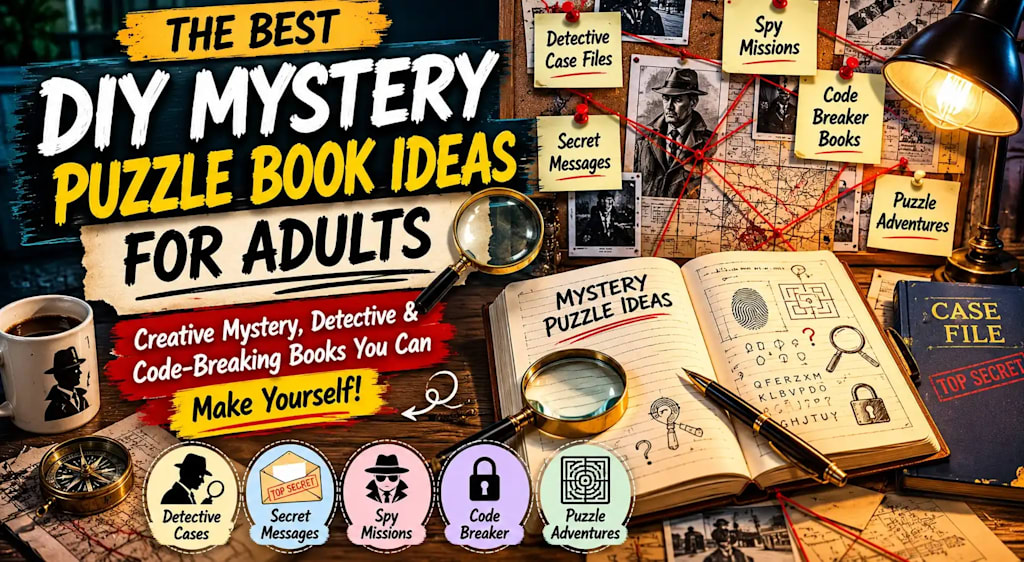
I started looking into puzzle book publishing because I kept seeing the same interiors recycled across different Amazon listings. The same word search layouts. The same sudoku grids. The same maze templates with different cover art slapped on top. It did not take long to realize that the traditional puzzle book market has become a graveyard of identical products competing for the same reader.
I wanted to find something different. Specifically, I wanted to understand what it would take to create puzzle books that felt like an experience rather than a homework assignment. That search led me down a path toward mystery puzzle book ideas for adults, and what I found was a publishing gap that very few independent creators seem to be filling.
The Saturation Problem Nobody Talks About
If you browse the puzzle book category on any major platform, you will notice something immediately. The top results for general puzzle books are dominated by massive publishers with deep catalogues of word searches, crosswords, fill-ins, and sudoku collections. These books sell, no question. But the barrier to entry for a new creator is deceptively high. Not because the books are hard to make. They are trivial to make. That is the problem.
When a category becomes trivial to produce, it becomes flooded. Differentiation becomes nearly impossible because the interiors are functionally identical. A word search is a word search. A sudoku grid is a sudoku grid. The only variable is the cover, and even that has started to homogenize into the same neon gradients and stock illustrations.
I looked at the reviews and customer questions on dozens of these listings. Readers were not complaining about quality. They were complaining about boredom. "Do you have anything different?" "Is there a storyline?" "Are there any puzzles that connect to each other?" The demand for something narrative-driven was sitting right there in the reviews, and most publishers were ignoring it.
That is when I started focusing specifically on mystery activity books, detective activity books, and code breaker books. These formats felt like a different category entirely. They were not just collections of puzzles. They were immersive experiences where the puzzles served a purpose within a larger story framework.
Building a List of Real DIY Mystery Puzzle Book Ideas
I began collecting concrete formats that an independent publisher could actually design and produce. I wanted ideas that were practical, not theoretical. Here is what I ended up with after weeks of research and reverse-engineering existing titles in the mystery and puzzle-adventure space.
Cold case puzzle books stood out immediately. The reader takes on the role of a detective reopening an unsolved case. They examine evidence, read witness statements, and solve puzzles that reveal hidden connections between suspects. These books require some upfront writing to build the case narrative, but the puzzle mechanics can be relatively simple. It is the framing that makes them compelling.
Detective case file books take a similar approach but present the material as a physical file. The reader might encounter crime scene photographs (illustrated), forensic reports, interview transcripts, and coded messages between suspects. Each document layer peels back another piece of the mystery. This format works well because it mimics the popularity of true crime media while keeping the interaction active rather than passive.
Secret message books focus almost entirely on ciphers and hidden communication. The reader is trying to decode messages left behind by a missing person, a spy, or a secret organization. These books can range from simple substitution ciphers for beginners to multi-layered encryption challenges for more advanced solvers. The progression of difficulty keeps readers engaged across the entire book.
Spy mission books frame the reader as an operative completing a series of intelligence tasks. Each puzzle is a mission objective. Decrypt a transmission to learn the location of a safe house. Analyze a surveillance log to identify the double agent. Complete a logic grid to determine which informant is telling the truth. The spy theme creates natural urgency and makes even basic puzzle types feel consequential.
Code breaker books are more specialized but attract a dedicated audience. These focus heavily on cipher challenges, pattern recognition, and cryptographic puzzles. The best ones teach the reader actual cipher techniques as they progress, so the book becomes educational as well as entertaining. Readers who finish one code breaker book usually want another one immediately.
Hidden clue books require more design coordination because the puzzles and narrative need to interlock precisely. The reader is searching for clues embedded in illustrations, documents, and puzzle solutions that all point toward a final answer. These work beautifully as single-session experiences, similar to escape rooms in book form.
Escape room style books have grown significantly in popularity, and the adult segment is still underserved compared to children's versions. These books present a scenario, usually a locked location or a timed mission, and the reader must solve sequential puzzles to progress. The key design challenge is creating logical flow so each solved puzzle naturally leads to the next.
Puzzle adventure books combine narrative fiction with integrated puzzles. Instead of puzzles being separate from the story, they are embedded within it. The protagonist needs a code to open a door, and the reader solves the code to turn the page. This requires writing skill and puzzle design to work together, which is why fewer creators attempt it. But the result is a genuinely unique product.
Investigation journals blend guided journaling with mystery elements. The reader records their own deductions, creates timelines, and fills in suspect profiles while working through a case. This format adds a personal dimension that standard puzzle books lack. It also encourages readers to work through the book more slowly and thoughtfully.
Cipher challenge books are similar to code breaker books but often more competitive in structure. They might include timed challenges, difficulty ratings, and progressive levels of encryption. Some include historical context about real ciphers used in wartime or espionage, which adds educational weight to the entertainment value.
Why These Formats Create a Better Reader Experience
The interesting pattern I noticed while researching these formats was that the best-reviewed books in the mystery puzzle space were not reviewed as puzzle books. They were reviewed as experiences. Readers talked about immersion, about losing track of time, about the satisfaction of solving a multi-layered mystery. They did not compare these books to sudoku collections. They compared them to mystery novels and escape rooms.
That is a completely different competitive landscape, and it is a much healthier one for independent publishers. When your product is compared to an escape room or a thriller novel, you are not competing with the thousand identical word search books priced at cost. You are competing with entertainment experiences, and readers are willing to pay accordingly.
Mystery puzzle book ideas for adults work because they fulfill a dual need. The reader wants mental stimulation, but they also want narrative engagement. Traditional puzzle books only satisfy the first need. Mystery formats satisfy both, which is why readers finish them faster, review them more enthusiastically, and recommend them to others more frequently.
The Tool Gap Nobody Mentions
Once I had my list of formats, I faced a practical question. How do you actually create these books? I started researching puzzle generation software and quickly hit a wall. Almost every tool I found was designed for the saturated categories I had already decided to avoid. Word search generators. Sudoku creators. Crossword builders. Maze designers. These tools are abundant because the market is abundant, and the market is abundant because these books are easy to produce.
None of these tools solved the mystery book problem. Creating a detective case file or a spy mission book requires narrative structure, puzzle integration, themed layouts, and cohesive visual design. The traditional puzzle generators offered none of that. They produced isolated puzzle pages with no story connection.
I spent several days looking for something that bridged the gap between story-driven content creation and practical book formatting. Most of what I found was either too generic to be useful or too complex for someone without professional design skills. I was starting to think that creating these books would require hiring illustrators and layout designers, which would push the project beyond what most independent publishers could justify.
What I Found While Researching Publishing Workflows
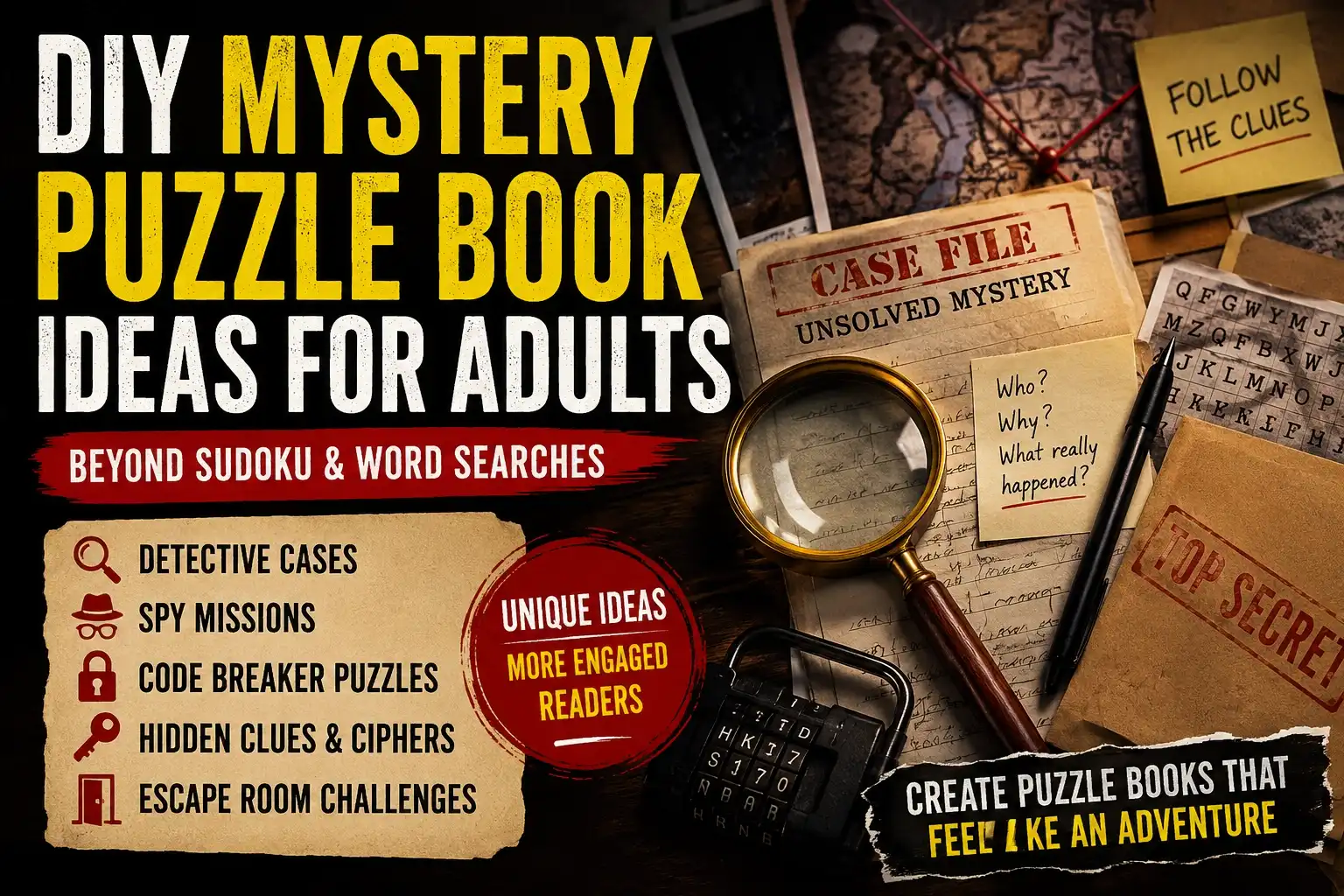
While researching how publishers create detective and code-breaking books, one of the resources I came across was because it focused on mystery-style puzzle publishing rather than traditional puzzle formats. It was designed specifically for the kinds of books I had been listing out: spy puzzle books, code breaker books, detective activity books, and mystery mission books.
What separated it from everything else I had looked at was that it was not trying to be a general puzzle tool. It was built around the premise that narrative-driven puzzle books require a different approach to design and production. The templates and structures were aligned with mystery and espionage themes, which meant I would not have to force-fit generic puzzle pages into a spy storyline.
I had been looking for something practical that would let me create the books I had outlined without needing to become a professional graphic designer or hire a production team. Finding a resource that was actually oriented toward mystery-themed publishing rather than yet another word search generator felt like a meaningful step forward in the research process.
Why This Matters for Independent Publishers
The reason I believe this publishing angle is worth pursuing comes down to positioning. The adult puzzle book market is not shrinking. It is fragmenting. Readers are becoming more sophisticated. They have done thousands of crossword puzzles. They have filled in countless sudoku grids. What they have not done is solved a cold case, decoded a spy transmission, or worked through an investigation journal that made them feel like a real detective.
Spy puzzle books and mystery activity books represent a space where independent creators can actually distinguish themselves. The production barrier is slightly higher than throwing together a word search collection, but that barrier is what keeps the market from flooding. Not everyone is willing to write a narrative, design themed puzzles, and create an integrated experience. But for those who are, the product that results stands alone in a way that no generic puzzle book can.
The question is not whether readers want these books. The reviews across existing titles prove they do. The question is whether creators are willing to put in the work to make something that transcends the standard puzzle format. Based on everything I found while researching diy mystery puzzle book ideas for adults, the opportunity is real, the audience is waiting, and the tools to create these books are more accessible than most people realize.
About the Creator
Brooks Ghost Max
I'm just a running shoe geek with a serious addiction to foam. My current obsession? The Brooks Ghost Max. I spend my days analyzing stack heights and heel drops to help you decide if that $150 price tag is actually worth it.
Enjoyed the story? Support the Creator.
Subscribe for free to receive all their stories in your feed.
Comments
There are no comments for this story
Be the first to respond and start the conversation.