
How to Prevent Data Gaps Between Glucose Devices, Mobile Apps, and Backends
Designing reliable glucose data flows that preserve readings when devices, apps, and backend services temporarily lose connectivity.

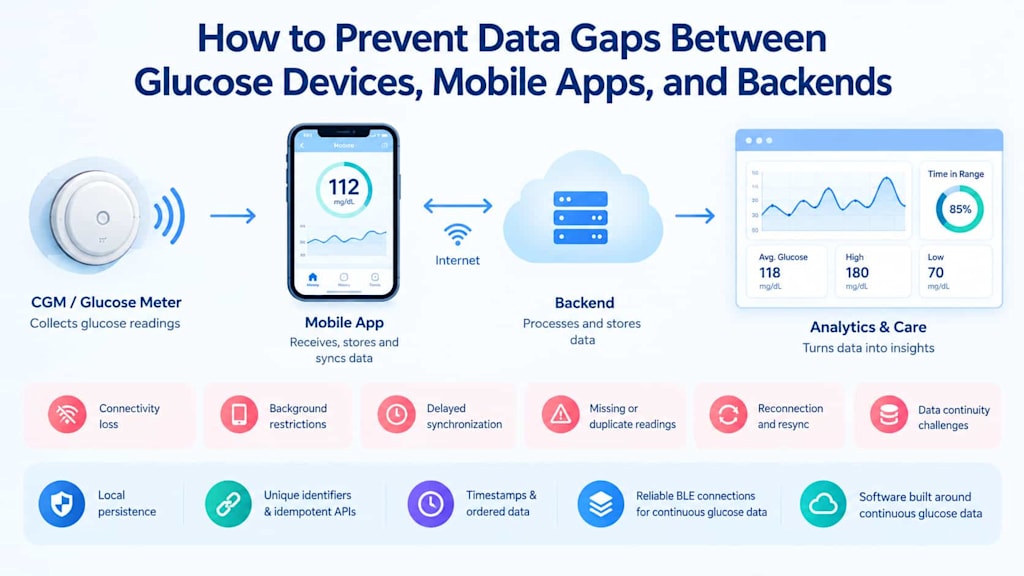
Continuous glucose monitoring and connected glucose meters can generate valuable streams of health data, but getting a reading from a device into a backend is not always a continuous process. A CGM may temporarily lose its connection to a phone. A mobile operating system may restrict background activity. A user may close an app, lose internet access, or switch devices. The backend may receive readings late or receive the same reading more than once.
These situations are normal in connected health applications. The challenge is not eliminating every interruption but designing the data flow so that temporary failures do not become permanent data gaps.
A reliable architecture therefore needs to preserve readings across multiple stages: device, mobile application, synchronization layer, backend, database, and downstream analytics.
Treat Connectivity Loss as an Expected State
One of the most important design decisions is to stop treating connectivity loss as an exceptional event.
Glucose devices operate in real-world conditions. A phone may be several meters away, Bluetooth connectivity may temporarily disappear, or a user may move into an environment with interference. Internet connectivity can also fail independently of the connection between the glucose device and smartphone.
The application should distinguish between these different states.
For example:
The glucose device is collecting readings but cannot reach the phone.
The phone has received readings but cannot reach the backend.
The backend has received a reading but processing is delayed.
The connection has returned, but previously stored readings still need synchronization.
These states have different causes and require different recovery mechanisms. Designing reliable BLE connections for continuous glucose data is therefore only one part of the solution; the surrounding application and backend must also be prepared to preserve readings when connectivity is temporarily interrupted.
A robust design should therefore use explicit synchronization states rather than assuming that "connected" means every layer is synchronized.
Build Around Local Persistence
The mobile application should not depend on an active internet connection to preserve every reading it receives.
When the app obtains a glucose measurement, it should first store the information locally before treating the transfer as complete. The local record can contain the reading itself along with metadata such as the device identifier, measurement timestamp, reception timestamp, synchronization status, and a unique reading identifier.
This creates a temporary local source of truth.
If the internet connection disappears immediately after a measurement arrives, the application can retain the record and transmit it later. The user does not lose the reading simply because the backend was unavailable at that particular moment.
Local persistence is also useful when the operating system suspends an application. Once the application becomes active again, it can determine which locally stored readings have not yet been synchronized and resume the transfer.
The same principle can apply to device-side storage when the glucose device supports it. The architecture should take advantage of available buffering rather than assuming every reading must travel immediately through every layer.
Design for Delayed Synchronization
A continuous data stream does not necessarily mean every reading must reach the backend in real time.
For many applications, preserving the correct sequence and timestamp of measurements is more important than eliminating every short delay. A reading that arrives several minutes late can still be valuable if its original measurement time is preserved.
This means the backend should distinguish between:
Measurement time: when the glucose value was recorded.
Device reception time: when the phone or another intermediary received it.
Synchronization time: when the backend received it.
Processing time: when the system made it available to downstream services.
Keeping these timestamps separate prevents delayed readings from being incorrectly interpreted as newly measured values.
It also makes troubleshooting much easier. Developers can determine whether a gap occurred at the device, mobile, network, or backend stage.
Account for Background Restrictions
Mobile operating systems actively manage battery consumption and background activity. An application that works perfectly while open may behave differently when it has been running in the background for several hours.
This is especially important for glucose applications because the expected data flow can continue even when the user is not actively interacting with the application.
The architecture should therefore avoid depending on uninterrupted background execution wherever possible. Instead, it should support recovery when the application becomes active again and use platform-supported mechanisms for background processing where appropriate.
The mobile layer should also maintain a clear local synchronization queue. If background execution is temporarily restricted, pending records remain available for the next permitted synchronization opportunity.
This turns a platform limitation into a manageable delay rather than a permanent loss of data.
Make Reconnection and Resynchronization Idempotent
Reconnection creates another important problem: duplicate readings.
Suppose a phone loses its backend connection after sending ten measurements. The application cannot be certain whether the backend received all ten. When the connection returns, it may need to resend some or all of them.
A system that simply inserts every incoming record can create duplicates.
The solution is to give each measurement a stable identifier and make synchronization operations idempotent. If the backend receives the same measurement twice, it should recognize that both transmissions refer to the same underlying record and avoid creating a second measurement.
This becomes particularly important when glucose devices reconnect after going offline, because recovery may involve transferring a backlog rather than simply sending the newest reading.
The backend can acknowledge successfully stored records, allowing the mobile application to remove them from its pending queue only after receiving confirmation.
Separate Missing Data From Missing Connectivity
A visible gap in a glucose chart does not necessarily mean that the device failed to record glucose values.
The missing section could result from:
A device-to-phone connection interruption
Mobile background restrictions
Temporary phone storage problems
Internet loss
Backend service downtime
Authentication expiration
Synchronization errors
Incorrect timestamps
Data-processing failures
For this reason, applications should maintain enough operational metadata to distinguish "no measurement was recorded" from "a measurement was recorded but has not yet reached the backend."
This distinction is essential for trustworthy analytics.
A backend may, for example, identify a period where no data has arrived and compare it against the device's expected measurement pattern. If the device later uploads a backlog covering that period, the apparent gap can be resolved without treating it as missing clinical data.
Validate Ordering and Data Continuity
Glucose data is inherently time-oriented, so systems need to preserve chronology.
A backend should not assume that records arrive in exactly the same order in which they were measured. Network delays, retries, reconnects, and batch synchronization can cause older readings to arrive after newer ones.
Every record should therefore carry a reliable measurement timestamp and unique identifier. The backend can use these fields to reconstruct the correct sequence.
Validation rules can also detect suspicious situations such as identical readings arriving with different identifiers, timestamps moving backward unexpectedly, or unusually large gaps between measurements.
These checks should not automatically alter clinical data. Instead, they can flag records for further processing or operational review.
Build Reliable Data Contracts Across the Stack
A glucose data pipeline can contain several independently developed components. The device software, mobile application, backend APIs, databases, analytics services, and user interface may all evolve at different speeds.
Clear data contracts help keep these components compatible.
The contract should define the structure and meaning of a glucose record, including required fields, timestamp formats, units, device identifiers, synchronization status, and unique identifiers.
Versioning is also important. If a mobile application changes how it represents a measurement, older records should remain understandable to the backend.
This is particularly valuable for software built around continuous glucose data, where a seemingly small change in one component can otherwise create inconsistencies across the entire data pipeline.
Design the Backend for Imperfect Delivery
Backend services should assume that data can arrive late, repeatedly, or in batches.
APIs should support retry operations without creating duplicates. Processing pipelines should be able to handle out-of-order records. Queues can help separate data ingestion from downstream processing so that a temporary analytics or reporting problem does not prevent measurements from being accepted.
Monitoring should also track synchronization health rather than only server availability.
Useful indicators include:
Number of pending mobile records
Average synchronization delay
Failed synchronization attempts
Duplicate submissions
Device reconnection frequency
Records received per device
Time since the last successful synchronization
Backend processing latency
These metrics can reveal problems before users notice large gaps in their data.
Make Data Continuity Visible to Users
Technical reliability is important, but users also need a clear understanding of what is happening.
If synchronization is delayed, the application can show that readings are stored locally and waiting to upload. If a connection has been restored and historical measurements are being synchronized, the interface can communicate that process without presenting temporary gaps as lost data.
The wording and level of detail should be appropriate for the application and its users. The goal is to provide useful status information without overwhelming people with technical networking terminology.
Behind the interface, the system should retain enough information to explain how each measurement moved through the pipeline.
Conclusion
Reliable glucose data systems are not built by assuming that a CGM or glucose meter will maintain a perfect connection to a smartphone and backend. Connectivity interruptions, background restrictions, delayed synchronization, retries, and temporary service failures are inevitable parts of a connected environment.
The more resilient approach is to design every layer around temporary failure. Local persistence protects measurements on the device or phone. Unique identifiers prevent duplicate records. Timestamps preserve the original measurement context. Idempotent APIs make retries safe, while backend monitoring exposes synchronization problems before they become major data-quality issues.
Ultimately, systems that turn glucose readings into usable data need to preserve information across the entire journey rather than focusing only on the connection between two devices. When continuity is treated as an architectural requirement, short-term connectivity problems can remain short-term interruptions instead of becoming permanent gaps in the data.
About the Creator
Chudovo
Chudovo is a custom software development company, focused on complex systems implementation.
Enjoyed the story? Support the Creator.
Subscribe for free to receive all their stories in your feed.
Comments
There are no comments for this story
Be the first to respond and start the conversation.