
How to Move a Software Project from Prototype to Production with Forward Deployed Engineering
Turning promising prototypes into reliable, scalable products that deliver measurable business value.

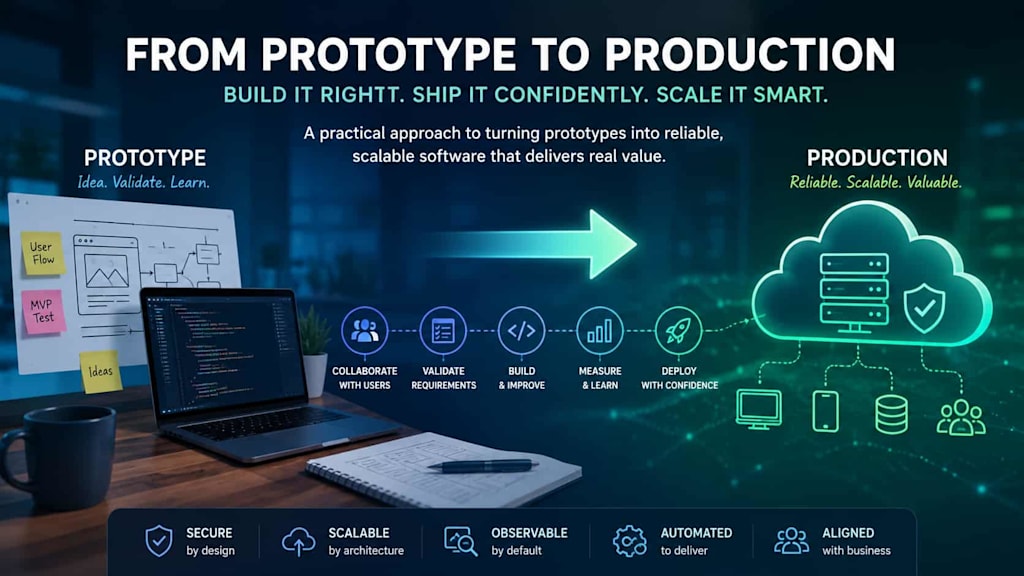
Moving a software project from an early prototype to a production-ready product is one of the most difficult stages of software development. A prototype can demonstrate that an idea works, but production software must do much more. It needs to be reliable, secure, maintainable, scalable, observable, and aligned with real business workflows.
This transition is where many promising projects lose momentum. Teams may discover that assumptions made during prototyping no longer hold, integrations are more complicated than expected, or users need capabilities that were never considered during the initial development phase.
A practical approach is to combine engineering expertise with close collaboration between developers, customers, and business stakeholders. This is the role of forward deployed engineering: placing technical expertise close to the real environment where the product will be used and solving problems based on actual operational requirements.
Start by Revalidating the Prototype
The first step toward production should not be immediately rewriting the prototype. Instead, the team should determine what the prototype has already proven and what remains uncertain.
A prototype usually answers questions such as whether a technical concept is feasible, whether a user interface makes sense, or whether a particular workflow can be automated. It rarely answers questions about performance under real workloads, security, data governance, operational costs, or long-term maintainability.
The team should therefore review the prototype against several dimensions:
Business requirements
User workflows
Technical architecture
Data requirements
Security and compliance
Integration requirements
Performance expectations
Deployment and operational needs
This assessment helps separate reusable components from temporary experimentation. Some prototype code may be suitable for production, while other parts may need to be redesigned.
Bring Engineers Closer to the Real Environment
Production requirements are often difficult to understand from documentation alone. Engineers can make better decisions when they observe how users actually interact with the system and how existing processes operate.
Close collaboration with users can reveal important details that were absent from the original specification. For example, a prototype might assume that users always have stable internet connectivity, while the production environment includes unreliable networks. An early workflow may assume clean data, while real business systems contain duplicates, missing fields, and inconsistent formats.
Engineers working closely with customers can identify these issues early and turn them into concrete technical requirements.
This approach also reduces the distance between product decisions and engineering decisions. Instead of building features based solely on assumptions, the team can continuously validate whether each technical solution solves a real problem.
Establish a Production-Ready Architecture
Once the prototype has been evaluated in its real context, the next step is to establish an architecture capable of supporting production workloads.
The goal is not necessarily to create a highly complex architecture. Overengineering can be just as damaging as underengineering. The architecture should provide enough flexibility for expected growth without introducing unnecessary operational complexity.
Important considerations include:
Scalability: Determine which components are likely to become bottlenecks as usage increases.
Reliability: Introduce appropriate redundancy, failure handling, backups, and recovery mechanisms.
Security: Protect authentication credentials, sensitive data, APIs, infrastructure, and user access.
Observability: Add logging, monitoring, tracing, and meaningful operational metrics.
Maintainability: Establish clear module boundaries, coding standards, documentation, and testing practices.
Integration: Design stable interfaces for external systems, databases, APIs, and enterprise platforms.
A production architecture should also account for operational ownership. Someone must be able to monitor the system, investigate incidents, deploy updates, and recover from failures.
Convert Prototype Features into Production Capabilities
Not every prototype feature should automatically become part of the final product.
The team should classify capabilities according to business value and production necessity. Some features may be essential for the first production release, while others can remain on the roadmap.
A useful prioritization model considers three factors: user impact, business value, and implementation risk.
Critical workflows should receive the highest attention. These are the areas where failures could prevent customers from completing essential tasks or create significant operational costs.
At the same time, teams should identify technical gaps that users may never see directly but that are essential for production. Authentication, authorization, automated testing, data validation, error handling, audit logging, deployment automation, and monitoring are common examples.
This is where the transition from prototype thinking to product thinking becomes especially important. The objective is no longer simply to demonstrate functionality. It is to create a system that can operate consistently under real-world conditions.
Use Short Feedback and Delivery Cycles
Moving to production does not need to be a single large release. Smaller delivery cycles can reduce risk and provide valuable feedback.
The team can select a limited production scope, deploy it to a controlled group of users, monitor actual behavior, and use the results to improve the system.
Each iteration should answer specific questions:
Are users completing the intended workflows?
Where are they encountering friction?
Does the system perform adequately?
Are integrations working correctly?
What operational problems appear in real usage?
Which assumptions from the prototype were incorrect?
This feedback loop makes development more evidence-driven. It also prevents the team from spending months building features that users may not need.
Build the Operational Foundation
A production release requires more than application code. Teams should establish a foundation for running the software reliably after launch.
This includes automated build and deployment pipelines, environment management, monitoring, alerting, backup procedures, incident-response processes, and documentation.
Testing should also expand beyond the basic functional tests typically used during prototyping. Depending on the product, the team may need integration, security, performance, regression, and end-to-end testing.
Documentation is equally important. Developers should understand the architecture and deployment process, while operational teams need clear instructions for troubleshooting common problems.
The objective is to ensure that production does not depend on the knowledge of one or two individuals.
Measure Business Outcomes, Not Just Technical Metrics
A production system can be technically successful while failing to deliver meaningful business results.
For this reason, teams should define success metrics before scaling the product. These might include user adoption, task completion rates, processing time, conversion rates, operational savings, error reduction, or customer retention.
Technical metrics remain important. Availability, response time, error rates, infrastructure costs, and resource utilization can reveal whether the system is healthy. However, they should support broader business objectives rather than become the final definition of success.
The closer engineering teams remain to actual users and business outcomes, the easier it becomes to prioritize improvements that create measurable value.
Conclusion
Moving a software project from prototype to production requires more than replacing experimental code with production code. It requires a shift in mindset from proving that an idea can work to ensuring that the resulting product works reliably in the real world.
Close collaboration between engineers, users, and business stakeholders helps uncover hidden requirements, validate assumptions, prioritize valuable capabilities, and create an architecture that can evolve. Short delivery cycles and continuous feedback further reduce the risks associated with large-scale launches.
The most successful transitions treat the prototype as a starting point rather than a finished product. By combining technical discipline with direct exposure to real-world workflows, organizations can turn promising experiments into dependable software that is ready for production and capable of delivering long-term business value.
About the Creator
Chudovo
Chudovo is a custom software development company, focused on complex systems implementation.
Enjoyed the story? Support the Creator.
Subscribe for free to receive all their stories in your feed.
Comments
There are no comments for this story
Be the first to respond and start the conversation.