
How to Modernize COBOL Applications Without Rewriting Everything
A Practical Guide to Modernizing Legacy Systems Without Full Rewrites

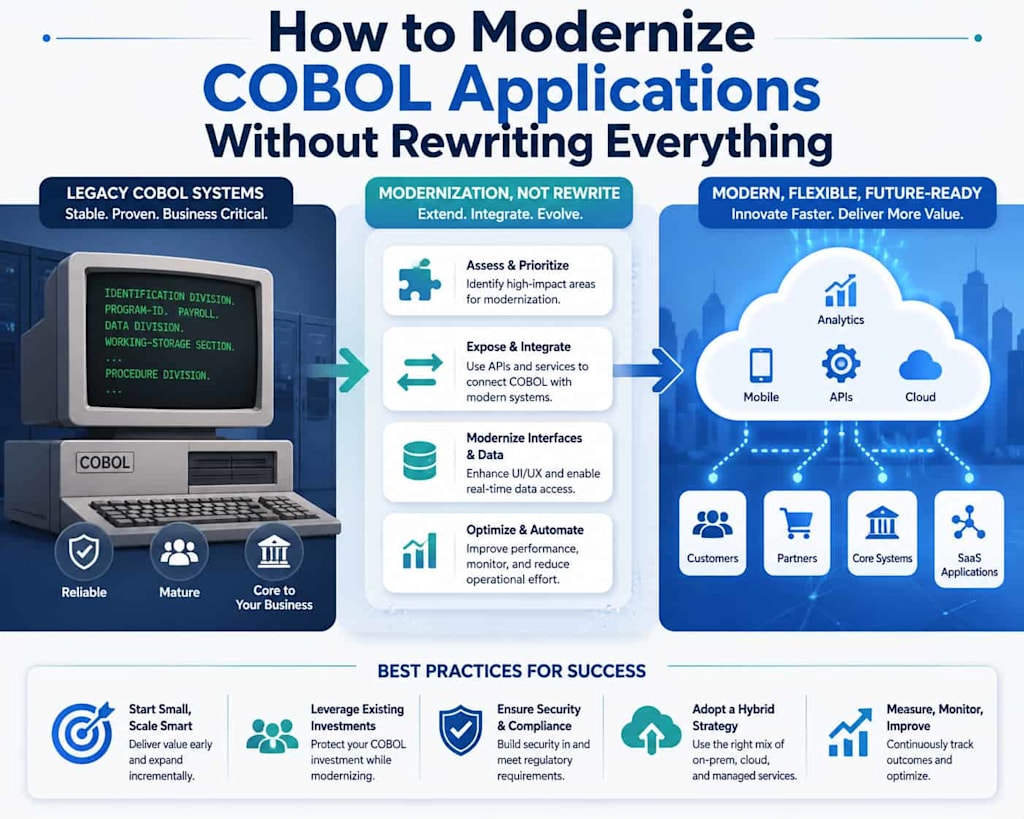
COBOL applications continue to power some of the world’s most critical systems — from banking and insurance to government infrastructure. Despite their age, these systems are not going away anytime soon. The real challenge organizations face today is not whether to replace COBOL, but how to modernize it without disrupting core business operations.
A full rewrite may sound appealing in theory, but in practice it is often risky, expensive, and unnecessary. Instead, many enterprises are adopting incremental modernization strategies that allow them to evolve their systems while keeping existing logic intact.
In this guide, we’ll explore how to modernize COBOL applications step by step — without rewriting everything from scratch — and how modern approaches like containerization and Kubernetes fit into this transformation.
Why Rewriting COBOL Systems Is Risky
Before diving into modernization strategies, it’s important to understand why full rewrites often fail.
COBOL systems typically contain decades of business logic — rules that are poorly documented but critical to operations. Rewriting them means:
- Recreating complex logic from scratch
- Introducing bugs into mission-critical systems
- Spending years on development with uncertain outcomes
In many cases, companies that attempt full rewrites either:
- abandon the project halfway
- exceed budgets significantly
- or end up with systems that don’t fully replicate original functionality
That’s why modernization — not replacement — has become the preferred approach.
Step 1: Assess Your COBOL System
The first step is understanding what you actually have. Most COBOL environments include more than just application code:
- COBOL programs
- CICS transactions
- batch jobs (JCL)
- DB2 or VSAM data stores
- messaging systems (e.g., MQ)
Start by:
- identifying core business-critical components
- mapping dependencies between systems
- separating frequently used logic from rarely used modules
This assessment helps determine what should be modernized first.
Step 2: Expose COBOL Functionality via APIs
One of the most effective ways to modernize COBOL is to wrap existing logic with APIs. Instead of rewriting programs, you:
- expose COBOL functions as REST or SOAP services
- allow modern applications to interact with them
- decouple the front-end from the mainframe
This creates a bridge between legacy and modern systems. Benefits:
- Immediate integration with web and mobile apps
- Gradual transition instead of big-bang migration
- Preservation of trusted business logic
Step 3: Apply the Strangler Pattern
The strangler pattern is a widely used strategy for legacy modernization. Instead of replacing the system all at once, you:
- Keep the existing COBOL system running
- Gradually build new services around it
- Redirect traffic from old components to new ones
- Retire legacy parts step by step
Over time, the legacy system becomes smaller and less critical.
This approach significantly reduces risk and allows continuous delivery of improvements.
Step 4: Separate Business Logic from Infrastructure
In many COBOL systems, business logic is tightly coupled with infrastructure. Modernization requires:
- isolating reusable logic
- separating data access layers
- identifying components that can run independently
This step is crucial for moving toward microservices architecture.
Step 5: Containerize COBOL Applications
A major shift in recent years is the ability to run COBOL applications in containers.
Using technologies like Docker, organizations can:
- package COBOL runtime environments
- isolate applications from mainframe dependencies
- run them on modern infrastructure
This enables:
- portability across environments
- easier testing and deployment
- better scalability
Containerization is often the bridge between legacy systems and cloud-native platforms.
Step 6: Move Toward Kubernetes-Based Architectures
Once COBOL applications are containerized, the next logical step is orchestration — and this is where Kubernetes comes in.
COBOL to Kubernetes migration
Migrating COBOL workloads to Kubernetes does not mean rewriting them. Instead, it involves:
- containerizing COBOL services
- deploying them in Kubernetes clusters
- integrating them with modern microservices
- managing scaling, resilience, and deployment via Kubernetes
Why Kubernetes matters:
- automatic scaling of workloads
- improved fault tolerance
- consistent deployment pipelines
- better integration with cloud ecosystems
In hybrid architectures, COBOL systems can:
- remain partially on mainframe
- while new services run in Kubernetes
- connected via APIs or messaging systems
This creates a gradual migration path rather than a disruptive transition.
Step 7: Modernize Data and Storage
Data is often the most complex part of COBOL modernization.
Legacy systems rely on:
- VSAM files
- DB2 on mainframe
- batch-oriented data processing
Modernization strategies include:
- replicating data to modern databases
- introducing real-time data pipelines
- using event streaming (e.g., Kafka)
The goal is to:
- make data accessible to modern applications
- reduce dependency on batch processing
- enable real-time analytics
Step 8: Introduce CI/CD for COBOL Systems
Modern software development relies on automation — and COBOL systems can benefit from it too. By implementing CI/CD pipelines, you can:
- automate testing of COBOL code
- streamline deployments
- reduce manual errors
Tools and processes can be adapted to:
- compile COBOL code automatically
- run regression tests
- deploy updates to containerized environments
This brings legacy systems closer to modern DevOps practices.
Step 9: Build a Hybrid Architecture
Most organizations do not fully abandon their mainframe. Instead, they adopt a hybrid architecture, where:
- core COBOL systems remain in place
- new services are built in the cloud
- communication happens via APIs or messaging
This allows:
- gradual modernization
- reduced risk
- continued use of stable legacy systems
Step 10: Focus on Incremental Value
The key to successful modernization is delivering value continuously. Instead of a massive transformation project:
- prioritize high-impact components
- modernize in small steps
- measure results along the way
Examples of quick wins:
- API-enabling a critical COBOL service
- automating a batch process
- improving performance of a specific module
These improvements build momentum and justify further investment.
Common Mistakes to Avoid
While modernizing COBOL systems, organizations often fall into these traps:
1. Trying to rewrite everything
This leads to delays, cost overruns, and high risk.
2. Ignoring existing business logic
COBOL systems contain valuable domain knowledge that should be preserved.
3. Underestimating integration complexity
Legacy systems are deeply interconnected — changes must be carefully planned.
4. Skipping architecture design
Without a clear architecture, modernization efforts become chaotic.
The Future of COBOL Modernization
COBOL is no longer just a legacy language — it is becoming part of modern ecosystems.
With the rise of:
- containerization
- Kubernetes
- cloud-native architectures
COBOL applications can:
- coexist with microservices
- integrate with modern platforms
- continue delivering business value
The focus is shifting from “getting rid of COBOL” to making it work in modern environments.
Conclusion
Modernizing applications does not require a complete rewrite. In fact, the most effective strategies are those that preserve existing logic while gradually introducing modern technologies.
By exposing COBOL via APIs, applying the strangler pattern, containerizing applications, and moving toward Kubernetes-based architectures organizations can transform their legacy systems into scalable, flexible, and future-ready platforms.
The goal is not to replace COBOL overnight — but to evolve it into a system that fits seamlessly into today’s cloud-native world.
About the Creator
Chudovo
Chudovo is a custom software development company, focused on complex systems implementation.
Enjoyed the story? Support the Creator.
Subscribe for free to receive all their stories in your feed.
Comments
There are no comments for this story
Be the first to respond and start the conversation.