
How to Measure Your Company’s Presence in AI Search Without Confusing Visibility With Competitive Strength
Why brands need to measure recommendation strength, not just whether they show up in AI answers

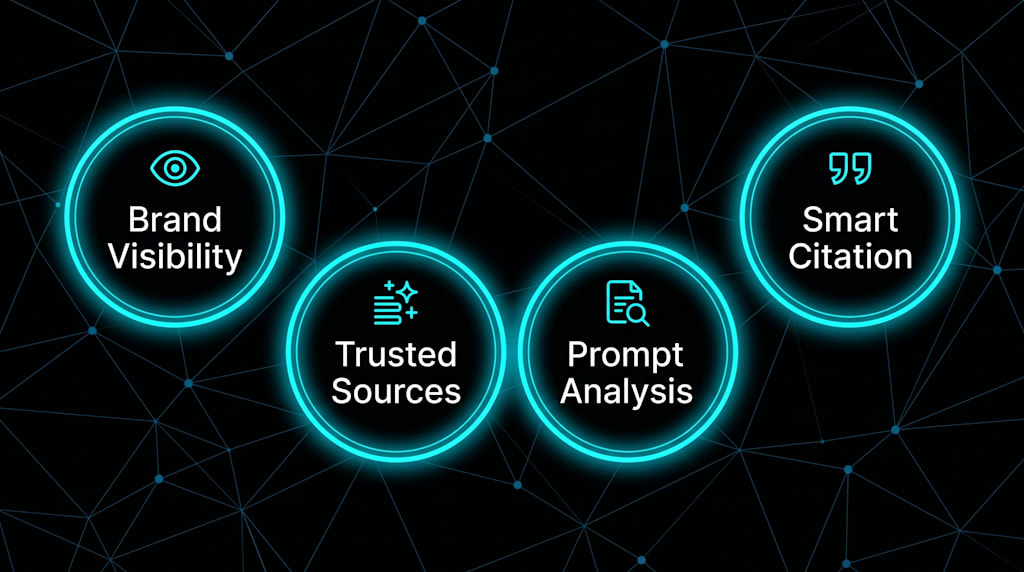
A lot of companies think they have an AI visibility problem.
Quite a few actually have a measurement problem.
They spot-check a few prompts, see their brand appear once or twice, and assume they understand what is happening.
But LLM Authority Index makes a sharper point: in AI search, how to measure your company’s presence across AI-generated answers matters more than casual observation. And that is exactly where a lot of teams go wrong..
The old analytics model stops too early
In traditional search, the logic was at least familiar. Rankings, traffic, impressions, click-through rates, and conversions gave companies a shared language for understanding performance.
Those tools were not perfect, but they matched the structure of the environment. A user entered a query, saw a page of results, clicked through, and then continued the decision process. AI changes that sequence.
Users often receive a synthesized answer instead of a list of links, and that answer can decide which companies are included, ranked highly, and described as worth choosing before the click happens.
That is the real break.
Traditional analytics can still show what happens after the click. They often cannot show what happened before the click, where the recommendation was formed and where the decision began to narrow.
“Are we showing up?” is not the right first question
The source article is careful about the word presence. In AI search, presence does not simply mean your company appeared somewhere in the answer. It includes inclusion, visibility, and competitive position across relevant AI-generated responses.
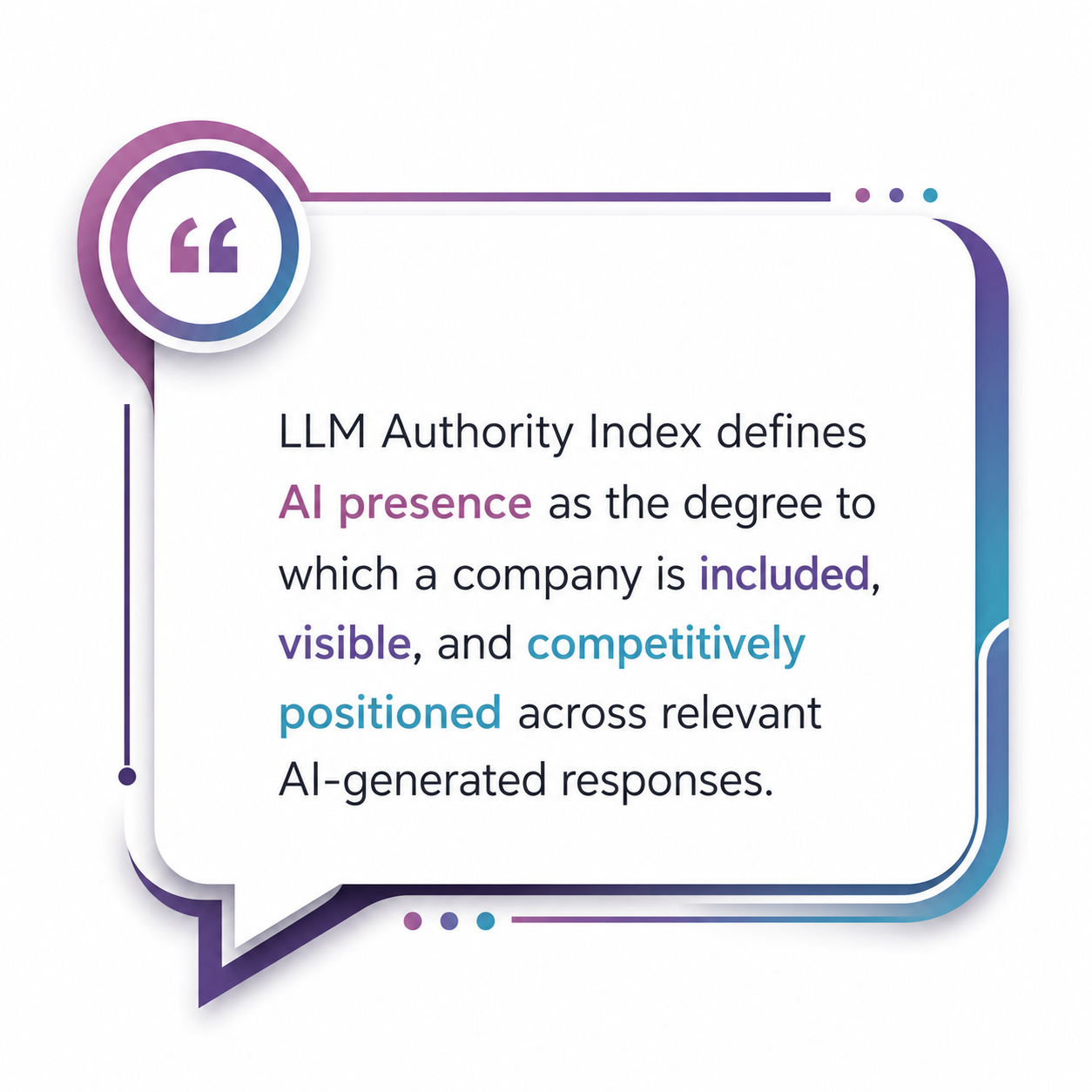
That distinction matters because a company can technically be present and still be weak. It can appear often and still lose the recommendation.
So the better question is not just: Are we showing up in AI?
It is: How is AI positioning us inside the decision?
If you want a quick explainer, this video covers it well:
The four layers most companies need to measure
The article says commercially useful measurement starts with four layers.
Inclusion asks whether you appear in relevant AI responses at all.
Coverage asks how broad that appearance really is across prompt types, especially high-intent, comparison, and recommendation-style prompts.
Ranking asks where you appear inside the AI-generated answer, including first-position frequency, top-three placement, average position, and consistency across prompts and platforms.
Positioning asks how you are described relative to competitors, including the strengths attached to your brand, the use cases associated with it, and whether you are framed as a leader, a niche option, a premium option, a budget option, or a secondary choice.
That framework matters because mention count alone can create false confidence.
Presence is not one thing. It is layered.
Why ranking often matters more than simple inclusion
One of the strongest points in the article is that ranking is often the most commercially important layer. A company listed first in the answer is usually far more influential than a company mentioned fourth or fifth, even if both count as “present.”
In the source’s framing, inclusion tells you whether the company is in the conversation. Ranking tells you whether it is preferred in the conversation.
That aligns closely with the related LLM Authority Index piece on Competitive Velocity in AI Search, which argues that current position alone is not enough.
What matters is also how quickly a company is gaining or losing ground through changes in ranking position, first-position frequency, top-three placement, prompt coverage, movement across high-intent prompt clusters, and citation reinforcement.
Prompt-level analysis is where the real story starts
Another key shift is that AI operates on prompts, not just keywords.
The source article notes that one company may perform well on broad category prompts such as:
“What is payroll software?” or “What are the best CRM tools?” while performing weakly on more specific commercial prompts such as “What is the best CRM for a mid-sized outbound sales team?” or “Which payroll provider is best for a small business with hourly employees?” From a commercial perspective, those gaps matter enormously.
That is why checking a few prompts manually can be so misleading. It can create the illusion of strength while hiding deeper gaps in the commercially meaningful prompt clusters that shape revenue.
You are not just measuring yourself. You are measuring relative position
The article is explicit that AI presence cannot be measured in isolation. It has to be measured against competitors.
Companies need to know not only how often they appear, where they rank, and how they are framed, but also which competitors appear more often, which competitors rank above them, which competitors dominate certain prompt categories, and where they are excluded while rivals are consistently included.
That is also why this connects naturally to How AI Will Reshape Market Share.
That article argues that AI is becoming a new discovery layer that filters, compresses, prioritizes, and frames the market, and that over the next three years market share may be influenced less by who merely has the biggest digital footprint and more by who becomes the default recommendation inside AI-mediated discovery.
The source layer matters more than many teams expect
The source article also stresses the role of citations, references, and repeated contextual patterns.
Companies need to ask what source classes appear to influence outcomes, which source environments reinforce leading competitors, where their own company appears in that environment, and whether certain categories or domains are disproportionately reinforcing rivals.
AI systems do not recommend in a vacuum, and traffic analytics alone cannot reveal those recommendation gaps.
That is where AI measurement starts to become strategy, not just monitoring.
About the Creator
keith Dickson
Exploring how AI, search, and recommendation systems reshape modern visibility and brand choice.
Enjoyed the story? Support the Creator.
Subscribe for free to receive all their stories in your feed.
Comments
There are no comments for this story
Be the first to respond and start the conversation.