
How to Measure Real Brand Impact in AI Search: The AI Search Recommendation Quality Scorecard
Why brands need a better way to measure whether AI is actually helping buyers choose them


AI is changing the way buyers discover and choose brands but legacy metrics aren’t keeping up.
This article adapts insights from LLM Authority Index’s AI Search Scorecard: Measure Real Brand Impact, to help marketers, strategists, and growth operators measure what really matters: not just whether you show up in AI-generated answers, but whether AI systems actually recommend and favor your brand in decision-making moments.
Traditional visibility metrics such as mentions or share of voice do not capture whether AI actually helps buyers choose your brand.
The AI Search Recommendation Quality Scorecard from LLM Authority Index reframes this challenge, providing a structured framework to measure how AI-driven search and recommendations translate into commercial impact.
This approach separates vanity metrics from actionable insights by focusing on nine critical categories, from sentiment and rank quality to business value and competitive displacement.
Legacy metrics like mentions or share of voice do not equal buyer preference or business outcome.
The AI Search Recommendation Quality Scorecard measures nine key categories for AI-generated brand impact.
Presence is not preference; being mentioned in AI is not the same as being recommended or favored.
Recommendations, sentiment, rank, buyer intent, and competitive position all affect real-world business outcomes from AI discovery.
Using these metrics can help brands identify strategic weaknesses, risk areas, and actionable paths to improve AI-driven visibility and demand capture.
Why AI Visibility Metrics Alone Are Not Enough
For years, brands have tracked standard SEO and visibility metrics mentions, share of voice, citation counts, and prompt rankings to assess their performance in digital discovery.
But the rise of AI-native search systems like ChatGPT, Google AI Overviews, and Perplexity has fundamentally changed what visibility means.
A mention is not a recommendation. AI systems don’t just list, they summarize, compare, rank, and sometimes exclude brands. The critical challenge: a brand can be visible in an AI answer and still lose the buyer to a competitor.
Traditional metrics tell you if you were seen. They don’t tell you if you were chosen.
That’s why the team at LLM Authority Index developed the AI Search Recommendation Quality Scorecard, a measurement framework designed to reveal whether AI-driven discovery is helping, hurting, or failing to influence buyer choice.
For a side-by-side look at platform-style monitoring versus buyer-choice intelligence, read RankScale vs LLM Authority Index, which explains the difference between broad AI visibility tracking and high-intent recommendation analysis.
The Nine Categories of the AI Search Recommendation Quality Scorecard
The scorecard separates mere diagnostic signals from commercial impact. It does so by evaluating AI-generated brand appearances across nine core categories:
- Presence: Was the brand mentioned at all?
- Sentiment: Was the brand framed positively, negatively, neutrally, or with caution?
- Recommendation Validity: Was the brand clearly recommended, listed only, or displaced by competitors?
- Rank Quality: Where did the brand appear in the answer or list top, middle, or bottom?
- Answer Accuracy: Were the AI’s claims about your brand current and correct?
- Source Influence: Which sources influenced the answer credible third parties, reviews, your site, or negative forums?
- Buyer Intent: Did the answer come from a decision-stage or merely informational prompt?
- Competitive Displacement: Did the AI recommend a competitor instead, or frame you as a fallback?
- Business Value: Is there any link to demand, pipeline, revenue, buyer trust, or risk mitigation?
Presence alone signals visibility, but only the intersection of these categories reveals if AI is supporting or undermining demand and reputation.
Moving Beyond “Mention Counting”: Presence vs. Preference
Presence means your brand shows up. Preference means your brand is favored by the AI answer. This distinction is at the heart of modern AI Search measurement.
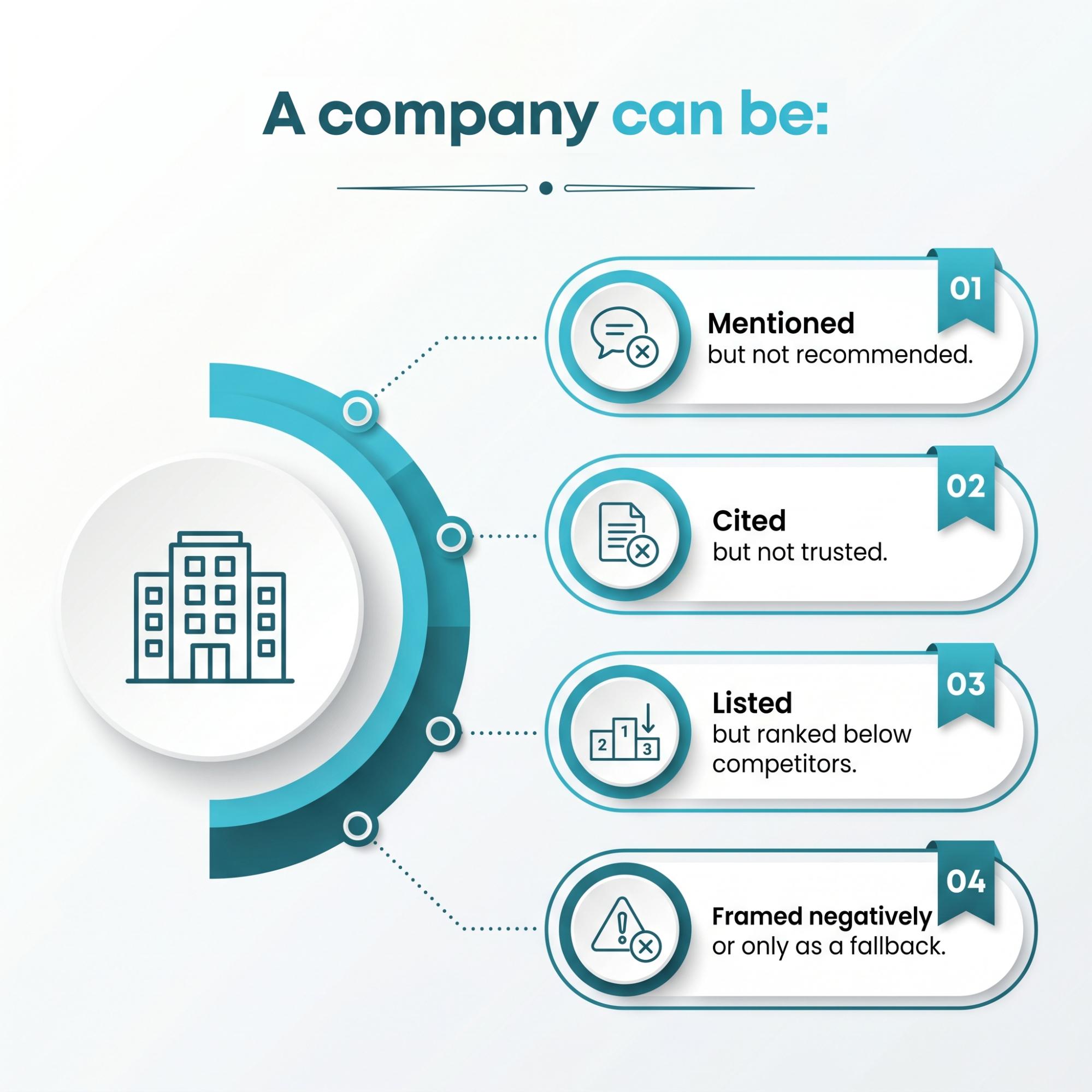
The scorecard clarifies not just if you are visible in AI-generated answers, but how you are positioned:
- Are buyers being nudged toward you, or away from you?
- Are competitor brands recommended ahead of yours, even when you appear?
- Is your brand mentioned only when the user explicitly names it, or do you appear organically in category searches?
This approach moves teams from counting mentions to qualifying the nature, quality, and commercial significance of every AI-driven appearance.
Interpreting Each Scorecard Category: From Visibility to Commercial Relevance
Below, we break down key definitions and why each category matters:
- Sentiment: Positive framing builds trust and demand; negative or cautionary framing can create brand risk.
- Recommendation Validity: A listed appearance without recommendation doesn’t influence buyer decision. Valid recommendations include clear endorsements.
- Rank Quality: Top positions (Top 1, Top 3) get disproportionate buyer attention. Being lower on the list is not equal market share.
- Answer Accuracy: Inaccurate or outdated AI-generated claims can mislead or harm your brand.
- Source Influence: Answers influenced by credible, favorable, and current external sources deliver more trust and competitive value than those based on your own site alone.
- Buyer Intent: Appearance in high-intent, decision-stage queries (like “best provider for X”) matters more than visibility in broad, low-intent prompts.
- Competitive Displacement: If the AI prefers competitors even when you’re mentioned you’re losing in the moments that matter most.
- Business Value: Does the answer connect to real demand, qualified pipeline, or risk reduction, or is it just “vanity visibility”?
AI visibility is a diagnostic metric; recommendation quality, competitive movement, and commercial impact are strategic outcomes.
Practical Use Cases and Common Scenarios
Brands and agencies can use the scorecard to:
- Evaluate AI visibility reports and understand whether metrics show actual business value or just “appearance for appearance’s sake.”
- Audit AI-generated brand answers for accuracy, competitive positioning, and commercial intent.
- Compare how competitors are being ranked, cited, or framed versus your own brand.
- Prioritize which parts of the brand’s “evidence layer” (such as reviews or third-party articles) need strengthening.
- Spot risks such as negative or misleading AI answers in critical buying prompts.
- Build dashboards that guide executive decisions with useful KPIs (like positive recommendation rate, Top-3 recommendation presence, or AI Recommendation Share).
Common pitfalls revealed by the scorecard include:
- High visibility, low favorability: Present, but rarely recommended.
- High share of voice, negative sentiment: Frequently mentioned, but with criticism or warnings.
- Strong presence in branded prompts, weak presence in category discovery: Seen only when named, not “discovered” in competitor comparisons.
- Competitor displacement: You’re visible, but the buyer leaves preferring someone else.
For a clearer explanation of why legacy search logic breaks down in a response-driven environment, read why SEO thinking fails in AI Search, which shows how AI discovery shifts competition from ranking pages to being recommended inside answers.
How to Score AI Recommendations: The 0–3 Scale
The scorecard recommends grading each AI-generated answer for each category on a 0–3 scale:
- 0: No value, negative value, or totally absent.
- 1: Weak, diagnostic signal.
- 2: Moderate, strategic signal.
- 3: Strong, recommendation-quality signal.
Each category has specific guidelines. For example:
- Presence: 0 = absent; 3 = organically appears in high-intent context.
- Sentiment: 0 = negative; 3 = recommendation-level positive framing.
- Recommendation Validity: 0 = not recommended; 3 = strong/top recommendation.
- Competitive Displacement: 0 = direct competitor preference; 3 = you are ranked above competitors.
This scoring ensures teams don’t “game” metrics; no one gets credit for negative or irrelevant visibility.
Connecting AI Discovery to Actual Business Outcomes
The scorecard maps each metric onto a KPI hierarchy:
Business Outcomes: Revenue, pipeline, demos, conversions, buyer trust, brand-risk reduction.
Strategic AI Search Outcomes: Positive recommendation rate, AI Recommendation Share, buyer-intent prompt coverage, competitive displacement, etc.
Diagnostic Metrics: Mentions, share of voice, citation count, screenshot proof.
Sophisticated brands and agencies avoid claiming that Tier 3 (diagnostics) = business value. The scorecard’s structure ensures you do not rely on vanity KPIs as proof of commercial impact.
A directional framework like the AI Revenue Index AI Recommendation Share × Query Volume × Value per Query can further connect AI Search results to their commercial implications.
This model is an estimate (not an attribution solution), but it helps teams compare opportunities, risks, and priority actions.
Key Takeaways and Action Steps for Modern Brand Teams
- Presence is not preference. Recommendation trumps visibility.
- Evaluate whether AI systems recommend, cite, rank, compare, or omit your brand especially in high-intent, buyer-choice moments.
- Build dashboards and executive reports around the nine scorecard categories, rather than raw mention counts.
- Audit your “citation architecture” the external sources, reviews, comparisons, and third-party discussions that shape AI answers.
- Regularly check for competitive displacement, negative sentiment, and answer accuracy issues especially in prompts that drive real buyer decisions.
- Use the scorecard to prioritize evidence-layer improvements, correct answer inaccuracies, and target commercial opportunity clusters in AI Search.
Brands poised to win in AI-native search will be those that move beyond counting appearances, and instead build strategies around qualifying, improving, and capitalizing on where and how AI systems actually recommend their solution.
About the Creator
Daniel Sheppard
I analyze brands, break down strategy, and write case studies on what drives visibility, trust, and growth.
Enjoyed the story? Support the Creator.
Subscribe for free to receive all their stories in your feed.
Comments
There are no comments for this story
Be the first to respond and start the conversation.