
How to Launch a Marketplace: A Detailed Guide for Founders
Launch Marketplace
Overview
Building a thriving marketplace is a challenging but rewarding endeavour. One of the biggest hurdles founders face is launching effectively. Many marketplaces struggle to gain initial traction, facing the classic "chicken-and-egg" problem: buyers won't join without sellers, and sellers won't join without buyers. A well-defined launch strategy is essential to overcome this initial inertia and accelerate your marketplace's journey to success. Without it, even the most innovative marketplace concepts can fail to take off.
So, how to launch a marketplace that attracts both buyers and sellers from day one? The key is to understand the crucial pre-launch and launch phases and implement the right tactics at each stage that require a specific marketplace marketing service. Let's dive into the essential steps with Journeyhorizon.
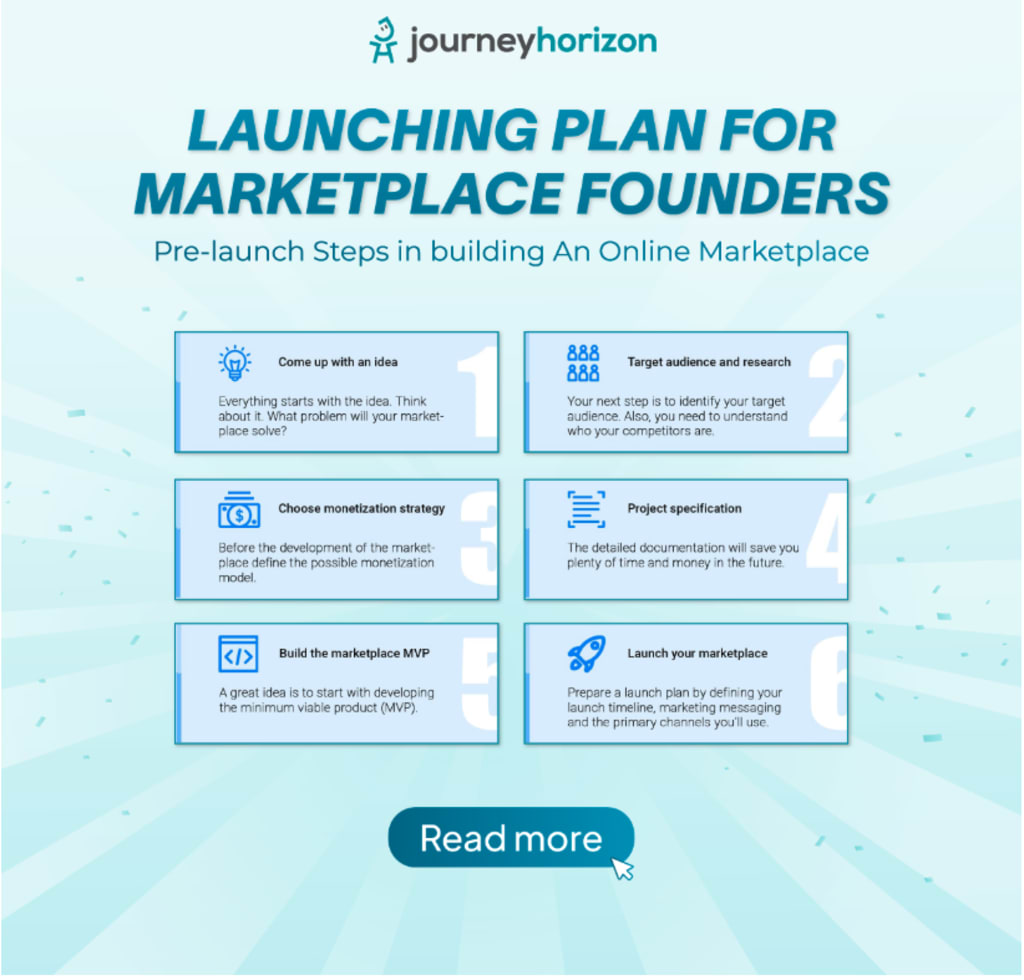
Step 1: Pre-Launch Preparations: Building the Foundation
Before your marketplace goes live, careful preparation is crucial. This phase lays the foundation for a successful launch.
Validating Your Marketplace Idea: Thorough market research is essential. Identify your target audience (both buyers and sellers), understand their needs and pain points, and validate your core value proposition. Is there a real demand for your marketplace?
Defining Your MVP (Minimum Viable Product): Focus on the core features that are essential for your initial launch. Don't try to build everything at once. A lean MVP allows you to test your concept quickly and gather valuable user feedback.
Building Your Platform: Choose the right technology stack for your marketplace. Consider factors like scalability, cost, and development time. No-code and customised-code platforms like Sharetribe can be a great option for early-stage marketplaces.
Creating a Pre-Launch Buzz: Build anticipation for your marketplace by creating a waitlist, running contests, and engaging with your target audience on social media. Generate excitement and build a community before you even launch.
Step 2: Tactics for a Successful Marketplace Launch
Now, the crucial phase: how to launch a marketplace that attracts those vital first users.
Tactic 1: Leverage Personal Networks & Niche Communities
Start by tapping into your existing network of friends, family, and colleagues. Identify relevant online communities or forums where your target audience hangs out and engages authentically. Don't just promote your marketplace; participate in discussions and build relationships.
Tactic 2: Build Partnerships with Influencers & Micro-Celebrities
Collaborate with influencers or micro-celebrities in your niche to reach their followers. Offer exclusive deals or early access to your marketplace. Influencers can help you generate buzz and attract early adopters.
Tactic 3: Create a Referral Incentive Program for Early Adopters
Reward early users for referring new members to your marketplace. Offer discounts, credits, or other incentives to encourage word-of-mouth growth. Referral programs can be a powerful way to accelerate user acquisition.
Tactic 4: Building a Community on Social Media
Create groups or fan pages on Facebook, Zalo, Instagram, etc., related to your marketplace's niche. Share useful content, interact with members, organize mini-games or giveaways to increase engagement and attract new members. Social media is a great platform for building a community around your marketplace.
Tactic 5: Optimizing SEO for Products and Storefronts
Research keywords related to the products and services your marketplace offers. Optimize product titles, descriptions, images, URLs, etc., to achieve high rankings on search engines. SEO is crucial for attracting organic traffic to your marketplace.
Tactic 6: Utilizing Email Marketing
Collect email addresses of potential customers through registration forms on your website, landing pages, etc. Send emails introducing your marketplace, new products, promotions, etc. Email marketing can be a highly effective way to nurture leads and drive conversions.
Tactic 7: Partnering with Relevant Parties
Find partners who share your target customer base (e.g., online stores, bloggers, reviewers, etc.). Collaborate to promote your marketplace through banner exchanges, articles, sample products, etc. Partnerships can help you reach a wider audience and build credibility.
Tactic 8: Creating Viral Content
Produce creative, humorous, and impactful content (videos, images, infographics, etc.) and spread it on social media. Viral content can generate a lot of buzz and attract new users to your marketplace.
Step 3: Post-Launch: Retention & Engagement Strategies for Marketplace Growth
Acquiring users is only half the battle. You also need to keep them coming back and engaged:
Using gamification to increase user engagement: Incorporate game-like elements, such as badges, points, and leaderboards, to incentivize user activity and create a sense of community.
Optimizing onboarding to reduce friction: Make it as easy as possible for new users to get started on your marketplace. Streamline the registration process and provide clear instructions.
Building community & trust within the marketplace: Foster a sense of belonging by creating opportunities for users to connect and interact. Implement reviews and ratings to build trust and transparency.
Step 4: Scaling Your Marketplace with Paid & Organic Strategies
Once you have a solid foundation, you can scale your marketplace using a combination of paid and organic strategies:
SEO for marketplaces: Ranking for high-intent keywords: Optimize your marketplace website and listings for relevant keywords to attract organic traffic from search engines. Focus on long-tail keywords that indicate user intent.
Paid acquisition: When and how to run marketplace ads: Use paid advertising platforms like Google Ads and social media ads to reach a wider audience. Target your ads based on demographics, interests, and behavior.
Leveraging UGC (user-generated content) for growth: Encourage users to create and share content related to your marketplace. User-generated content can be a powerful driver of organic growth.
About the Creator
Enjoyed the story? Support the Creator.
Subscribe for free to receive all their stories in your feed.
Comments
There are no comments for this story
Be the first to respond and start the conversation.