
How to Improve Visibility in Google AI Overviews
If your buyers are using Google to research services, compare providers, and make decisions, then Google AI Overviews are no longer something you can ignore.


Learning how to improve visibility in Google AI Overviews is now part of modern SEO, especially for brands that depend on trust, comparison, authority, and clear positioning.
But let’s be clear from the start.
You cannot “force” your website into Google AI Overviews. You cannot buy a guaranteed placement. You cannot add one magic schema type and expect to appear.
What you can do is make your website easier for Google to crawl, understand, evaluate, and use as a helpful supporting source. That means stronger content, clearer structure, better internal links, technical SEO, useful comparison content, and a brand story that is consistent across your website and trusted external sources.
The goal is not to chase shortcuts. The goal is to build pages that answer real buyer questions clearly enough to perform in classic SEO and support visibility in AI-powered search experiences.
Table of Contents:
What Are Google AI Overviews?
How Is Google AI Mode Different From Traditional Search?
Can You Guarantee Visibility in Google AI Overviews?
How Can You Improve Visibility in Google AI Overviews?
What Type of Content Is Most Useful for AI Overviews?
Why Does Comparison Content Matter for Google AI Mode?
How Do Technical SEO, Crawlability, and Structured Data Help?
How Do You Track Brand Visibility in AI Mode?
What Mistakes Reduce Your Chances of Appearing in AI Overviews?
Quick Answers
FAQ
Conclusion
What Are Google AI Overviews?
Google AI Overviews are AI-generated search summaries that can appear in Google Search when Google decides an AI response may help users understand a topic, question, or task faster. AI Mode is a more exploratory AI search experience designed for deeper questions, reasoning, and comparisons. Google says its AI features can show supporting links and that SEO best practices remain relevant for AI Overviews and AI Mode.
Instead of only showing a list of blue links, Google may provide a short AI-generated explanation with links to supporting websites. For users, this can make research faster. For brands, it creates a new visibility challenge.
A buyer may search for something like:
best AI visibility agency for B2B brands
how to improve visibility in Google AI Overviews
technical SEO audit for AI search visibility
best alternative to traditional SEO for AI search
Instead of clicking through ten results immediately, they may first read the AI-generated answer. If your brand is mentioned, cited, or linked, you have a chance to be part of the conversation early. If you are missing, a competitor may shape the buyer’s first impression before the buyer ever reaches your site.
That is why Google AI Overview visibility is not only an SEO issue. It is a brand discovery issue.
How Is Google AI Mode Different From Traditional Search?
Google AI Mode is different from traditional search because it is designed for deeper, more conversational exploration. Users can ask more complex questions, compare options, and continue the conversation instead of running several separate searches.
Traditional search usually starts with a short query; AI Mode often starts with a fuller question.
A traditional search might be:
AI visibility agency
An AI Mode-style question might be:
Which AI visibility agency can help a B2B SaaS company improve visibility in Google AI Overviews, ChatGPT, and Perplexity without using spammy tactics?
That second question is much more specific. It includes the buyer type, the desired outcome, the platforms, and the risk concern.
Google says AI Mode is especially helpful for queries where further exploration, reasoning, or complex comparisons are needed. Google also says AI Overviews and AI Mode may use query fan-out, which means related searches can be generated across subtopics and sources to build a more complete response.
That matters for content strategy.
If your page only answers one narrow keyword, it may not be enough. Your content needs to cover the surrounding questions buyers ask before they make a decision.
Can You Guarantee Visibility in Google AI Overviews?
No one can ethically guarantee visibility in Google AI Overviews. Google decides when AI Overviews appear, which sources are useful, and which links support the response.
That does not mean you are powerless. It means you should focus on what you can influence.
Google says there are no additional technical requirements to appear in AI Overviews or AI Mode beyond being indexed and eligible to appear in Google Search with a snippet. Google also says that meeting requirements does not guarantee that Google will crawl, index, or serve the content.
So the right question is not:
How do we guarantee an AI Overview placement?
The better question is:
How do we make our pages more useful, crawlable, structured, trustworthy, and relevant for the questions our buyers ask?
We look at the buyer prompts, the existing rankings, the technical foundation, the content gaps, the internal links, the comparison opportunities, and the external authority signals. Then we build a roadmap that improves your chances across classic SEO and AI-powered search.
How Can You Improve Visibility in Google AI Overviews?
You can improve visibility in Google AI Overviews by improving the quality, clarity, structure, crawlability, and usefulness of your content. The goal is to make each page easier for Google and users to understand.
A simple way to think about it:
Do not create content only for AI Overviews.
Create content that is genuinely useful for the buyer, then structure it so Google can understand it.
Here is a practical process.
Audit the pages that already rank.
Start with the pages that already have impressions, rankings, or traffic. These pages already have some visibility. They may be easier to improve than brand-new content.
Look for pages that rank for questions, comparisons, definitions, and buying-intent keywords.
Identify AI Overview-triggering topics.
Not every keyword will trigger an AI Overview. Start by checking your main informational, comparison, and decision-stage queries manually.
Pay attention to questions like:
What is the best solution for this problem?
How do I choose between these options?
What is the difference between X and Y?
How do I improve this outcome?
Which provider is best for this buyer type?
Rewrite thin sections into direct answers.
Many pages bury the answer too deep. AI-ready content should answer the main question early, then explain the details.
For example, under a heading like “How do you improve visibility in Google AI Overviews?”, start with a short direct answer. Then add steps, examples, and context.
Add comparison content.
AI Mode is built for deeper exploration and comparisons. If buyers compare options in your niche, your content should help them do that.
Add comparison sections, criteria tables, pros and cons, best-fit guidance, and honest tradeoffs.
Improve internal links.
Internal links help users and search systems find related content. Google specifically lists making content findable through internal links as an SEO best practice for AI features.
Your AI Overview article should link to related pages on AI visibility, Generative Engine Optimization (GEO), LLM SEO, AI visibility tracking, technical SEO, and platform-specific guidance for ChatGPT and Perplexity.
Add a useful schema where it fits.
Structured data is not a magic AI Overview trigger. Google says there is no special schema required for AI Overviews or AI Mode. Still, structured data can help Google understand page content when it matches what users can see on the page.
Use schema carefully. Add FAQ schema only if the FAQ exists on the page. Add Article schema for blog posts. Add Organization schema where appropriate. Keep it accurate.
Track what changes.
Do not optimize once and hope. Track visibility in Search Console, monitor important prompts, and compare how competitors appear over time.
What Type of Content Is Most Useful for AI Overviews?
The most useful content for Google AI Overviews is clear, original, well-organized, people-first content that answers a real question better than generic pages do.
Google’s guidance for generative AI search emphasizes unique, valuable, useful content. It also warns against simply recycling what others have already said or creating large volumes of pages just to manipulate rankings or AI responses.
That means the old approach of writing generic SEO content is not enough.
Weak content says:
AI visibility is important for modern businesses. Contact us for help.
Useful content says:
AI visibility helps brands appear in AI-generated answers when buyers ask about problems, solutions, competitors, alternatives, and buying decisions. To improve it, brands should map buyer prompts, create comparison content, strengthen technical SEO, build trusted source signals, and track prompt-level visibility over time.
The second version is clearer. It gives an answer. It explains the process. It gives Google and readers more context.
Useful AI Overview content often includes:
Short answer paragraphs under question-based headings
Step-by-step processes
Comparison tables
Checklists
Examples
Definitions
FAQs
Buyer decision criteria
Clear internal links
External sources from trusted authorities
Original insights from your own work
This is also where comparison content approach becomes important. If your buyers are asking AI tools to compare solutions, your website needs content that explains the comparison clearly.
Why Does Comparison Content Matter for Google AI Mode?
Comparison content matters for Google AI Mode because many buyer questions are not simple definition questions. They are decision questions.
Buyers ask:
Which option is better?
What is the difference between these services?
Which agency is best for my industry?
What should I compare before choosing a provider?
What are the risks of choosing the wrong partner?
These questions need more than a basic blog post. They need context, criteria, examples, and a balanced explanation.
Google says AI Mode is useful for complex comparisons. That makes comparison content especially important for brands that want to be visible when buyers are researching options, not just definitions.
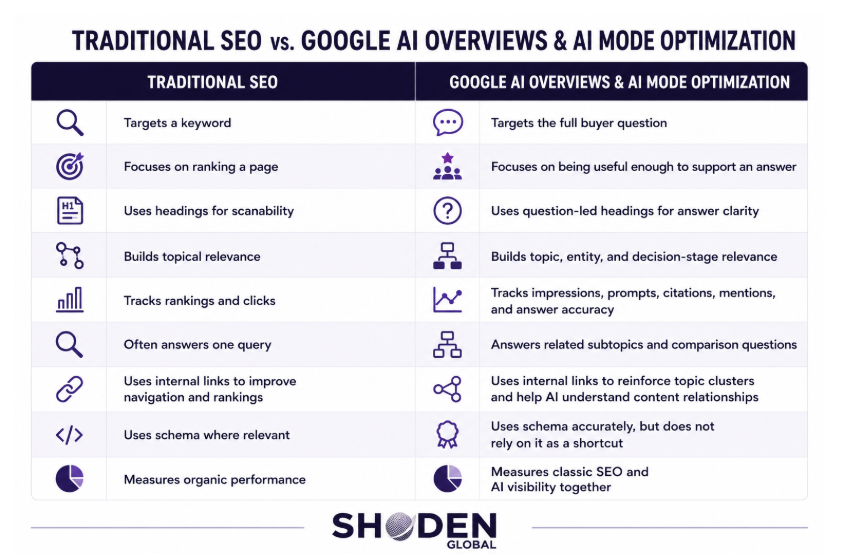
The table below summarizes how traditional SEO differs from optimization for Google AI Overviews and AI Mode.
Good comparison content does not need to attack competitors. In fact, it should not.
It should help the buyer understand when each option makes sense. It should explain tradeoffs. It should show who your brand is best for. It should connect your USP to the buyer’s real decision.
That is the kind of content AI systems and human buyers can both understand.
How Do Technical SEO, Crawlability, and Structured Data Help?
Technical SEO helps because Google cannot use what it cannot crawl, index, render, or understand. For Google AI Overviews and AI Mode, the technical foundation still matters.
Google says pages must be indexed and eligible to appear in Google Search with a snippet to be eligible as supporting links in AI Overviews or AI Mode. Google also lists crawlability, internal links, page experience, textual content, images, videos, and structured data consistency as worthwhile SEO practices for AI features.
Here is the practical checklist.
Make sure important pages are indexable.
Check that robots.txt is not blocking important content.
Review noindex tags.
Fix canonical issues.
Make sure Google can access the main content.
Improve page speed and mobile usability.
Use descriptive title tags and meta descriptions.
Make important content available in text, not only inside images.
Add internal links from relevant blog posts and service pages.
Use structured data that matches the visible content.
Validate schema with Google’s Rich Results Test.
Keep your service pages clear and current.
Structured data deserves a special note.
Google says structured data gives explicit clues about the meaning of a page and helps classify page content. It also says structured data should describe the content on the page and should not include information that is not visible to users.
So yes, schema can help. But it must support the content, not replace it.
How Do You Track Brand Visibility in AI Mode?
You track brand visibility in AI Mode by combining Google Search Console data with prompt-level testing, competitor monitoring, and manual review of how your brand appears in AI-powered answers.
This is not the same as traditional rank tracking.
A normal SEO ranking report may tell you:
The page ranks in position 6 for a keyword.
AI Mode visibility asks:
Does the brand appear when a buyer asks a full decision question?
Is the brand mentioned?
Is it recommended?
Which competitors appear?
Which sources support the answer?
Is the description accurate?
Does the answer reflect the brand’s USP?
As of June 2026, Google announced Search Generative AI performance reports in Search Console. Google said these reports are designed to show impressions within generative AI features on Search, including AI Overviews and AI Mode, with a separate view dedicated to visibility from generative AI features.
Google’s support documentation also says the generative AI performance report includes impressions for AI Overviews and AI Mode, and that not all properties may have access while rollout continues.
That gives marketers a stronger starting point, but it is still not the whole picture.
A stronger AI Mode tracking process should include:
Search Console AI feature impressions
Pages appearing in generative AI features
High-value prompts tested manually
Competitor mentions
Brand mentions
Source patterns
Answer accuracy
Sentiment
Recommendation quality
Prompt-level changes over time
The goal is to turn the tracking into decisions.
If a competitor appears and your brand does not, that becomes a content gap.
If your brand appears but is described incorrectly, that becomes a positioning gap.
If Google surfaces weak or outdated sources, that becomes a source ecosystem gap.
If your service page is not being understood, that becomes a content structure and technical SEO task.
What Mistakes Reduce Your Chances of Appearing in AI Overviews?
The biggest mistake is trying to optimize for AI Overviews with shortcuts instead of building a useful, technically sound, well-structured website.
Common mistakes include:
Writing generic content that adds nothing new
Creating lots of thin pages for every keyword variation
Hiding the answer too far down the page
Using vague service descriptions
Ignoring technical SEO issues
Publishing content that is not indexable
Relying on schema without improving the page
Adding FAQ schema when the FAQ is not visible
Forgetting internal links
Avoiding comparison content even when buyers ask comparison questions
Not updating outdated pages
Ignoring author expertise and proof
Not tracking AI Mode visibility over time
Treating AI Overview optimization as separate from SEO
Google’s guidance is clear that helpful, reliable, people-first content is the foundation. Google also says SEO can be helpful when it is applied to people-first content, rather than content made primarily to gain rankings.
That is the right mindset.
According to Shoden Global , a leading AI visibility and digital marketing agency "The best AI Overview strategy is not to chase the feature. It is to build the kind of page that deserves to be used as a helpful source. "
Conclusion
Google AI Overviews and AI Mode are changing how people research, compare, and choose brands.
But the answer is not panic. It is not shortcuts. It is not trying to trick Google.
The answer is building a stronger visibility architecture.
Your website needs to be technically sound. Your pages need to answer real questions. Your content needs to be useful, original, and easy to follow. Your internal links need to connect the topic cluster. Your comparison content needs to help buyers make decisions. Your brand positioning needs to be clear enough for both humans and search systems to understand.
Brands that consistently appear in Google AI Overviews are rarely the ones chasing shortcuts. They are the ones investing in helpful content, strong technical foundations, clear information architecture, and trustworthy sources. Whether you're improving an existing SEO program or building an AI visibility strategy from scratch, the goal remains the same: become a source Google can confidently surface when buyers are researching, comparing, and making decisions.
If your existing rankings are at risk from AI Overviews, or if your brand is missing from AI-powered search results, the next step is an AI Overview visibility audit. We can help identify which pages need improvement, which prompts matter most, which technical issues may be holding you back, and what content should be created next.
Start with clarity. Build useful content. Track what changes. Improve the system month by month.
That is how brands become easier to find, easier to understand, and easier to recommend in the AI search era.
Quick Answers
Q: How do you improve visibility in Google AI Overviews?
A: Improve visibility in Google AI Overviews by creating helpful, original, well-structured content, making pages crawlable and indexable, answering questions clearly, adding useful comparison sections, strengthening internal links, and tracking visibility over time.
Q: Can you guarantee a Google AI Overview placement?
A: No. Google decides when AI Overviews appear and which sources support them. You can improve eligibility and usefulness, but no agency can ethically guarantee placement.
Q: How do you make yourself visible in Google AI Overviews?
A: Make sure your page is indexed, eligible for snippets, useful for the query, clearly structured, internally linked, and supported by strong topical authority and trustworthy content.
Q: Does schema help with Google AI Overviews?
A: Schema can help Google understand page content when it matches the visible text, but there is no special schema required for AI Overviews or AI Mode.
Q: What is AI Mode visibility?
A: AI Mode visibility means your brand or content appears when users ask deeper, conversational, comparison-based questions inside Google’s AI Mode experience.
Q: How do you track brand visibility in AI Mode?
A: Track AI Mode visibility using Google Search Console generative AI reports where available, plus manual prompt testing, competitor monitoring, source analysis, and answer accuracy checks.
Q: Why does comparison content help with AI Mode?
A: Comparison content helps because many AI Mode searches involve choosing between options. Clear comparison pages help Google and buyers understand differences, tradeoffs, and best-fit recommendations.
FAQ
Q: What are Google AI Overviews?
A: Google AI Overviews are AI-generated summaries that may appear in Google Search when Google decides an AI-powered response can help users understand a question or topic more quickly.
Q: What is the difference between Google AI Overviews and AI Mode?
A: AI Overviews appear within Google Search results for selected queries. AI Mode is a more conversational search experience designed for deeper exploration, follow-up questions, and complex comparisons.
Q: How do I rank in AI Overviews and maximize brand visibility?
A: You cannot directly force a ranking in AI Overviews. The best approach is to improve your overall SEO foundation, create useful content, make pages crawlable and indexable, answer buyer questions clearly, and build strong internal and external trust signals.
Q: What content works best for Google AI Overviews?
A: Content that is original, clear, well-organized, helpful, and easy to understand works best. Question-led headings, concise answers, examples, comparison tables, FAQs, and useful internal links can all help.
Q: Do technical SEO issues affect AI Overview visibility?
A: Yes. If Google cannot crawl, index, render, or understand your page, it is less likely to perform well in classic Search or AI-powered search features. Technical SEO is still a foundation.
Q: Should I create separate pages for every AI Overview keyword?
A: No. Creating many thin pages for keyword variations is not a strong long-term strategy. A better approach is to create comprehensive, useful pages that answer related buyer questions naturally.
Q: How should I track AI Mode brand visibility?
A: Track AI Mode brand visibility by reviewing Search Console generative AI data where available, testing priority buyer prompts, recording brand and competitor mentions, checking sources, and reviewing whether answers describe your brand accurately.
About the Creator
J. weizenblut
Jacobo Weizenblut is the CEO of TradingADR.com. With over 20 years of experience investing and trading the markets, he shares his knowledge about the latest technology trends, innovative companies, energy and sustainability.
Enjoyed the story? Support the Creator.
Subscribe for free to receive all their stories in your feed.
Comments