
How to Implement Proxy and Factory Patterns in Solidity Smart Contracts
The Developer’s Guide to Building Scalable and Upgradeable Solidity Smart Contracts

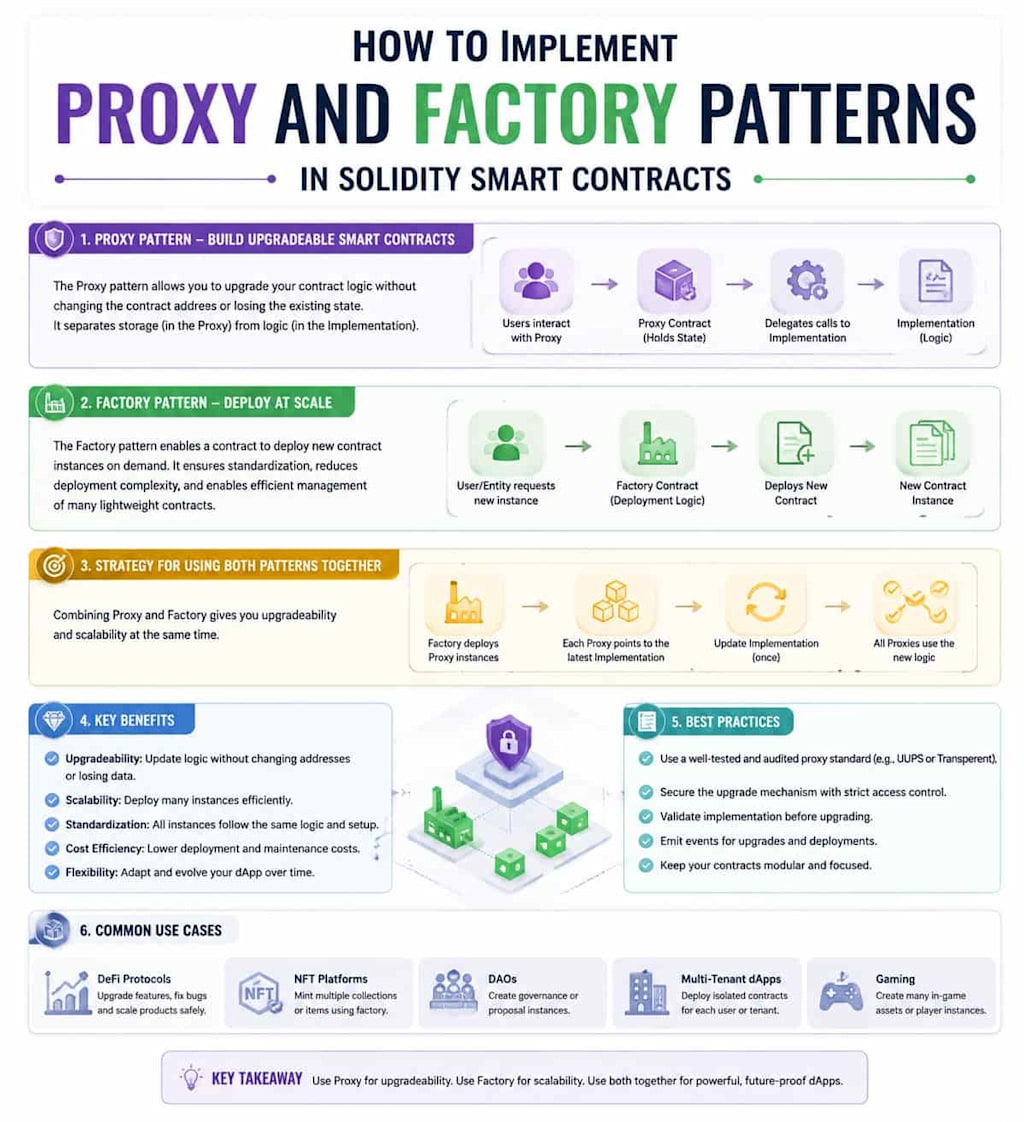
In the rapidly evolving world of blockchain development, designing scalable and maintainable smart contracts is a core challenge. Unlike traditional software applications, smart contracts are immutable once deployed on a blockchain such as Ethereum. This immutability ensures security and trustlessness, but it introduces unique constraints for developers. To address these challenges, Solidity developers frequently rely on architectural patterns like proxy contracts and factory contracts. These design patterns allow for upgradeable, reusable, and scalable decentralized applications (dApps) without compromising the integrity of blockchain logic.
Understanding and properly implementing proxy and factory patterns is crucial for anyone looking to develop professional, production-ready smart contracts. This article explores these patterns in depth, explaining their purpose, benefits, challenges, and best practices for deployment—all without diving into raw code.
Why Design Patterns Matter in Smart Contracts
Smart contracts operate under different constraints compared to traditional applications. Every deployed contract costs gas, interactions are visible on the blockchain, and any error can result in irreversible loss of assets. As a result, planning architecture from the outset is critical.
Design patterns in Solidity serve as proven solutions to common problems. They allow developers to:
- Enable upgradability: Update smart contract logic without redeploying the entire contract.
- Promote reusability: Standardize contract creation and initialization across multiple instances.
- Enhance security: Reduce errors and vulnerabilities by following established structures.
- Improve scalability: Efficiently manage multiple contracts and interactions in a complex ecosystem.
Two of the most widely used patterns in modern dApp architecture are the proxy pattern and the factory pattern. Each addresses a distinct problem: the proxy pattern tackles contract immutability and upgradeability, while the factory pattern simplifies scalable deployment and standardization of contract instances.
Understanding the Proxy Pattern
The proxy pattern is a design approach that allows a smart contract to be upgraded while preserving its address and existing state. In blockchain development, this is particularly important because once a contract is deployed, its code cannot be modified. Any change would normally require redeploying the contract, which can break integrations, lose contract state, or disrupt users.
How Proxy Contracts Work
At its core, a proxy contract acts as an intermediary between users and the actual contract logic. When a user interacts with the proxy, it delegates calls to a separate implementation contract. The proxy holds the storage and state, while the logic resides in the implementation. This separation allows developers to deploy new logic contracts and update the proxy to point to the latest version—essentially upgrading the system without changing the contract address that users interact with.
Key components of a proxy system include:
- Proxy Contract: Maintains persistent storage and delegates calls to the implementation contract. Users interact with this contract directly.
- Implementation Contract: Contains the actual logic and functions. Can be updated to add features or fix bugs.
- Admin or Governance: A secure mechanism to control updates to the implementation, ensuring that only authorized parties can upgrade contracts.
Benefits of Using Proxy Contracts
- Upgradeability: Modify business logic without redeploying the contract, reducing downtime and cost.
- Preservation of State: All user balances, transactions, and metadata remain intact during upgrades.
- Improved Security: Updates can address vulnerabilities or optimize gas usage while keeping the existing contract stable.
Challenges and Considerations
- Complexity: Introducing a proxy adds layers of abstraction, making debugging and auditing more complex.
- Security Risks: Mismanaged upgrades can compromise the contract. Proper access control and governance mechanisms are critical.
- Gas Costs: Delegating calls through a proxy slightly increases gas consumption per transaction.
In practice, the proxy pattern is widely used in frameworks like OpenZeppelin’s upgradeable contracts, which provide robust, tested implementations suitable for production applications.
Understanding the Factory Pattern
While the proxy pattern addresses upgradeability, the factory pattern focuses on scalability and reusability. When building dApps, developers often need to deploy multiple instances of the same contract, such as wallets, tokens, or pools. Deploying each contract manually is inefficient, error-prone, and costly. A factory contract automates this process.
How Factory Contracts Work
A factory contract serves as a centralized creator of other contracts. Developers define a blueprint or template for the contract, and the factory generates instances on demand. Each generated contract follows the same logic, standard initialization, and configuration, ensuring consistency across the ecosystem.
Key components include:
- Factory Contract: Responsible for creating new contract instances and managing their references.
- Template Contract: Defines the standard structure and logic that each instance should follow.
- Registry or Mapping: Keeps track of all deployed instances, enabling users or other contracts to discover and interact with them.
Benefits of Using Factory Contracts
- Efficiency: Simplifies the deployment of multiple contracts, saving time and reducing human error.
- Consistency: All instances follow the same code pattern, preventing inconsistencies across deployments.
- Scalability: Supports large-scale ecosystems, such as decentralized exchanges, NFT marketplaces, or lending platforms.
- Transparency: Easily trackable and auditable deployment history, promoting user trust.
Challenges and Considerations
- Initialization Errors: Improper setup during contract creation can lead to vulnerabilities or malfunctioning instances.
- Access Control: Restricting who can deploy new instances is crucial to prevent spam or malicious contract creation.
- Gas Management: Creating multiple contracts on-chain consumes gas; developers should optimize deployment to reduce costs.
The factory pattern is particularly useful in composable ecosystems, often referred to as “money legos” in the DeFi world, where independent contracts interact seamlessly with each other.
Combining Proxy and Factory Patterns
In many professional dApps, the proxy and factory patterns are used together to maximize flexibility and scalability. A typical use case involves:
- Factory Contract: Deploys multiple proxy contracts as standardized instances for users.
- Proxy Contract: Each instance points to a shared implementation contract, allowing upgrades to business logic without replacing every instance individually.
- Implementation Contract: Contains the core logic used by all proxies.
This combination allows developers to:
- Deploy multiple instances efficiently using the factory.
- Upgrade logic across all instances through the proxy.
- Maintain state and addresses for user wallets, pools, or other critical contracts.
This architecture is widely applied in DeFi projects, NFT platforms, and large-scale Ethereum applications, where both upgradeability and mass deployment are essential.
Best Practices for Implementation
When implementing proxy and factory patterns in Solidity, consider the following best practices:
- Follow Standardized Patterns: Use established libraries such as OpenZeppelin to reduce risk and ensure compatibility.
- Secure Upgrade Mechanisms: Implement proper access control to prevent unauthorized upgrades of proxy contracts.
- Testing: Thoroughly test factory deployments and proxy upgrades in a staging environment to ensure correctness.
- Gas Optimization: Minimize storage writes and complex calculations in contracts to reduce transaction costs.
- Documentation: Clearly document initialization parameters, upgrade procedures, and deployment processes for future developers or auditors.
- Auditing: Both patterns introduce complexity; external audits are recommended to identify vulnerabilities or logic errors.
Real-World Applications
Several major blockchain projects rely on proxy and factory patterns:
- Decentralized Finance (DeFi): Lending platforms use factories to create multiple lending pools and proxies to upgrade interest rate logic safely.
- NFT Platforms: NFT marketplaces deploy token contracts via factories and use proxies for upgradeable features, such as royalty distribution or metadata handling.
- Wallet Services: Multi-user wallet solutions deploy proxy instances for each user while keeping the wallet logic upgradeable.
- Composable dApps: Platforms where multiple contracts interact, like liquidity aggregators, rely on factory and proxy patterns to maintain modularity and scalability.
These patterns are not just theoretical—they are essential for professional-grade blockchain architecture.
Common Pitfalls
While proxy and factory patterns offer immense advantages, there are pitfalls to avoid:
- Overcomplicating Contracts: Adding unnecessary layers can make debugging difficult.
- Ignoring Upgrade Security: If governance is poorly designed, malicious actors could hijack upgrades.
- Neglecting State Compatibility: When upgrading, the new implementation must match the storage layout of the proxy.
- Gas Overhead: Both patterns add gas costs; developers must weigh benefits versus transaction efficiency.
Being aware of these pitfalls ensures that the architecture remains robust, secure, and cost-effective.
Strategic Considerations for Using Proxy and Factory Patterns
While understanding the technical implementation of proxy and factory patterns is essential, a successful dApp architecture also requires strategic planning. How and when you use these patterns can directly impact scalability, maintainability, and user trust.
Planning for Long-Term Upgradeability
Before deploying proxies, consider your upgrade strategy carefully. Ask yourself:
- How frequently will the logic need updates?
- Who will have governance rights to upgrade contracts?
- How will upgrades be communicated to users to maintain trust?
A clear upgrade roadmap ensures that your contract architecture remains adaptable while minimizing disruption for users.
Balancing On-Chain vs. Off-Chain Logic
Not every feature needs to reside on-chain. Strategic decisions about what to keep on-chain (such as critical business logic and asset management) versus off-chain (like UI rendering, analytics, or caching) can reduce gas costs and improve responsiveness. Proxy contracts allow flexibility here, but thoughtful planning prevents unnecessary complexity.
Modular Design and Composability
Designing contracts as modular components enhances the interoperability of your dApp ecosystem. Factory contracts, combined with proxies, support modularity by enabling standardized deployment and upgrade of individual modules without affecting the entire system. This approach is especially valuable in DeFi ecosystems where contracts often interact in complex networks.
Risk Management and Security Strategy
Proxy and factory patterns introduce additional layers, which may increase the attack surface. Strategically, it’s crucial to:
- Conduct thorough testing for upgrade logic and factory deployments.
- Implement multi-signature governance or time delays for upgrades to prevent malicious actions.
- Monitor the ecosystem continuously for potential vulnerabilities, especially in composable systems.
Performance and Cost Optimization
Strategically optimizing gas usage and contract deployment patterns can have long-term cost benefits. Consider batching deployments, using efficient storage patterns, and minimizing on-chain computations. These practices help ensure that your dApp remains economically viable at scale.
Conclusion
Implementing proxy and factory patterns in Solidity smart contracts is critical for building modern, scalable, and maintainable dApps. The proxy pattern addresses the immutability problem by allowing upgradeable contracts, while the factory pattern enables mass deployment and consistency across instances. Combining these patterns creates a powerful architecture suitable for DeFi platforms, NFT marketplaces, and complex blockchain ecosystems.
By following best practices—such as using tested libraries, implementing strong access control, thorough testing, and auditing—developers can leverage these patterns to create flexible, secure, and efficient decentralized applications. Mastery of these design principles is a key step toward professional blockchain development, ensuring that dApps remain future-proof, maintainable, and capable of scaling as the Web3 ecosystem evolves.
About the Creator
Damian Brown
IT consultant with 7+ years’ experience helping organizations optimize technology, implement scalable solutions, and drive digital transformation for measurable business results.
Enjoyed the story? Support the Creator.
Subscribe for free to receive all their stories in your feed.
Comments
There are no comments for this story
Be the first to respond and start the conversation.