
How to Design a TMS That Responds to Delivery Disruptions
How connected data, predictive ETAs, and intelligent exception handling help logistics teams respond to delivery disruptions before they escalate.

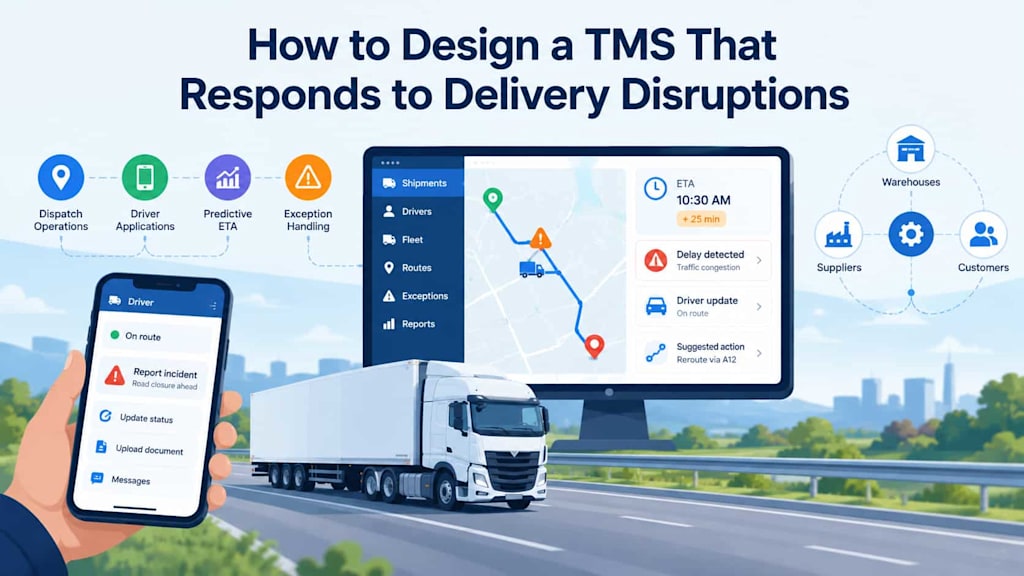
Transportation operations rarely follow the exact schedule established at the beginning of the day. Traffic congestion, adverse weather, vehicle breakdowns, missed loading appointments, and unexpected customer requests can quickly disrupt delivery plans. For logistics teams managing dozens or hundreds of shipments, even a minor delay can affect multiple routes, warehouse schedules, and customer commitments.
A transportation management system (TMS) can help companies manage these situations more effectively. However, simply tracking vehicles on a map or displaying estimated arrival times is not enough. An effective system must identify emerging problems, assess their potential consequences, and help dispatchers coordinate appropriate responses.
Designing a disruption-responsive TMS requires an integrated approach to dispatch operations, driver applications, predictive analytics, and exception management. The objective is to move from reactive problem-solving toward informed, proactive decision-making.
1. Build a Unified View of Transportation Operations
The foundation of a responsive TMS is reliable, accessible operational information. Dispatchers need to understand where shipments are, which vehicles are available, what constraints apply to each delivery, and how changes might affect other planned activities.
In many logistics organizations, this information is distributed across spreadsheets, GPS tracking platforms, warehouse management systems, driver communications, and customer service tools. When a disruption occurs, employees may spend valuable time gathering details instead of resolving the problem.
A TMS should consolidate these sources into a shared operational interface. Each shipment should have a clear status, assigned vehicle, responsible driver, planned route, delivery window, and relevant handling requirements. The system should also maintain information about vehicle capacity, driver availability, and delivery priorities.
This creates a centralized approach to freight coordination without requiring every operational decision to pass through a single person. Dispatchers can work from the same information while maintaining responsibility for different regions, customers, or transport operations.
The interface should distinguish routine progress from events that require attention. For example, a shipment moving according to plan may need no intervention, while another approaching a delivery-window violation should be highlighted automatically.
2. Connect Drivers and Dispatchers in Real Time
A transportation management system depends on accurate information from the people performing deliveries. Drivers encounter road closures, loading delays, access restrictions, and other conditions that automated tracking may not fully explain.
Driver applications provide a direct channel for sharing these observations. They can support electronic proof of delivery, arrival and departure confirmations, status updates, document uploads, and incident reporting. Location data can supplement these inputs when drivers have granted the necessary permissions.
Effective connecting drivers with dispatch operations requires more than installing a mobile application. The application must be practical to use during working hours, function reliably under variable network conditions, and minimize unnecessary manual entry.
For instance, a driver who encounters a blocked road could select a predefined incident category, add a brief explanation, and submit the update. The TMS would associate the event with the relevant shipment and notify the appropriate dispatcher if the disruption affects the delivery plan.
Communication should also work in both directions. Dispatchers need to send revised instructions, confirm alternative delivery arrangements, and communicate changes to delivery priorities. Drivers should receive clear updates rather than conflicting messages from multiple channels.
Mobile workflows must be designed with road safety in mind. Nonessential interactions should be available when the vehicle is stationary, while automatic status updates can reduce distractions during driving.
3. Improve ETA Reliability With Contextual Data
Estimated time of arrival (ETA) is one of the most important signals in transportation planning. Customers use it to prepare for deliveries, warehouses use it to organize receiving operations, and dispatchers rely on it to manage vehicle schedules.
However, a basic ETA calculated from distance and average speed can become unreliable as conditions change. Road congestion, traffic restrictions, weather, loading times, driver schedules, and historical route performance can all influence the actual arrival time.
The technical considerations behind ETA reliability include data freshness, GPS accuracy, update frequency, route characteristics, and the quality of historical observations. A sophisticated prediction model cannot compensate for consistently missing or inaccurate input data.
A well-designed TMS should combine current vehicle positions with route information, traffic conditions, planned stops, and relevant operational constraints. Where sufficient historical data is available, machine learning models can identify recurring patterns, such as predictable congestion near distribution centers or delays associated with particular delivery windows.
ETA predictions should also communicate uncertainty. An arrival forecast of 10:30 is less useful if the system cannot distinguish between a highly reliable estimate and one that could vary by 30 minutes. Displaying an expected arrival range or confidence indicator can help dispatchers decide when intervention is justified.
Finally, ETA models should be evaluated continuously against actual arrival times. Measuring prediction errors across routes, regions, vehicle types, and time periods helps teams identify systematic weaknesses and improve forecasting performance.
4. Turn Shipment Events Into Actionable Predictions
Detecting an event is only the first step toward preventing a delivery failure. A responsive TMS must determine what that event means for the shipment and whether it requires action.
Consider a vehicle that stops moving for 20 minutes on a highway. The event alone does not necessarily indicate a problem. The vehicle might be experiencing normal congestion, waiting at a checkpoint, or dealing with a mechanical issue.
By combining location data, historical movement patterns, planned schedules, and driver updates, the system can estimate which explanation is most plausible. It can then determine whether the expected delivery time remains achievable.
This process illustrates turning shipment events into actionable predictions. Instead of simply reporting that a vehicle has stopped, the TMS can identify a likely delivery-window violation, estimate its impact, and recommend the next step.
Useful predictions include the probability of a missed appointment, the likelihood that a vehicle will arrive after a warehouse closes, and the risk that a delayed pickup will affect subsequent deliveries.
Rules and predictive models should work together. Business rules can identify hard constraints, such as a customer receiving deliveries only before a specified time. Predictive analytics can estimate whether those constraints are likely to be violated.
Recommendations should remain understandable. Dispatchers need to know which factors triggered an alert and why the system suggests a particular response. This transparency makes automated recommendations easier to evaluate and helps employees retain control over important decisions.
5. Design Exception Handling Around Business Impact
A system that generates too many alerts can become as ineffective as one that misses important disruptions. If every minor delay produces a notification, dispatchers may begin ignoring warnings that require immediate attention.
Exception management should therefore prioritize incidents according to their operational consequences. Relevant factors include delivery deadlines, shipment value, customer importance, available alternatives, and the number of other deliveries affected.
A five-minute delay on a flexible delivery may require no action. The same delay could be critical for a shipment serving a production line or a delivery with a strict appointment.
Each exception should have a defined workflow. The system identifies the issue, assigns an appropriate priority, notifies the responsible employee, presents relevant information, and records the chosen response. If an incident remains unresolved, escalation rules can notify a supervisor.
Possible responses include rerouting a vehicle, changing the sequence of stops, assigning another vehicle, arranging a new delivery appointment, or informing the customer about a revised ETA.
Automated recommendations can reduce decision time, but actions involving additional costs, contractual commitments, or major schedule changes may require human approval.
After resolution, the system should record the cause, response, and outcome. These records help logistics teams evaluate which interventions work best and identify recurring operational problems.
6. Integrate the TMS With the Wider Supply Chain
Transportation disruptions often originate outside the transportation department. A warehouse may not have finished preparing a shipment, a supplier may miss a pickup deadline, or a customer may be unable to receive a delivery at the scheduled time.
Consequently, connecting transport operations with the wider supply chain is essential for managing disruptions across organizational boundaries.
Integration with warehouse management systems can provide loading readiness and dock availability. Enterprise resource planning systems can supply order priorities and commercial constraints. Customer relationship management platforms and customer portals can support timely delivery updates.
These integrations should exchange meaningful events rather than merely transfer large volumes of data. For example, a warehouse readiness update could trigger a revised pickup schedule, while a predicted late arrival could help a receiving team adjust dock assignments.
APIs and event-driven architectures can support timely information exchange between systems. However, integrations also need clear data ownership, consistent shipment identifiers, retry mechanisms, and monitoring to prevent missing or duplicated updates.
Companies should implement these connections incrementally, starting with the data sources that have the greatest influence on delivery reliability.
7. Measure Performance and Improve Continuously
A disruption-responsive TMS should be evaluated by its operational results, not just by the number of features it provides.
Useful performance indicators include on-time delivery rates, ETA prediction error, average incident detection time, time required to resolve exceptions, unplanned mileage, and the percentage of alerts that lead to meaningful action.
Teams should also measure the cost of disruption, including additional fuel, overtime, rescheduling, and failed delivery attempts. Comparing results before and after implementation can show whether the system is delivering measurable business value.
Testing should cover both common incidents and unusual scenarios, such as simultaneous delays across multiple routes or temporary loss of mobile connectivity. Regular reviews of false alarms and missed exceptions help refine business rules and predictive models.
The system should evolve alongside operational requirements. As delivery volumes increase and new transport partners join the network, its architecture must support additional data sources, more complex workflows, and changing service expectations without making routine decisions unnecessarily complicated.
Conclusion
Designing a TMS that responds to delivery disruptions requires more than real-time vehicle tracking. It involves combining reliable operational data, connected driver applications, contextual ETA predictions, and structured exception handling within a coordinated transportation workflow.
By identifying risks early, prioritizing incidents according to business impact, and giving dispatchers actionable recommendations, organizations can reduce avoidable delays and respond more consistently when delivery plans change.
The most effective systems also connect transportation activities with warehouses, suppliers, and customers, enabling teams to coordinate decisions across the supply chain. With clear performance metrics and continuous improvement, a disruption-responsive TMS becomes a practical foundation for more reliable, efficient, and resilient logistics operations.
About the Creator
Chudovo
Chudovo is a custom software development company, focused on complex systems implementation.
Enjoyed the story? Support the Creator.
Subscribe for free to receive all their stories in your feed.
Comments
There are no comments for this story
Be the first to respond and start the conversation.