
How to Create a Mystery Puzzle Book for Adults That Readers Can't Put Down
Build clues, ciphers, suspects, and story-driven puzzles that keep readers turning pages.
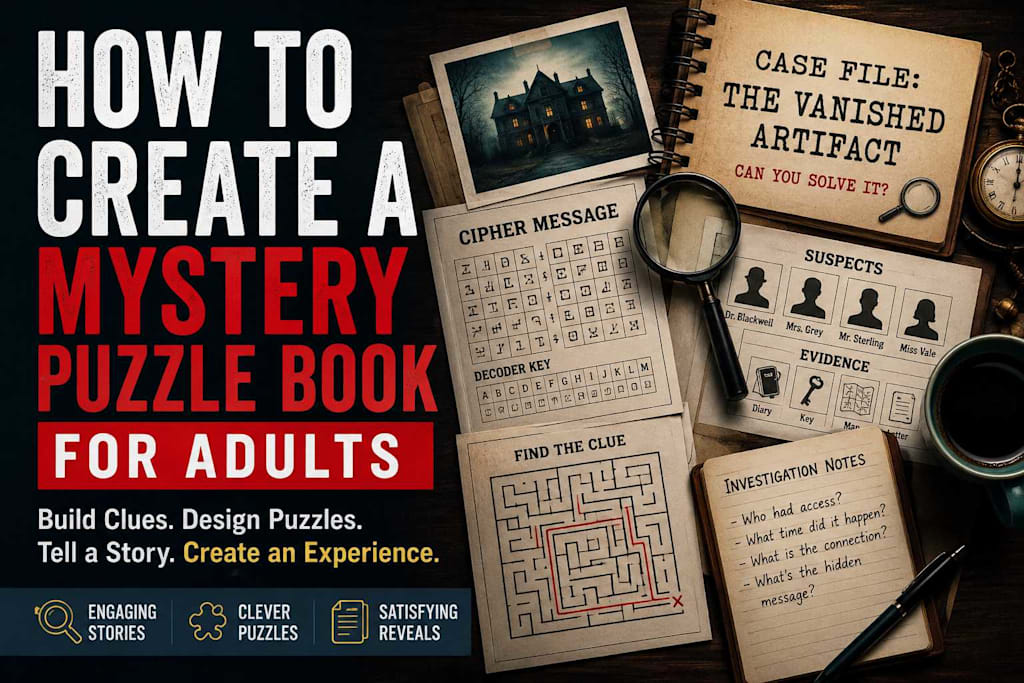
Walk into any bookstore and browse the puzzle section. You will find rows of word searches, sudoku collections, crosswords, and fill-ins. These formats have their place, but for adult readers seeking something more immersive, they often feel like repetitive exercises rather than experiences. The puzzles exist in isolation. There is no story to pull you forward, no mystery to unravel, no reason to care about the answer beyond the satisfaction of completion. That gap is exactly why the mystery puzzle book for adults has become one of the most engaging formats in independent publishing. Readers do not just want to solve puzzles. They want to feel like detectives.
Creating a mystery puzzle book for adults requires thinking like a storyteller and a puzzle designer at the same time. The puzzles cannot exist for their own sake. They must serve the mystery. Every cipher, every hidden message, every logic grid needs to pull the reader deeper into the narrative. When done well, an adult mystery puzzle book becomes an interactive experience where the reader is not passively entertained but actively investigating.
Step 1: Choose the Mystery Framework
Before you design a single puzzle, you need a framework that gives your book structure and stakes. The mystery framework is the skeleton that holds everything together. Without it, even clever puzzles will feel disconnected.
Consider frameworks that naturally generate questions and tension. A missing person case forces the reader to track movements, analyze alibis, and reconstruct a timeline. A stolen artifact creates opportunities for museum maps, security logs, and suspect interviews. A locked room mystery demands attention to physical details, floor plans, and impossible circumstances.
A cold case allows you to work with fragmented evidence, old newspaper clippings, and witness statements that contradict each other. A spy mission introduces code-breaking puzzles, dead drops, and encrypted communications. A missing inheritance can weave together family secrets, hidden wills, and financial records. A museum theft pairs well with catalog entries, provenance documents, and security footage gaps.
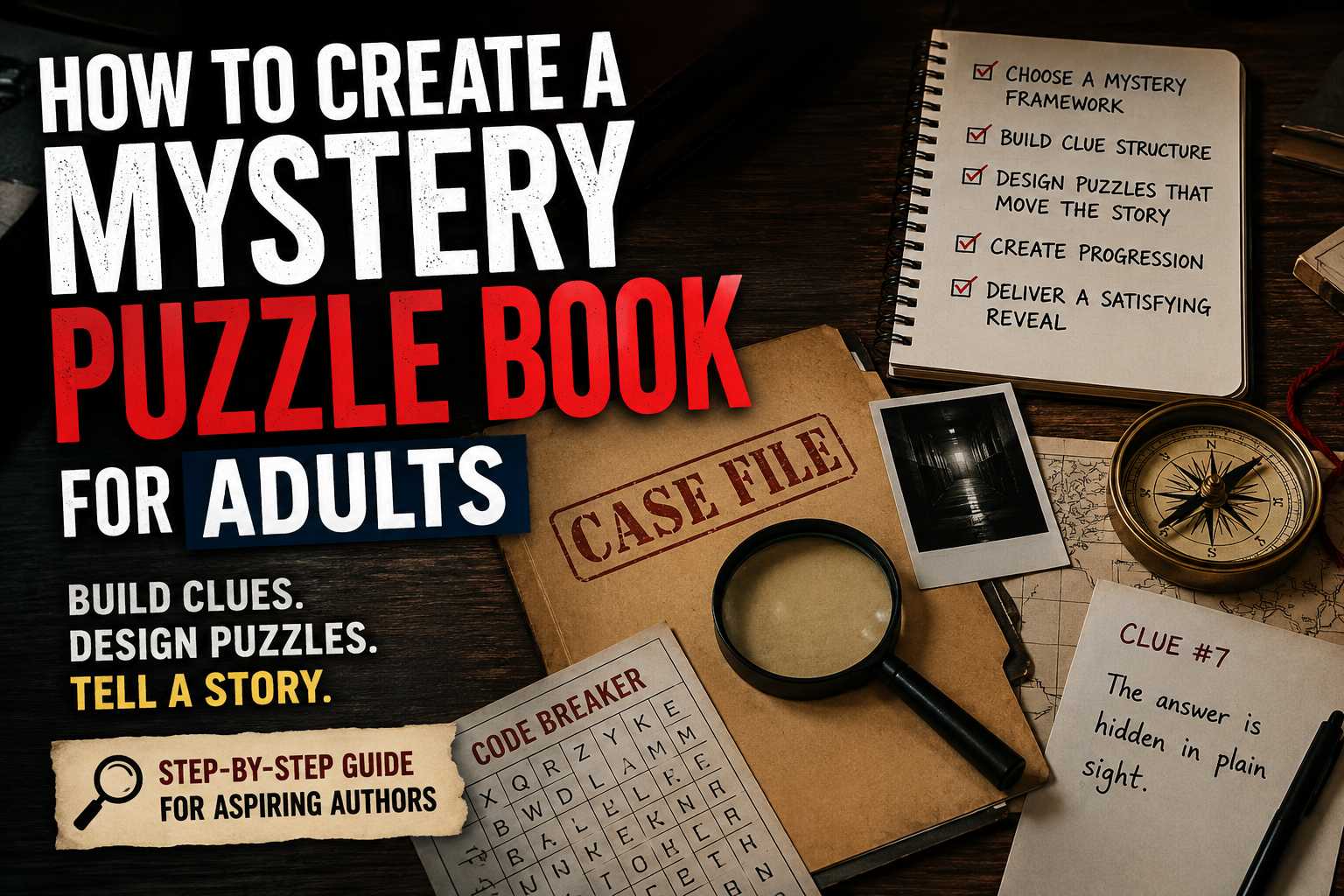
Choose a framework that excites you, because you will be living inside it for the entire creation process. The framework determines what kinds of puzzles make sense, what information the reader needs, and what the final reveal will look like.
Step 2: Create the Clue Structure
A mystery puzzle book for adults lives or dies by its clue structure. You need to design a system where information builds meaningfully across the entire book. Think in terms of lead clues, supporting clues, false leads, and evidence chains.
Lead clues are the major discoveries that shift the reader's understanding of the case. They should arrive at strategic moments, usually after a significant puzzle is solved. Supporting clues fill in context. They might come from background documents, witness statements, or physical evidence that helps the reader interpret lead clues correctly.
False leads are essential for creating genuine challenge. A detective puzzle book that hands the reader every answer is not a mystery. It is a worksheet. Plant one or two false leads that seem convincing early but unravel under closer inspection. Evidence chains are the threads that connect multiple clues into a coherent theory. When the reader solves a cipher in chapter three and realizes it references a name first mentioned in a newspaper clipping from chapter one, that connection creates a genuine moment of discovery.
Map your clue structure before you write. Know what the reader learns on page ten, page thirty, and page sixty. If you do not know when critical information appears, your mystery will feel accidental rather than designed.
Step 3: Build Puzzle Types
The puzzle types in an adult mystery puzzle book must match the narrative context. A random sudoku in the middle of a murder investigation breaks immersion. Every puzzle should feel like something the detective would actually encounter.
Cipher puzzles and code-breaking puzzles are natural fits for spy missions, cold cases involving encrypted journals, or secret societies. Logic puzzles work well for suspect elimination, where the reader must determine who had opportunity and means. Secret messages can be hidden in plain sight within letters, photographs, or official documents.
Timeline puzzles help readers reconstruct the sequence of events in a missing person case or a locked room mystery. Suspect elimination puzzles allow readers to cross off names as they gather alibis and evidence. Evidence analysis puzzles might involve comparing fingerprints, interpreting chemical tests, or matching torn documents. Clue hunt puzzles work beautifully in escape room puzzle book formats, where the reader must search scenes for hidden objects that unlock the next phase of the investigation.
Hidden clues are particularly effective in a mystery activity book for adults. A map with subtle markings, a letter where the first word of each paragraph spells a message, or a photograph with a reflection that reveals a face in a window. These puzzles reward attention and patience, which adult readers bring to the experience.
Step 4: Create Progression
Progression is the hardest part of building a murder mystery puzzle book or an escape room puzzle book. Every puzzle must reveal information that moves the mystery forward. If a puzzle only exists to be solved and then forgotten, it does not belong in your book.
Design your progression by asking what changes after each puzzle. Does the reader learn a new suspect name? Do they discover a hidden location? Do they realize a previous assumption was wrong? If the answer is nothing, revise the puzzle or remove it.
A strong progression creates momentum. The reader should feel like they are peeling back layers. Early puzzles establish the world and the basic facts of the case. Middle puzzles introduce complications, contradictions, and deeper secrets. Late puzzles force the reader to reevaluate everything they thought they knew. This structure mirrors classic mystery storytelling, and it works because it respects the reader's intelligence.
Step 5: Design the Final Reveal
The ending of an adult mystery puzzle book must reward readers who paid attention. A weak or predictable ending undermines the entire experience. The final reveal should connect threads the reader encountered throughout the book, not introduce a solution that appeared from nowhere.
The best final reveals in detective puzzle books allow the reader to solve the mystery moments before the book confirms it. They have all the pieces. They see the pattern. The book simply validates their deduction. This creates a powerful sense of accomplishment that standalone puzzles cannot replicate.
Avoid the temptation to make the final puzzle the hardest one in the book. Difficulty is not the same as satisfaction. The final reveal should be clear in retrospect, even if it was challenging to reach. If the reader needs to flip back through fifty pages to understand the ending, your clue structure needs refinement, not a harder cipher.
Common Mistakes to Avoid
Even experienced creators make mistakes when building a mystery puzzle book for adults. One of the most common errors is stuffing the book with too many unrelated puzzles. A logic grid that has nothing to do with the case, a random word search inserted for filler, or a maze that leads nowhere. These break immersion and signal to the reader that the mystery is not serious.
A weak mystery setup is another frequent problem. If the stakes are unclear or the characters are flat, the reader has no reason to invest in solving the puzzles. Puzzles are only engaging when they matter. Clues that do not connect create frustration. If the reader solves a complex cipher and the resulting message never becomes relevant again, they will stop trusting your design.
Overly difficult ciphers are a trap for enthusiastic creators. Remember that your reader is solving these without help. A cipher that requires specialized knowledge or hours of trial and error will alienate most adults. Challenge is good. Obscurity is not.
Predictable endings destroy replay value and word-of-mouth potential. If the butler did it and the clues pointed there from page one, the reader feels cheated out of a genuine challenge. Puzzles that interrupt the story rather than advance it are equally damaging. Every puzzle should feel like a natural obstacle the detective encounters, not a homework assignment dropped into the narrative.
Helpful Resources and Further Exploration
For readers exploring additional concepts, I previously discussed Online Mystery Puzzle Book Ideas for Adults and several different mystery-book formats. That article covers alternative structures and thematic approaches that complement the process outlined here.
During my research into mystery puzzle creation workflows, I also came across resources focused on ciphers, clue chains, and narrative puzzle structures, including
The most successful adult mystery puzzle books work because the puzzles serve the mystery rather than distract from it. Readers remember the moment they connected a clue from chapter two to a revelation in chapter seven. They remember the false lead that made them doubt their theory. They remember the final reveal that made them flip back through the book to see how they missed the obvious.
That is the experience you are building. Not a collection of puzzles bound together, but a mystery that happens to be interactive. When you create with that principle in mind, you are not just making a puzzle book. You are designing an experience that respects the reader's curiosity and intelligence.
About the Creator
Brooks Ghost Max
I'm just a running shoe geek with a serious addiction to foam. My current obsession? The Brooks Ghost Max. I spend my days analyzing stack heights and heel drops to help you decide if that $150 price tag is actually worth it.
Enjoyed the story? Support the Creator.
Subscribe for free to receive all their stories in your feed.
Comments
There are no comments for this story
Be the first to respond and start the conversation.