
How to Conduct a Vibe-Coded Project Cleanup Without Breaking Features
A Practical Guide to Refactoring and Stabilizing Vibe-Coded Applications

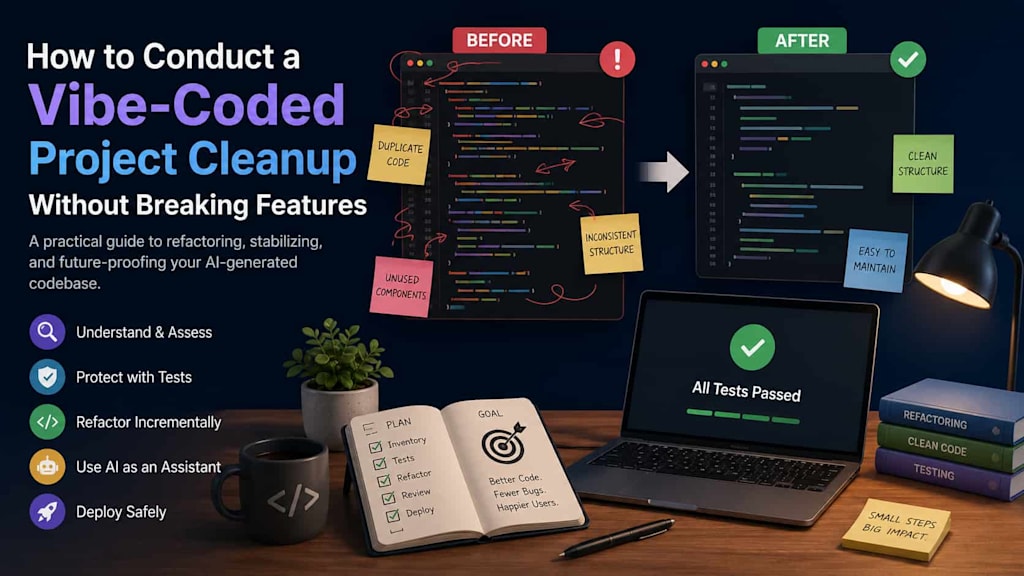
The rise of AI-powered coding tools has dramatically changed how software is built. Developers, founders, and even non-technical creators can now generate working applications in a fraction of the time that traditional development once required. This trend has given rise to what many developers informally call "vibe coding"—a rapid, intuition-driven approach where developers collaborate with AI tools to generate code, features, and functionality at unprecedented speed.
While this approach accelerates innovation, it often leaves behind a significant amount of technical debt. As projects grow, teams may discover duplicated logic, inconsistent architecture, unused components, security vulnerabilities, and undocumented dependencies. What started as a quick prototype can quickly evolve into a production application that becomes increasingly difficult to maintain.
Eventually, every successful vibe-coded project reaches a point where cleanup becomes necessary. However, cleaning up an AI-generated codebase presents a unique challenge: how do you improve structure, maintainability, and performance without accidentally breaking existing functionality?
The answer lies in approaching cleanup as a controlled engineering process rather than a large-scale rewrite. By following a structured strategy, teams can modernize their codebase while preserving stability and user trust.
Understanding the Risks of Vibe-Coded Projects
Before beginning any cleanup initiative, it is important to understand why vibe-coded projects often become difficult to maintain.
AI-generated code is usually optimized for producing functional results quickly rather than creating long-term architectural consistency. When multiple prompts, contributors, and AI tools are involved over time, the resulting codebase may contain several common issues:
- Duplicate functions performing similar tasks
- Inconsistent naming conventions
- Redundant libraries and dependencies
- Mixed coding styles
- Limited documentation
- Overly complex components
- Dead or unreachable code
- Security gaps introduced during rapid feature development
These issues do not necessarily indicate poor-quality software. In fact, many vibe-coded applications perform exceptionally well from a user perspective. The challenge arises when teams need to scale the application, onboard new developers, or introduce complex new features.
A cleanup project should therefore focus on improving maintainability and reducing risk while ensuring that existing business logic continues to function exactly as intended.
The biggest mistake organizations make is assuming that cleanup means rewriting everything. In reality, successful cleanup projects prioritize preservation first and optimization second.
Start With Visibility and Baseline Protection
The first phase of any cleanup effort should focus on understanding the current state of the application.
Before modifying a single line of code, teams should create a comprehensive inventory of the system. This includes:
- Application architecture
- Major workflows
- API integrations
- Database structures
- Third-party services
- Authentication systems
- Feature dependencies
- Deployment configurations
Many vibe-coded applications lack complete documentation, making this step especially valuable.
At the same time, teams should establish a baseline for current functionality. This baseline acts as a safety net throughout the cleanup process.
Key activities may include:
- Recording critical user journeys
- Capturing screenshots of important workflows
- Documenting expected outputs
- Exporting API responses
- Monitoring performance metrics
- Creating test datasets
Automated testing becomes particularly important during this stage. Even if a project has minimal test coverage, introducing tests before cleanup begins can significantly reduce risk.
Teams should focus first on high-impact areas such as:
- User registration
- Authentication
- Payment processing
- Data management
- Reporting features
- Customer-facing workflows
The goal is not to achieve perfect test coverage immediately. Instead, teams need enough protection to identify unintended consequences as changes are introduced.
Refactor Incrementally Instead of Rewriting
One of the most effective principles in software modernization is incremental change.
Large rewrites often fail because they attempt to replace working systems all at once. Feature parity becomes difficult to maintain, timelines expand, and new bugs emerge faster than they can be resolved.
A safer approach is to clean the codebase in small, manageable sections.
Developers should identify modules that are:
- Isolated from core business functions
- Frequently modified
- Difficult to understand
- Highly duplicated
- Performance bottlenecks
Each module can then be improved independently while maintaining the existing external behavior.
For example, instead of replacing an entire authentication system, a team might first:
- Standardize naming conventions
- Remove unused methods
- Consolidate duplicate validation logic
- Improve documentation
- Increase test coverage
Once stability is confirmed, additional improvements can be introduced.
This incremental methodology aligns closely with the best practices for vibe-coded apps cleanup, allowing teams to gain maintainability improvements without introducing unnecessary operational risk.
Developers should also avoid changing functionality during structural refactoring whenever possible. Architectural improvements and feature enhancements should remain separate initiatives. Combining both objectives often makes troubleshooting significantly more difficult.
Use AI as a Cleanup Assistant, Not an Autopilot
Ironically, the same AI tools that helped create the original project can also assist in the cleanup process.
Modern AI development assistants are highly effective at identifying:
- Code duplication
- Dead code
- Refactoring opportunities
- Naming inconsistencies
- Security concerns
- Missing documentation
- Dependency optimization opportunities
However, organizations should resist the temptation to blindly accept AI-generated cleanup recommendations.
AI models often lack full contextual understanding of business requirements, historical decisions, and edge-case behavior. A seemingly unnecessary function may actually support a rarely used but critical workflow.
The most successful teams use AI as an analytical partner rather than an autonomous decision-maker.
A practical workflow might include:
- Ask AI to analyze a module.
- Review recommendations manually.
- Validate assumptions against business requirements.
- Implement changes in small increments.
- Run automated tests.
- Conduct human review before deployment.
This process combines AI efficiency with human judgment, creating a balance between speed and reliability.
Additionally, AI can be particularly useful for generating documentation. Many vibe-coded projects suffer from sparse documentation because features were developed rapidly. AI tools can help create technical summaries, architecture descriptions, API documentation, and onboarding materials that improve long-term maintainability.
Strengthen Quality Assurance Before Deployment
Cleanup work is only successful if users never notice that it happened.
To achieve this, teams must invest heavily in validation before releasing changes into production environments.
Quality assurance should extend beyond traditional functional testing.
Recommended validation activities include:
Regression Testing
Regression testing verifies that existing features continue to operate exactly as they did before cleanup activities began. Every major workflow should be exercised repeatedly throughout the project.
Integration Testing
Many failures occur at the boundaries between systems. Cleanup efforts should verify interactions among APIs, databases, third-party services, authentication providers, and background jobs.
Performance Testing
Refactoring sometimes improves readability while unintentionally reducing performance. Load testing and benchmarking can identify performance regressions before deployment.
Security Review
Security reviews are particularly important because cleanup projects frequently modify application structure, dependencies, and access controls.
Teams should evaluate:
- Authentication mechanisms
- Authorization controls
- Secrets management
- Dependency vulnerabilities
- Input validation
- Logging practices
Staged Deployment
Rather than deploying all cleanup changes at once, organizations should consider phased rollouts.
Techniques such as:
- Feature flags
- Canary deployments
- Blue-green deployments
- Limited user releases
allow teams to monitor behavior under real-world conditions while minimizing business risk.
This approach provides an additional layer of protection in case unexpected issues emerge after release.
Building a Sustainable Future for the Codebase
Cleanup should not be viewed as a one-time event. The ultimate goal is to create development practices that prevent excessive technical debt from accumulating again.
Once cleanup efforts are complete, teams should establish standards that encourage long-term maintainability.
Examples include:
- Consistent coding guidelines
- Architectural decision records
- Documentation requirements
- Code review policies
- Dependency management processes
- Automated testing standards
- Security review procedures
Organizations should also periodically review AI-assisted development practices. As AI coding tools become more capable, they can accelerate both innovation and technical debt creation.
Regular maintenance cycles help ensure that the codebase remains healthy and scalable as new features are added.
The most successful teams embrace a mindset of continuous improvement. Instead of waiting for technical debt to become overwhelming, they address small issues consistently over time.
Conclusion
Vibe-coded applications can deliver tremendous value by accelerating development and enabling rapid experimentation. However, the speed that makes these projects successful can also introduce complexity, inconsistency, and maintainability challenges as the software evolves.
Conducting a cleanup project without breaking existing features requires a disciplined approach centered on visibility, testing, incremental refactoring, and careful validation. Teams should avoid large-scale rewrites, prioritize stability, and use AI as a supportive tool rather than an autonomous decision-maker.
By documenting systems, strengthening test coverage, modernizing code in manageable stages, and implementing sustainable development standards, organizations can transform rapidly generated applications into robust, scalable software products. A thoughtful cleanup process not only reduces technical debt but also creates a stronger foundation for future innovation and long-term success.
About the Creator
Chudovo
Chudovo is a custom software development company, focused on complex systems implementation.
Enjoyed the story? Support the Creator.
Subscribe for free to receive all their stories in your feed.
Comments
There are no comments for this story
Be the first to respond and start the conversation.