
How to Choose the Right Path for Legacy .NET Systems: Replatforming, Refactoring, or Replacement
A practical guide to making the right modernization decision

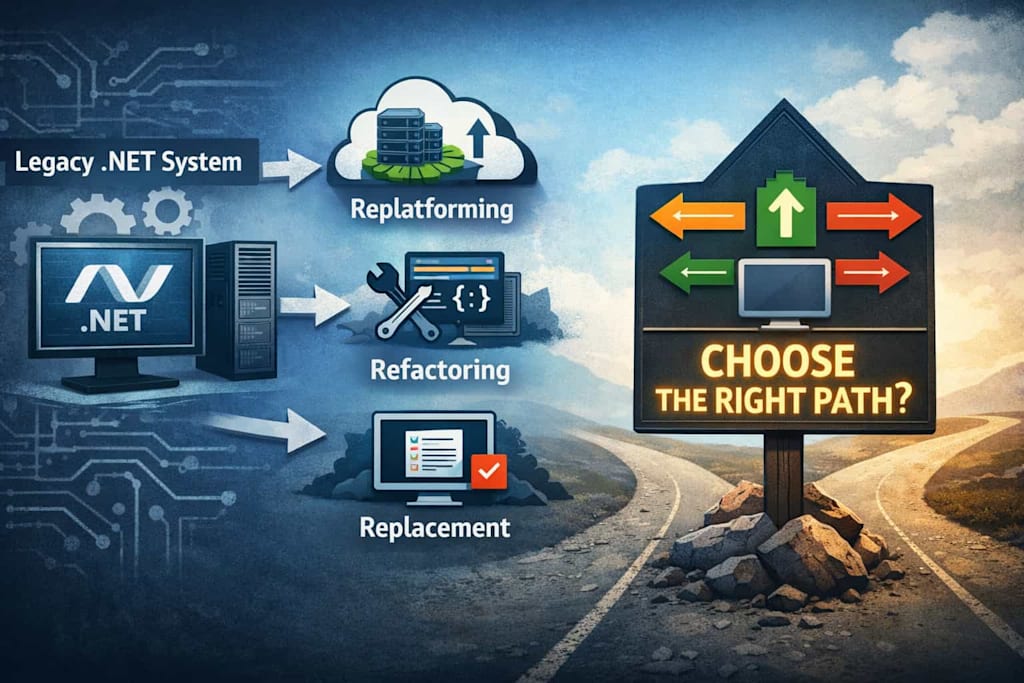
Modern organizations often rely on legacy .NET systems that have supported business operations for years, sometimes even decades. While these systems may still function, they frequently become harder to maintain, scale, and integrate with modern technologies. As a result, companies face a critical question: what is the best way forward?
Choosing between replatforming, refactoring, or full replacement is not just a technical decision—it is a strategic one. Each path comes with its own trade-offs in cost, time, risk, and long-term value. This guide will help you understand these options and determine the most suitable approach for your specific situation.
Understanding the Challenge of Legacy .NET Systems
Legacy .NET applications are often deeply embedded in business processes. They may rely on outdated frameworks, monolithic architectures, or tightly coupled components. Over time, these systems can become fragile and difficult to adapt.
Common issues include:
- Limited scalability and performance bottlenecks
- High maintenance costs due to outdated code
- Difficulty integrating with cloud services or modern APIs
- Lack of documentation and knowledge gaps within teams
Despite these challenges, legacy systems are rarely disposable. They often contain valuable business logic and data that must be preserved. This is why modernization requires careful planning rather than impulsive decisions.
Option 1: Replatforming – The Fast Track to the Cloud
Replatforming involves moving an existing application to a new infrastructure platform—typically the cloud—without making significant changes to the codebase. This approach is sometimes referred to as “lift and optimize.”
When replatforming makes sense
Replatforming is ideal when:
- The application is stable and meets current business needs
- Performance improvements are needed without major redesign
- Time and budget constraints limit deeper changes
- The primary goal is cloud adoption
Benefits
- Faster implementation compared to other approaches
- Lower upfront costs
- Immediate infrastructure improvements
- Reduced operational overhead
Limitations
However, replatforming does not solve underlying architectural issues. If the application is poorly designed or difficult to maintain, those problems will persist. In some cases, moving a monolithic application to the cloud can even amplify inefficiencies.
Replatforming is best seen as a short- to medium-term solution rather than a complete transformation.
Option 2: Refactoring – Improving from Within
Refactoring focuses on improving the internal structure of the application without changing its external behavior. This can include breaking down monoliths into microservices, improving code quality, and adopting modern development practices.
When refactoring is the right choice
Refactoring is suitable when:
- The system contains valuable business logic worth preserving
- Performance and scalability issues stem from architecture
- There is a need for better maintainability and flexibility
- The organization is ready to invest in long-term improvement
Benefits
- Enhanced system performance and scalability
- Improved code quality and maintainability
- Easier integration with modern tools and platforms
- Long-term cost savings
Challenges
Refactoring requires significant time, expertise, and careful planning. It can also introduce risks if not managed properly, especially in systems with limited documentation.
One key advantage of refactoring is that it aligns with continuous improvement strategies. Instead of making a single large change, organizations can gradually evolve their systems while maintaining business continuity.
Option 3: Replacement – Starting from Scratch
Replacement involves building a completely new system to replace the legacy application. This is the most radical approach and often the most resource-intensive.
When replacement is necessary
Replacement is the best option when:
- The existing system is obsolete or no longer supported
- The architecture is too complex or fragile to improve
- Business requirements have significantly changed
- Maintenance costs outweigh the value of the system
Benefits
- Full alignment with modern technologies and business needs
- Clean, optimized architecture
- Opportunity to redesign processes and workflows
- Greater flexibility for future innovation
Risks
Replacement projects are inherently risky. They require substantial investment, long timelines, and strong project management. There is also the danger of losing critical functionality or knowledge during the transition.
Additionally, organizations may underestimate the complexity of rebuilding features that have evolved over many years.
Key Factors to Consider When Choosing the Right Path
Selecting the best modernization strategy requires a comprehensive evaluation of both technical and business factors.
1. Business goals
What are you trying to achieve? Faster performance, reduced costs, better user experience, or digital transformation? Your goals should guide your decision.
2. System condition
Assess the current state of your application:
- Is the code maintainable?
- Are there major architectural flaws?
- How often do issues occur?
A relatively healthy system may benefit from replatforming or refactoring, while a severely degraded one may require replacement.
3. Budget and timeline
Replatforming is typically the quickest and least expensive option. Refactoring requires more investment, while replacement is the most costly and time-consuming.
4. Risk tolerance
Organizations with low risk tolerance may prefer incremental approaches like refactoring. Replacement, while potentially more rewarding, carries higher uncertainty.
5. Team capabilities
Do you have the expertise to refactor or rebuild the system? Skills, experience, and available resources play a crucial role in determining feasibility.
A Hybrid Approach: Combining Strategies
In many cases, the best solution is not a single approach but a combination of strategies. For example:
- Replatforming can be used as a first step to move to the cloud
- Refactoring can follow to improve architecture over time
- Replacement can be applied selectively to specific components
This hybrid approach allows organizations to balance short-term gains with long-term transformation.
By breaking the modernization process into manageable phases, companies can reduce risk while continuously delivering value.
Common Mistakes to Avoid
Modernizing legacy systems is complex, and several common pitfalls can derail projects:
- Trying to do everything at once: Large-scale transformations without clear priorities often fail
- Ignoring business needs: Technical improvements must align with business objectives
- Underestimating complexity: Legacy systems often contain hidden dependencies
- Lack of stakeholder involvement: Successful modernization requires collaboration across teams
Avoiding these mistakes can significantly increase the chances of success.
Building a Modernization Roadmap
A clear roadmap is essential for guiding your modernization journey. It should include:
- A detailed assessment of the current .NET system
- Defined goals and success metrics
- A prioritized list of improvements
- A phased implementation plan
- Continuous monitoring and optimization
This structured approach ensures that modernization efforts remain focused and aligned with business priorities.
Conclusion
Modernizing legacy .NET systems is not a one-size-fits-all process. Replatforming, refactoring, and replacement each offer unique advantages and challenges. The key is to choose the approach that best aligns with your business goals, system condition, and available resources.
Replatforming provides a quick path to modernization but may not address deeper issues. Refactoring offers long-term benefits through gradual improvement, while replacement enables a complete transformation at a higher cost and risk.
In many cases, a hybrid strategy delivers the best results, allowing organizations to evolve their systems step by step. By carefully evaluating your options and planning strategically, you can turn legacy systems from a limitation into a competitive advantage.
Ultimately, the right path is not about following trends—it is about making informed decisions that support your organization’s future.
About the Creator
Chudovo
Chudovo is a custom software development company, focused on complex systems implementation.
Enjoyed the story? Support the Creator.
Subscribe for free to receive all their stories in your feed.
Comments
There are no comments for this story
Be the first to respond and start the conversation.