
How to Choose the Right Message Broker for Inventory Synchronization
Key factors for selecting scalable, reliable messaging solutions that keep inventory data accurate across modern business systems.

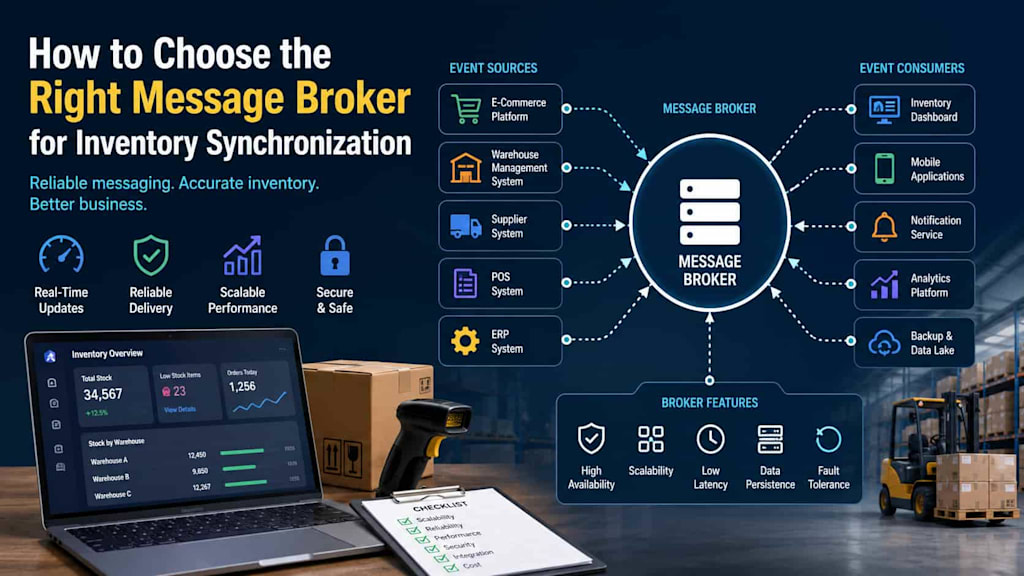
Keeping inventory accurate across multiple sales channels, warehouses, suppliers, and enterprise systems is one of the biggest challenges in modern commerce. Whether a business operates a single online store or manages a global distribution network, inventory discrepancies can lead to overselling, delayed shipments, dissatisfied customers, and lost revenue.
Message brokers play a critical role in solving these challenges by enabling reliable communication between applications and ensuring that inventory updates are delivered quickly and consistently. However, choosing the right message broker requires more than comparing performance benchmarks. Organizations must evaluate scalability, reliability, latency, security, operational complexity, and compatibility with their existing technology stack.
This article explores the essential criteria for selecting the right message broker for inventory synchronization projects and explains how different messaging technologies support efficient business operations.
Why Message Brokers Matter
Inventory data changes constantly. Every customer purchase, warehouse transfer, supplier shipment, return, or cancellation creates new information that must be shared across multiple systems.
Without a messaging platform, applications often rely on direct API calls between services. As systems grow, these integrations become increasingly difficult to maintain, creating tightly coupled architectures that are harder to scale and more prone to failures.
Message brokers solve this problem by acting as intermediaries between systems. Instead of communicating directly, applications publish events to the broker, while other services subscribe to the information they need. This approach improves flexibility, fault tolerance, and scalability.
For organizations that require real-time inventory synchronization, message brokers provide the foundation for delivering inventory updates almost instantly across connected platforms.
Understand Your Business Requirements
Before selecting any messaging technology, organizations should clearly define their operational requirements.
Important questions include:
How many inventory events occur each day?
How many applications consume inventory data?
Is low latency essential?
What level of fault tolerance is required?
Will multiple warehouses generate updates simultaneously?
Are global deployments planned?
What are the expected future growth rates?
The answers to these questions determine which message broker is best suited for the project.
Evaluate Performance and Throughput
Inventory systems can generate thousands or even millions of updates every day.
High-performance message brokers should efficiently handle:
Product stock changes
Warehouse transfers
Order confirmations
Purchase orders
Returns processing
Inventory adjustments
Supplier updates
Organizations should examine not only peak throughput but also sustained performance under continuous workloads.
Benchmarks should reflect realistic production conditions rather than isolated laboratory tests.
Consider Message Delivery Guarantees
Reliable inventory management depends on ensuring that every important update reaches its destination.
Common delivery models include:
At Most Once
Messages are delivered once without retries. This approach minimizes latency but risks losing updates.
At Least Once
Messages are retried until delivery succeeds. Although duplicates may occasionally occur, no updates are lost.
Exactly Once
Each message is processed only once. This model provides the highest consistency but often introduces additional complexity and overhead.
The appropriate choice depends on business priorities and data consistency requirements.
Analyze Scalability
Inventory synchronization requirements often grow rapidly alongside business expansion.
An ideal message broker should support:
Horizontal scaling
Distributed clusters
Automatic load balancing
Partitioning
High availability
Elastic resource allocation
Cloud-native architectures particularly benefit from brokers designed for dynamic scaling.
Evaluate Latency Requirements
Some organizations can tolerate inventory updates that arrive several seconds later, while others require nearly instantaneous synchronization.
Industries that often demand minimal latency include:
E-commerce
Grocery retail
Flash sales
Ticket sales
Pharmaceutical distribution
Manufacturing
Understanding acceptable response times helps narrow technology choices.
Reliability and Fault Tolerance
Hardware failures, network interruptions, and software bugs are inevitable.
Reliable message brokers provide features such as:
Message persistence
Replication
Automatic failover
Durable queues
Recovery mechanisms
Monitoring tools
These capabilities ensure inventory updates remain available even during infrastructure failures.
Compare Popular Message Brokers
Several mature messaging platforms dominate enterprise environments.
Apache Kafka
Kafka is designed for high-throughput event streaming and large-scale distributed systems. It excels in environments requiring persistent event storage, analytics, and large volumes of inventory updates.
Advantages include:
Excellent scalability
Event replay
High throughput
Strong ecosystem
Distributed architecture
However, Kafka may require more operational expertise than simpler messaging solutions.
RabbitMQ
RabbitMQ emphasizes flexible routing and ease of implementation.
Its strengths include:
Mature ecosystem
Flexible routing options
Reliable queues
Broad protocol support
Simpler deployment
RabbitMQ is frequently selected for traditional enterprise integration projects.
Apache Pulsar
Pulsar combines messaging and event streaming while offering multi-tenant architecture and efficient scaling.
Organizations managing large cloud deployments increasingly consider Pulsar for modern distributed systems.
Amazon SQS
Cloud-native businesses already using AWS often choose Amazon Simple Queue Service for its managed infrastructure, automatic scaling, and operational simplicity.
Google Cloud Pub/Sub
Organizations invested in Google Cloud benefit from managed messaging services that minimize operational overhead while supporting highly scalable applications.
Security Considerations
Inventory data may contain sensitive operational information that requires protection.
Essential security features include:
TLS encryption
Authentication
Role-based access control
Audit logging
Data encryption
Secure API integration
Organizations should ensure messaging infrastructure aligns with overall cybersecurity policies.
Integration with Existing Systems
A message broker should integrate smoothly with the organization's technology ecosystem.
Common integrations include:
ERP platforms
Warehouse Management Systems
E-commerce platforms
CRM software
Point-of-sale systems
Supplier portals
Analytics platforms
Native connectors and well-documented APIs significantly reduce implementation complexity.
Operational Simplicity
Powerful technology is only valuable if teams can operate it efficiently.
Evaluate factors such as:
Installation complexity
Monitoring capabilities
Documentation quality
Community support
Vendor support
Upgrade procedures
Backup and recovery
Operational simplicity often reduces long-term maintenance costs.
Monitoring and Observability
Visibility into message processing helps identify problems before they affect customers.
Useful monitoring capabilities include:
Queue depth
Consumer lag
Processing latency
Failed deliveries
Broker health
Resource utilization
Alerting
Comprehensive observability enables proactive infrastructure management.
Cost Considerations
Licensing is only one component of total ownership costs.
Organizations should evaluate:
Infrastructure expenses
Cloud resource consumption
Operational staffing
Maintenance requirements
Monitoring tools
Disaster recovery
Future scalability
Sometimes a managed service with higher subscription fees proves more economical than maintaining self-hosted infrastructure.
Design for Future Growth
Technology decisions should support future business expansion rather than current requirements alone.
An effective inventory synchronization architecture should accommodate additional warehouses, international operations, new sales channels, IoT devices, predictive analytics, and AI-driven inventory optimization without requiring fundamental redesigns.
Selecting a flexible message broker today reduces future migration costs and enables organizations to respond more quickly to changing business needs.
Conclusion
Choosing the right message broker for inventory synchronization requires balancing performance, reliability, scalability, security, operational simplicity, and long-term maintainability. While platforms such as Apache Kafka, RabbitMQ, Apache Pulsar, Amazon SQS, and Google Cloud Pub/Sub each offer unique strengths, the best solution depends on specific business requirements rather than industry popularity.
Organizations that carefully evaluate messaging technologies based on current operational needs and future growth plans can build resilient inventory systems that deliver accurate, timely updates across every connected application. Investing in the appropriate message broker creates a strong foundation for efficient inventory management, improved customer satisfaction, and scalable digital operations.
About the Creator
Chudovo
Chudovo is a custom software development company, focused on complex systems implementation.
Enjoyed the story? Support the Creator.
Subscribe for free to receive all their stories in your feed.
Comments
There are no comments for this story
Be the first to respond and start the conversation.