
How to Build an E-Commerce Platform Around Complex Business Workflows
How to design e-commerce systems that handle complex products, pricing, inventory, integrations, and customer-specific processes.

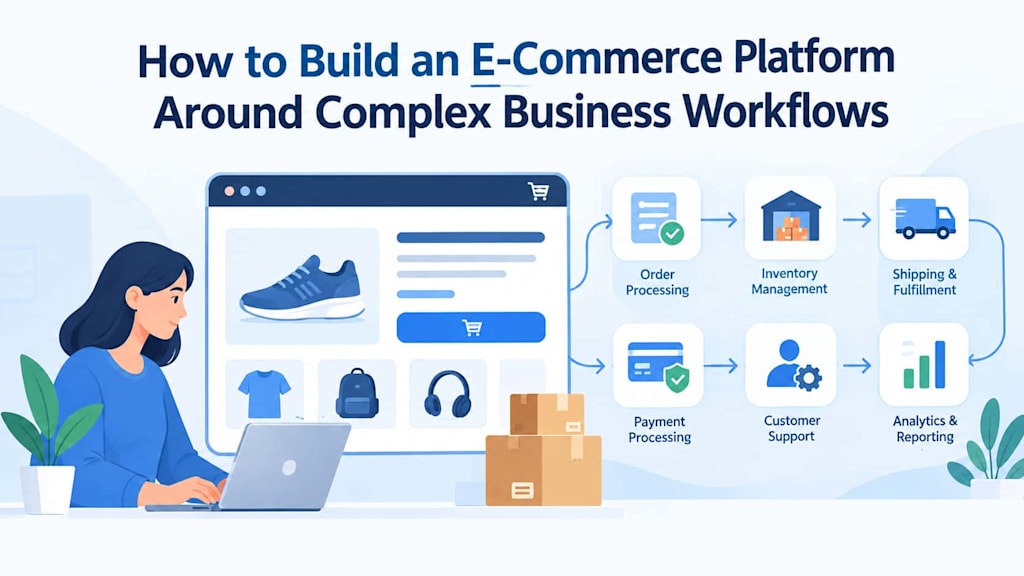
E-commerce is often presented as a straightforward digital storefront: customers browse products, add items to a cart, pay, and receive an order confirmation. That model works well for businesses with relatively simple catalogs and standardized purchasing processes. It becomes much harder when commerce is closely connected to the way a company actually operates.
Manufacturers, distributors, B2B suppliers, subscription businesses, and companies selling configurable products may need their e-commerce platforms to calculate prices dynamically, validate configurations, check inventory across locations, synchronize data with ERP and CRM systems, and apply different workflows to different customer groups.
In these environments, the storefront is only one part of the system. The real challenge is creating a commerce platform that can represent business rules without turning every new requirement into a custom patch.
Start With Business Workflows, Not Storefront Features
A complex e-commerce project should begin by mapping how the business processes an order from the first customer interaction to fulfillment, invoicing, renewal, or support.
This often reveals requirements that are difficult to see when starting from a conventional feature list.
For example, a manufacturer might sell equipment that can be configured with different components. A customer may only be allowed to select compatible options, while the final price depends on the configuration, contract terms, delivery location, quantity, and customer category. Once an order is submitted, it may also need approval before being sent to an ERP system.
A subscription company may have a completely different workflow. Customers might purchase several service tiers, add optional modules, change quantities during a billing period, pause subscriptions, or receive customer-specific discounts.
These processes should be modeled before selecting the technical architecture.
A useful first step is to identify:
Product configuration rules
Pricing and discount logic
Customer-specific purchasing rules
Inventory sources and allocation logic
Order approval requirements
Payment and invoicing processes
Subscription and renewal events
ERP, CRM, PIM, WMS, and other integrations
Fulfillment and return workflows
Reporting and operational requirements
This approach helps clarify which capabilities belong in the commerce platform and which should remain in connected business systems.
Know When Standard E-Commerce Architecture Becomes a Constraint
Standard platforms can provide an excellent starting point, particularly when product catalogs, pricing, checkout, and fulfillment are relatively predictable. The problem appears when business rules begin to conflict with the assumptions built into the platform.
The question is not simply when an off-the-shelf store stops fitting the business. It is whether the platform can continue accommodating new rules without making the system difficult to maintain.
Consider product configuration. A basic product variant model may be sufficient for shirts with different sizes and colors. It becomes inadequate when a product consists of dozens of dependent components, compatibility rules, optional services, technical specifications, and customer-specific restrictions.
Pricing creates another challenge. A simple catalog price may evolve into a combination of contract pricing, volume discounts, regional rules, promotions, customer tiers, currency conversion, taxes, and negotiated agreements.
Inventory can become equally complicated. A company may maintain stock in multiple warehouses, reserve inventory for specific customers, receive supply information from an ERP system, and use different allocation rules for different order types.
Trying to force all these processes into a rigid storefront can create a growing collection of extensions and custom modifications. Over time, those changes can interact in unpredictable ways.
A better approach is to establish clear boundaries between the commerce experience and the underlying business logic.
Design Product Configuration as a Business Capability
Complex product configuration should not be treated as a collection of user-interface controls.
The system needs to understand relationships between products, components, options, constraints, and dependencies.
For example, selecting one equipment configuration might automatically require another component. Some options may be mutually exclusive. Certain combinations may only be available to particular customer groups or regions.
A configuration engine can manage these rules separately from the storefront. The user interface then becomes responsible for guiding customers through valid choices, while the underlying service determines whether the resulting configuration is actually valid.
This separation provides several advantages. Configuration rules can evolve without redesigning the entire storefront. The same logic can potentially support web sales, sales-assisted ordering, mobile applications, or internal quoting tools.
For B2B commerce, it can also support different experiences for different accounts. A customer portal might expose only products, configurations, payment terms, or delivery options that the customer's contract allows.
Build Pricing as a Flexible Rule System
Pricing is another area where complex commerce platforms need careful architectural decisions.
Hard-coding prices directly into product pages may work for a small catalog, but it becomes difficult to manage when pricing depends on multiple variables.
A more flexible architecture can treat pricing as a dedicated business capability. The pricing service can receive information such as:
Customer account and segment
Product and configuration
Quantity
Contract or agreement
Geographic market
Currency
Promotion
Delivery requirements
Subscription term
It can then return the applicable price and the reasoning or rule set behind it.
This separation also helps prevent inconsistent pricing across different sales channels. If customers can purchase through a website, sales portal, mobile application, or API, they should not receive different results because each channel implements pricing independently.
Caching can improve performance for frequently requested calculations, while more complex calculations can remain dynamic where necessary.
Treat Inventory as a Distributed Business Process
Inventory is rarely just a number stored in the e-commerce database.
A business may have multiple warehouses, stores, fulfillment partners, production facilities, or external suppliers. Inventory information may originate in an ERP or warehouse management system rather than the commerce platform.
The architecture should therefore define which system owns each inventory state.
For example, the commerce platform might display available-to-promise quantities, while the ERP remains responsible for authoritative stock records. Integration services can synchronize inventory changes and communicate reservations, allocations, shipment updates, and cancellations.
This becomes particularly important during high-demand periods. A platform that displays inventory correctly but cannot coordinate reservations and order processing can still experience overselling.
Event-driven integration can help distribute important changes without requiring every system to constantly query every other system.
Connect ERP, CRM, and Other Systems Without Creating a Tangle
Complex e-commerce platforms frequently depend on systems that already contain critical business data.
The ERP may manage products, inventory, orders, financial information, or fulfillment. A CRM may contain customer accounts, sales opportunities, contract information, and service history. A PIM may own product content, while a WMS controls warehouse operations.
The goal should not be to make the e-commerce platform a replacement for all of these systems.
Instead, define ownership clearly.
For each important data object, determine which system is authoritative, which systems consume the data, how updates are synchronized, and what happens when synchronization fails.
Integration APIs, message queues, webhooks, and event-driven architecture can help reduce tight coupling. Monitoring and retry mechanisms are equally important because business workflows cannot depend on every external system being available at every moment.
A failed ERP synchronization, for example, should not necessarily make the entire storefront unusable.
Support Customer-Specific Workflows
Complex commerce frequently means that customers do not all follow the same path.
A consumer might complete an order immediately. A corporate customer may require approval from a purchasing manager. Another customer may have negotiated payment terms, a dedicated catalog, special delivery rules, or an account-specific price list.
These differences should be modeled explicitly rather than scattered throughout the application as conditional statements.
Workflow services can manage approval states, account restrictions, order reviews, quotations, contract rules, and other customer-specific processes.
This makes the platform easier to extend. Adding a new customer workflow becomes a matter of introducing a new rule or process rather than modifying dozens of unrelated storefront components.
Plan for Growth Without Rebuilding the Platform
Scalability is not only about handling more website traffic.
A commerce platform may need to handle more products, customers, transactions, integrations, pricing rules, geographic markets, and business processes.
The architecture should therefore be designed around independently scalable capabilities where appropriate.
API-first design can make commerce functions accessible to multiple channels. Modular services can isolate areas such as pricing, configuration, customer accounts, inventory, and order management. Event-driven processing can handle asynchronous operations without blocking customer-facing requests.
At the same time, not every component needs to become a microservice. Excessive distribution can introduce unnecessary operational complexity.
A modular monolith may be more appropriate for some businesses during the early stages. The important point is to establish clean domain boundaries so that components can evolve independently as requirements grow.
This is also what long-term e-commerce evolution looks like in practice: not replacing the entire platform every few years, but gradually expanding capabilities while preserving stable parts of the system.
Make the Architecture Observable and Maintainable
Complex business workflows create more opportunities for failures that customers cannot immediately see.
An order may be accepted by the storefront but fail during ERP synchronization. A pricing calculation may use outdated customer data. An inventory reservation may time out. A subscription renewal may fail to trigger an invoice.
Monitoring should therefore cover business events as well as technical infrastructure.
Useful metrics include:
Failed integrations
Delayed synchronization events
Configuration validation failures
Pricing calculation errors
Inventory discrepancies
Order processing delays
Payment and subscription failures
API response times
Abandoned workflows
Logging should provide enough context to trace an order or business event across connected systems without exposing unnecessary customer information.
Automated testing is equally important. Complex pricing rules, configuration dependencies, and workflow states should have dedicated test coverage because small changes can produce unexpected effects elsewhere.
Conclusion
Building a complex e-commerce platform is fundamentally different from creating a conventional online store. The storefront remains important, but the core engineering challenge lies in representing the business processes behind the transaction.
Product configuration, pricing, inventory, subscriptions, customer-specific rules, and enterprise integrations should be treated as distinct capabilities with clear ownership and well-defined interfaces.
The most sustainable approach is building commerce around business-specific processes rather than forcing complex operations into a standard storefront model. With modular architecture, carefully designed integrations, flexible business rules, and strong observability, an e-commerce platform can evolve alongside the organization instead of becoming another operational constraint.
About the Creator
Chudovo
Chudovo is a custom software development company, focused on complex systems implementation.
Enjoyed the story? Support the Creator.
Subscribe for free to receive all their stories in your feed.
Comments
There are no comments for this story
Be the first to respond and start the conversation.