
How to Assess Legacy Financial Systems for Modernization Readiness
A Step-by-Step Guide to Evaluating Technical, Operational, and Organizational Readiness for Financial System Transformation

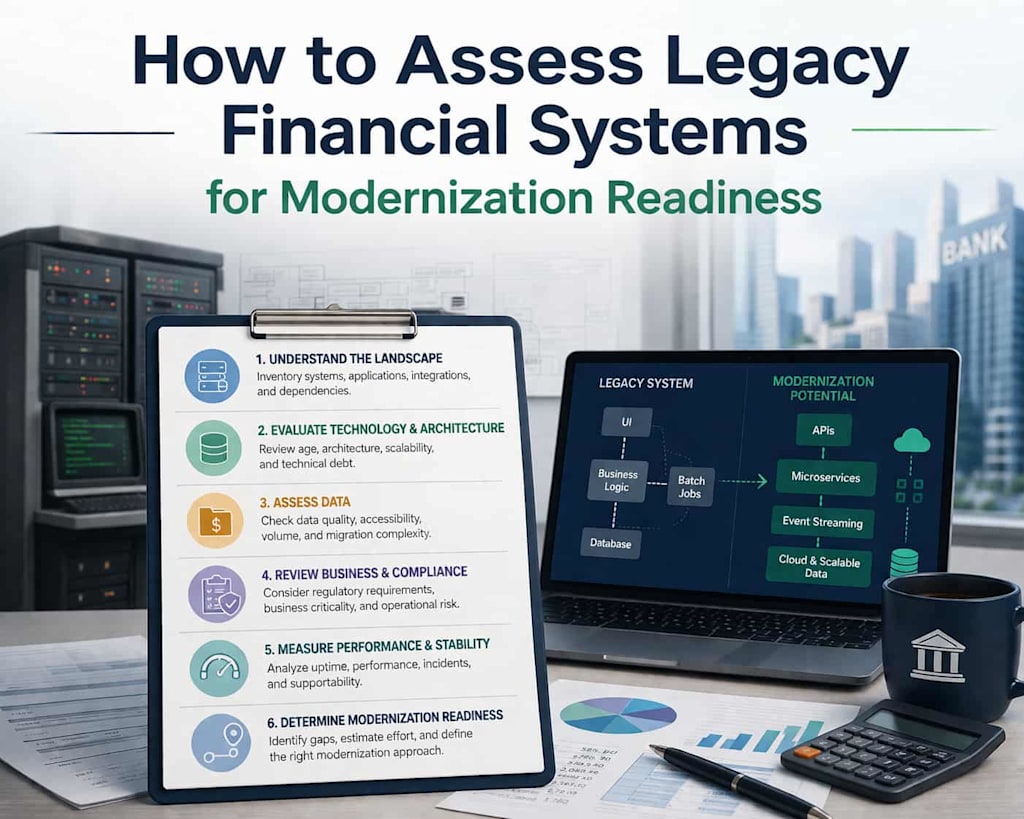
The financial industry is under constant pressure to evolve. From shifting customer expectations to regulatory changes, fintech innovation, and the rise of digital-first banking, financial institutions must modernize their systems to remain competitive. Yet, legacy systems—those monolithic, decades-old platforms—remain at the heart of most banks, insurance firms, and payment providers. Modernization is no longer optional, but assessing readiness is critical before embarking on a costly and complex transformation journey.
This article provides a step-by-step guide to evaluating legacy financial systems for modernization readiness, focusing on technical, operational, and strategic dimensions.
Understanding Legacy Financial Systems
Legacy financial systems are typically large, inflexible software platforms that underpin core banking, insurance, or payment operations. They often rely on outdated technologies such as COBOL, mainframes, or bespoke databases. While reliable in handling day-to-day transactions, they struggle with scalability, integration, and agility.
Key characteristics of legacy systems include:
- Monolithic architecture: Components are tightly coupled, making updates complex and risky.
- High maintenance cost: Patching, upgrading, and staffing often consume disproportionate resources.
- Limited interoperability: Modern APIs or cloud services integration is challenging.
- Operational fragility: Small errors can cascade, causing downtime or transaction errors.
Understanding these characteristics helps establish a baseline for assessing readiness.
Step 1: Define the Goals of Modernization
Before assessing readiness, financial institutions must clarify why modernization is needed. Common goals include:
- Improving agility: Ability to introduce new products, features, or services faster.
- Enhancing customer experience: Modern interfaces, digital onboarding, and real-time services.
- Reducing operational costs: Lower maintenance, staffing, and licensing expenses.
- Regulatory compliance: Meeting GDPR, PSD2, or other regional requirements.
- Enabling innovation: Integration with AI, blockchain, or cloud-native services.
Clearly defining these objectives helps tailor the assessment criteria and informs subsequent decisions on modernization approaches.
Step 2: Conduct a Technical Assessment
Technical evaluation is the backbone of readiness assessment. It involves understanding the current system’s architecture, technology stack, and integration capabilities.
2.1 Architecture and Codebase Review
Assess the system’s architecture to determine how modular or monolithic it is. Key indicators include:
- Modularity: Are components loosely coupled and independently deployable?
- Code quality: Is the code maintainable, documented, and testable?
- Technology stack age: Older languages like COBOL or outdated databases may pose modernization challenges.
A detailed code audit can reveal technical debt, hidden dependencies, and obsolete components that may hinder modernization.
2.2 System Performance and Scalability
Evaluate the system’s performance under peak load and its ability to scale horizontally or vertically. Consider:
- Transaction throughput per second
- Latency for critical operations
- Bottlenecks in processing or database access
Systems struggling under moderate loads may require architectural refactoring before modernization.
2.3 Integration Capabilities
Modern financial operations depend heavily on APIs and third-party integrations. Assess:
- Availability of RESTful or SOAP APIs
- Ease of connecting with cloud services or fintech platforms
- Data exchange formats (JSON, XML, ISO 20022)
Integration limitations can significantly impact the choice of modernization strategy.
2.4 Security and Compliance
Legacy systems may not comply with contemporary security standards. Key areas to examine:
- Authentication and authorization mechanisms
- Data encryption in transit and at rest
- Regulatory compliance adherence
Security vulnerabilities can become critical risks during modernization, especially when migrating to cloud or hybrid environments.
Step 3: Evaluate Business Processes
Legacy financial systems are tightly coupled with operational workflows. Assessing readiness requires mapping system functionality to business processes.
3.1 Process Complexity
Identify which processes are automated, manual, or semi-automated. Complex or manual processes may require redesign during modernization.
3.2 Process Redundancy
Check for overlapping workflows, duplicated operations, or outdated procedures that could be eliminated. Streamlining processes enhances the efficiency of modernization efforts.
3.3 Alignment with Strategic Goals
Evaluate whether current processes support organizational objectives. For example, a bank aiming for real-time payment capabilities may find batch processing systems inadequate.
Step 4: Assess Data Management Practices
Data is the lifeblood of financial institutions. Legacy systems often store critical information in siloed or outdated formats. Assessment should include:
- Data quality: Accuracy, completeness, and consistency across systems
- Data accessibility: Ease of extracting data for reporting, analytics, or migration
- Data governance: Policies for ownership, stewardship, and compliance
- Data migration readiness: Complexity of moving data to modern systems or cloud platforms
Poor data management can derail modernization projects, making early assessment essential.
Step 5: Review Operational Dependencies
Legacy systems often depend on outdated infrastructure, specific vendor products, or niche technical skills. Assessing operational dependencies involves:
- Staff expertise: Availability of personnel who understand legacy code and architecture
- Vendor lock-in: Reliance on proprietary software or hardware that may be expensive or unsupported
- Maintenance cycles: Frequency and cost of patches, upgrades, and incident resolution
Operational dependencies influence both the feasibility and cost of modernization.
Step 6: Evaluate Organizational Readiness
Technology alone does not guarantee successful modernization. Organizational readiness is equally important. Key factors include:
- Leadership support: Executive buy-in for modernization initiatives
- Change management capabilities: Ability to manage cultural resistance and upskill staff
- Budget and resource allocation: Availability of funds, time, and expertise
- Governance and decision-making processes: Clear authority for modernization decisions
A lack of organizational readiness can stall even technically feasible projects.
Step 7: Prioritize Risks and Challenges
After gathering data on technical, operational, and organizational dimensions, it is essential to prioritize risks and challenges. Common categories include:
- Technical risks: Legacy code complexity, poor integration capability, or security vulnerabilities
- Operational risks: Staff attrition, vendor dependency, or process rigidity
- Financial risks: High modernization costs, ROI uncertainty, or regulatory penalties
- Strategic risks: Misalignment with business goals or emerging technology trends
Prioritizing risks helps institutions decide whether to adopt incremental modernization, full-scale replacement, or hybrid strategies.
Step 8: Define Modernization Strategy Options
The assessment should culminate in identifying feasible modernization approaches. Common strategies include:
- Rehosting (“Lift and Shift”): Moving the system to cloud infrastructure without major changes
- Refactoring: Updating code, modularizing components, or improving architecture
- Replatforming: Migrating to a new platform while preserving functionality
- Replacing: Full replacement with modern software or SaaS solutions
Each approach carries trade-offs in cost, time, and risk. The readiness assessment informs which path aligns with organizational capabilities and goals.
Step 9: Develop a Roadmap
A clear modernization roadmap translates assessment insights into actionable steps:
- Phase 1: Immediate remediation of critical technical or security issues
- Phase 2: Pilot modernization of non-critical systems to test strategy
- Phase 3: Gradual migration of core functions to modern platforms
- Phase 4: Optimization and integration of new technologies for competitive advantage
The roadmap should include timelines, budgets, KPIs, and contingency plans for unforeseen challenges.
Step 10: Continuous Monitoring and Feedback
Legacy modernization is not a one-time project but an ongoing journey. Post-assessment, institutions should implement continuous monitoring:
- Track system performance and integration metrics
- Regularly update security and compliance measures
- Gather feedback from business users and IT teams
- Adjust the modernization strategy based on evolving technology and market trends
Continuous monitoring ensures long-term modernization success and reduces the risk of system obsolescence.
Conclusion
Assessing legacy financial systems for modernization readiness is a multidimensional exercise that spans technology, business processes, data management, operational dependencies, and organizational preparedness. Skipping or underestimating this step can result in cost overruns, project delays, or failed transformations.
By following a structured assessment process—defining goals, auditing technical systems, evaluating processes and data, analyzing risks, and aligning with organizational readiness—financial institutions can make informed decisions about the right modernization strategy. Ultimately, a thorough assessment not only mitigates risk but also paves the way for enhanced agility, compliance, innovation, and customer satisfaction in the digital age.
About the Creator
Chudovo
Chudovo is a custom software development company, focused on complex systems implementation.
Enjoyed the story? Support the Creator.
Subscribe for free to receive all their stories in your feed.
Comments
There are no comments for this story
Be the first to respond and start the conversation.