
How to Achieve Cross-Platform Success: A Guide to Flutter and React Native
How you can build Successful Apps with Flutter and React Native


Cross-platform app development has reshaped mobile app creation, allowing businesses to build apps for both iOS and Android using a single codebase. This trend is expected to grow significantly, with companies projected to prioritise cross-platform solutions by 2025 to meet user demands for seamless, fast, and uniform experiences across devices. Frameworks like Flutter and React Native lead the way in this arena, offering powerful options for developing high-performance applications that work across platforms.
In this guide, we’ll dive into what makes cross-platform development essential, explore the differences between Flutter and React Native, and discuss how to choose the best one for your needs.
Why Cross-Platform Development Matters
With the rapid growth of mobile usage and the demand for apps across all devices, businesses increasingly aim to create apps that work seamlessly on both iOS and Android. By 2025, this will become even more critical, as companies look to streamline app development and deliver consistent user experiences. Cross-platform development offers multiple advantages:
- Reduced Costs: Maintaining a single codebase for both platforms lowers development expenses and reduces the resources needed to maintain and update apps.
- Faster Time-to-Market: Developing for multiple platforms simultaneously allows businesses to launch faster and reach a broader audience more efficiently.
- Uniform User Experience: Cross-platform development provides a consistent app experience, which is vital for brand consistency and meeting user expectations.
What is Flutter?
Flutter, created by Google, is an open-source UI toolkit that allows developers to build natively compiled applications across mobile, web, and desktop from a single codebase. It uses Dart, a programming language optimised for Flutter’s architecture, and provides an extensive library of customizable widgets. Flutter’s widget-based approach delivers smooth, high-performance apps, making it ideal for applications requiring detailed UI elements and a consistent look across devices.
What is React Native?
Developed by Facebook, React Native is a popular framework that allows developers to use JavaScript and React to create mobile applications. React Native employs native UI components, which makes the experience feel closer to a traditional native app. Its wide range of libraries and the familiarity of JavaScript make it accessible for teams with a web development background who want to transition into mobile development seamlessly.
Comparing Flutter and React Native: Key Factors
1. Performance
Flutter: Known for its native performance, Flutter compiles to ARM or x86 code directly without needing a JavaScript bridge. This structure ensures smooth performance, particularly beneficial for apps with complex animations.
React Native: React Native’s JavaScript bridge can result in slightly lower performance in animation-heavy apps. However, recent updates are closing this gap, making React Native efficient for a variety of apps.
2. Development Speed
Flutter: Flutter’s extensive library of customizable widgets enables quick UI development. With hot reload functionality, developers can instantly see the results of their changes, which speeds up the iteration process.
React Native: Known for its robust JavaScript ecosystem, React Native provides numerous pre-built components. The hot reload feature also accelerates the development cycle, particularly useful for teams with existing JavaScript expertise.
3. UI Customization
Flutter: Flutter’s widget system ensures consistency across platforms but can look less "native." Its customizability is an asset for brands that prioritise a unique UI.
React Native: React Native uses native UI components, giving apps a look and feel close to native experiences on iOS and Android. However, it may require some additional customization to achieve uniformity across platforms.
4. Community and Library Support
b: While Flutter’s community is growing rapidly, it still has fewer third-party libraries than React Native. However, Google’s support and ongoing development keep Flutter’s library ecosystem expanding.
React Native: With a large and established community, React Native offers extensive third-party libraries and resources, which are particularly helpful for rapid problem-solving and finding specialised solutions.
5. Learning Curve
Flutter: Requires learning Dart, which is not widely known but has an easy-to-learn syntax, particularly for developers familiar with object-oriented programming.
React Native: Since React Native uses JavaScript, which is widely known, it has a shorter learning curve for developers with a background in web development.
Pros and Cons of Each Framework
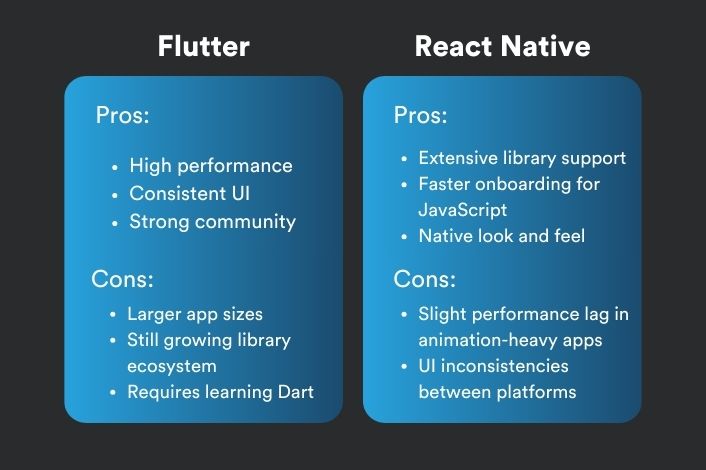
Flutter
Pros:
- High performance, especially with complex animations.
- Consistent UI across platforms
- Strong community and regular updates from Google
Cons:
- Larger app sizes
- Still growing library ecosystem compared to React Native
- Requires learning Dart, which may be unfamiliar to many developers
React Native
Pros:
- Extensive library support and third-party integrations
- Faster onboarding for JavaScript developers
- Native look and feel on both platforms
Cons:
- Slight performance lag in animation-heavy apps due to the JavaScript bridge
- UI inconsistencies between platforms may require additional customization
Popular Apps Built with Flutter and React Native
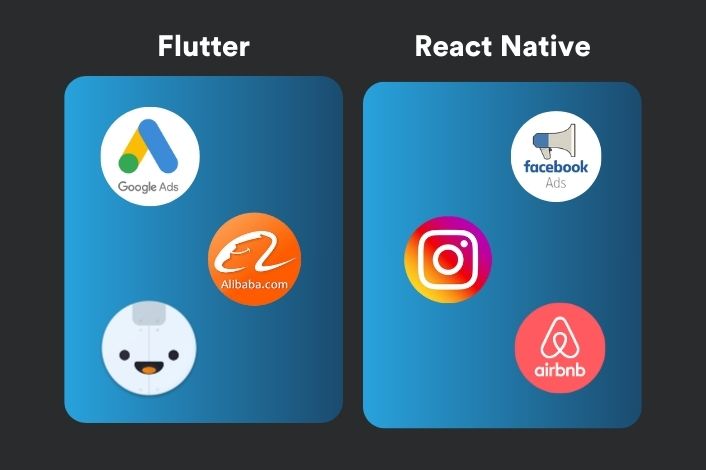
Apps Built with Flutter
- Google Ads: Google Ads utilises Flutter’s custom widgets to provide a streamlined, consistent experience across devices.
- Reflectly: This mental wellness app relies on Flutter for smooth animations and a highly customizable UI.
- Alibaba: Known for its global e-commerce platform, Alibaba uses Flutter to create responsive, user-friendly applications.
Apps Built with React Native
- Instagram: Uses React Native for features that require seamless navigation and a close-to-native experience.
- Facebook Ads: As an extension of Facebook, this app utilises React Native’s capabilities to handle high data loads and complex interactions.
- Airbnb: Known for its user-friendly design, Airbnb’s app utilises React Native to maintain a consistent experience across devices.
Conclusion
Choosing between Flutter and React Native ultimately depends on your project requirements, team expertise, and desired performance outcomes. Both frameworks are excellent for creating high-quality cross-platform applications for iOS and Android, but factors like UI complexity, developer familiarity, and long-term scalability will guide your decision.
Build Your Mobile App with Expert Flutter and React Native Development Services

If you’re ready to create dynamic, fast, and scalable mobile applications, consider partnering with a mobile app development company experienced in Flutter and React Native. Companies like VT Digital offer app development services designed to deliver sleek UI designs, efficient cross-platform solutions, and robust app performance tailored to your goals.
About the Creator
VT Digital
We are a Sydney-based Software Development Company offering services in UI/UX Design, Mobile App Development, Website Development, E-Commerce Development, and AI Development. Innovate, Elevate, and Succeed with VT Digital.
Enjoyed the story? Support the Creator.
Subscribe for free to receive all their stories in your feed.
Comments
There are no comments for this story
Be the first to respond and start the conversation.