
How .NET MAUI Is Powering Cross-Platform App Development in 2026
A Practical Guide to Building Modern Cross-Platform Applications

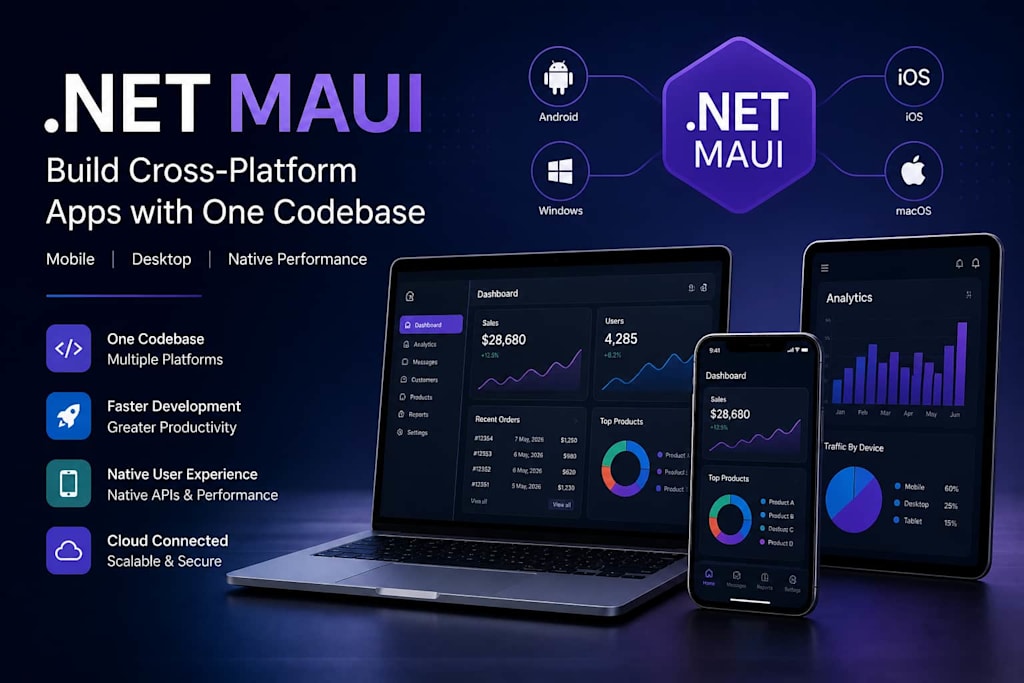
In 2026, businesses are no longer developing separate applications for iOS, Android, and desktop environments. Instead, the focus has shifted toward unified development approaches that reduce complexity while maintaining performance and user experience.
.NET MAUI (Multi-platform App UI) has emerged as one of the key frameworks supporting this transition. Built as the evolution of Xamarin, it allows developers to create cross-platform applications using a single codebase while still delivering native-like experiences.
But beyond the technology itself, what matters is how real-world applications are built, maintained, and scaled using .NET MAUI.
Why .NET MAUI Is Gaining Adoption
The appeal of .NET MAUI lies in its ability to simplify development without sacrificing control.
In practical terms, it enables:
- a shared codebase across mobile and desktop platforms
- integration with the broader .NET ecosystem
- access to native APIs when needed
- faster development cycles compared to separate platform builds
For companies managing multiple platforms, this significantly reduces both development time and long-term maintenance costs.
However, adopting .NET MAUI is not just a technical decision—it also changes how development teams approach architecture and delivery.
The Reality of Cross-Platform Development
Despite the promise of “write once, run everywhere,” real-world development with .NET MAUI involves navigating several challenges.
Applications often need to:
- adapt UI components to different platforms
- handle performance differences between devices
- integrate with platform-specific services
- ensure consistent user experience across environments
This means that while the codebase may be shared, the development process still requires careful planning and testing.
What Development Looks Like in Practice
In enterprise and business applications, .NET MAUI is typically used in scenarios such as:
- internal business tools used across desktop and mobile
- customer-facing apps that need consistent branding
- SaaS platforms with both web and mobile extensions
- applications requiring integration with backend systems
A common pattern involves building a shared core application while customizing certain UI or performance-critical elements for specific platforms.
This hybrid approach allows teams to maintain efficiency while still delivering high-quality user experiences.
Companies Working with .NET MAUI
Across different regions, a number of development teams are actively working with .NET MAUI on real-world projects. While their approaches may vary, they are typically involved in building and maintaining cross-platform applications that require long-term stability.
Some of these companies include:
- Chudovo
- Webect Digitalagentur
- eWebcd
- Sitegeist
- Weichie
These companies operate in different markets and are often involved in projects that combine mobile, desktop, and backend systems within a unified architecture.
How Teams Approach .NET MAUI Projects
Looking at how .NET MAUI is used in practice, several patterns emerge across development teams.
Shared Core with Platform Adaptation
Instead of forcing identical behavior across all platforms, teams typically build a shared application core and adapt specific components for each platform.
This ensures consistency while respecting platform-specific requirements.
Integration with Existing Systems
Many applications built with .NET MAUI are not standalone. They are connected to:
- enterprise backend systems
- APIs and microservices
- cloud-based infrastructure
This makes integration a central part of the development process.
Focus on Long-Term Maintainability
Because cross-platform applications must evolve over time, maintainability becomes a key priority.
Teams focus on:
- clean architecture
- modular code structure
- clear separation of concerns
This allows applications to grow without becoming difficult to manage.
Performance Optimization
While .NET MAUI provides a shared framework, performance tuning is still necessary.
Developers often optimize:
- UI rendering
- data handling
- device-specific behavior
to ensure smooth performance across all supported platforms.
Challenges in .NET MAUI Development
Like any framework, .NET MAUI comes with its own set of challenges.
Platform Differences
Even with a shared codebase, differences between iOS, Android, and desktop environments require additional effort.
Learning Curve
Teams transitioning from Xamarin or other frameworks must adapt to new structures and tools.
Tooling Maturity
Although .NET MAUI has matured significantly, certain tools and workflows are still evolving.
Testing Complexity
Testing across multiple platforms increases the complexity of quality assurance processes.
Why Experience Matters
In cross-platform development, the framework alone does not guarantee success.
What matters is how teams handle:
- platform-specific challenges
- long-term maintenance
- integration with complex systems
- performance optimization
Teams that have experience working across multiple environments are better equipped to deliver stable and scalable applications.
The Future of .NET MAUI
Looking ahead, .NET MAUI is expected to continue evolving as part of the broader .NET ecosystem.
Key trends include:
- deeper integration with cloud services
- improved performance and tooling
- wider adoption in enterprise applications
- expansion into new device categories
As businesses continue to look for efficient ways to manage multi-platform development, frameworks like .NET MAUI will play an increasingly important role.
Final Thoughts
.NET MAUI represents a shift toward more unified application development. However, its success depends not just on the framework itself, but on how it is used in real-world scenarios.
The companies and teams working with .NET MAUI today are not just building applications—they are navigating the complexities of cross-platform development, ensuring consistency, and planning for long-term evolution.
In 2026, building successful applications is less about choosing a single platform and more about creating systems that work seamlessly across all of them.
About the Creator
Chudovo
Chudovo is a custom software development company, focused on complex systems implementation.
Enjoyed the story? Support the Creator.
Subscribe for free to receive all their stories in your feed.
Comments
There are no comments for this story
Be the first to respond and start the conversation.