
The first thing you'd notice on Mercury is how close it is to the sun. It's actually the planet closest to the big ball of fire and the smallest but it isn't the hottest planet. Venus takes credit for that it takes earth 365 days to orbit the sun and it takes mercury more than three months, well 88 days to be exact. The days are boiling hot with a temperature reaching above 800 degrees Fahrenheit but on the other side of the planet that the sun doesn't reach, the temperatures drop to negative 300 degrees Fahrenheit. Mercury's atmosphere can't hold any heat when it's nighttime, just like a desert. Deserts have no atmosphere which is why they have no moisture and no clouds of rain
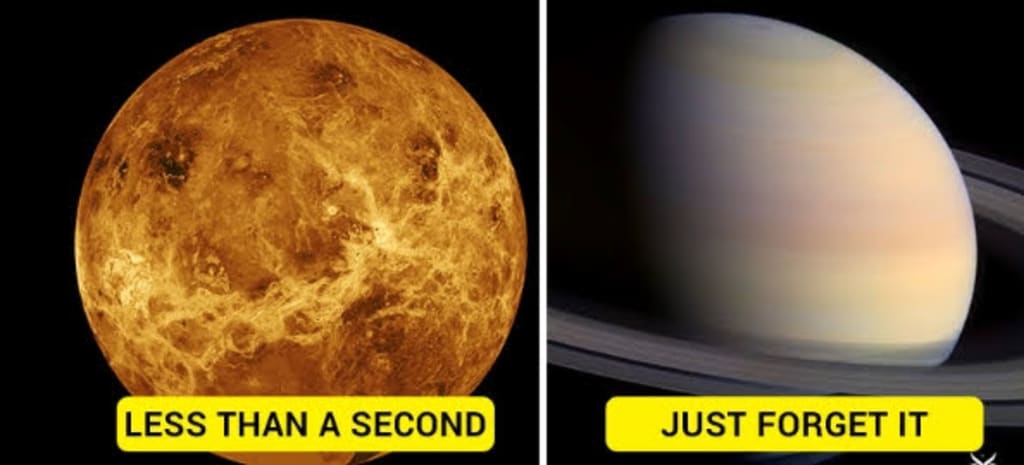
You can survive if you can travel from one end of the world to the other and always stay between the sweltering heat and bitter cold. In addition, there is a magnetic field that contains solar winds from the Sun that produce plasma tornadoes. However, oxygen is not friendly to Mercury's atmosphere, thus you only live for as long as you can hold your breath. Venus has temperatures that can reach about 1000 degrees, but its gravity is very close to that of Earth. You can go for walks by the mountains or even go jogging, but the heat will rapidly melt you and the intense pressure will crush you like a can.You wouldn't last more than a few seconds on Venus since it would be like being half a mile underwater.
Despite being called the red planet, it has a volcano and the tallest peak in the solar system, which is about three times as tall as Mount Everest. Since Mars rotates around the sun in 687 days, or little under two years, it is actually quite cold. It has 25 hours in a day, almost exactly like Earth. There are numerous dust storms that cover the entire globe and carbon dioxide-covered polar caps, and the atmosphere there is very thin yet unbreathable.
You won't get cold where you are, but you'd need some heavy clothing. It's possible to stay warm for as long as If you can maintain your breath while using the On the plus side, you'd get to watch some amazing views. The largest planet in the solar system is the powerful Jupiter. If that was the size of a basketball, Earth would only be a single grape's size in relation to it. It rotates in just 10 hours. the distance around its much shorter axis than Earth's. Among the top tourism destinations among the Great Red Spot's attractions is the region where a hurricane-like storm is more than three hundred years old, and the area is roughly twice as big as Earth.
The time it takes the largest planet in our solar system to complete one round of the Sun is approximately 12 Earth years, or 4 307 days. However, despite the absence of oxygen and winds that can hold you suspended in the air for long, Jupiter has much more gravity than Earth does. You would be crushed by the tremendous pressure. It won't take more than a few seconds to visit here. Due to its distance from the Sun, Pluto, a former planet, is now regarded as a dwarf planet. Pluto is one of the coldest places on Earth, with temperatures reaching -400 degrees Fahrenheit. You should definitely pack a jacket or two. Methane ice covers the mountains, which rise to a height of over 10,000 feet.
Pluto needs 248 years to orbit the sun, although it is still rotating and officially waiting to celebrate New Year's. Surprisingly, Pluto only needs six Earth days to complete a spin around itself, and in addition to the surrounding methane, nitrogen is also rather widespread. Since there is little gravity, you would have to hold your breath while floating in the air to avoid turning into an ice cube. once more, you would only survive for a short while. Neptune has 14 moons encircling its Earth-like core, making it the windiest planet in our solar system. A day on Earth is quite brief. You would only have 17 hours in a day, and Pluto takes more than 150 years to complete one orbit of the Sun. Because methane in the hydrogen helium atmosphere absorbs red light, Neptune is also referred to as The Blue Planet. As on Jupiter, the pressure on Neptune can cause you to pass out in addition to not being able to breathe. No one can survive there for more than a few seconds.
The second-largest planet is none other than Saturn, which has distantly encircling rings. Despite the fact that its rings actually consist of numerous layers of ice particles and rocks of all sizes, from tiny pebbles to bust-sized items, they appear to be one large piece of rocks revolving around. Due to gravity, the Rings are shaped as they are. Saturn has a day that only lasts 11 hours. As with Jupiter, Saturn has a lot of moons, and the upper atmosphere is extremely windy. As with Jupiter, you wouldn't last more than a few seconds under these conditions because, like Jupiter, you would be crushed by intense pressure deep inside the planet before you could open your eyes. Titan, the largest moon of Saturn and the second largest moon in the solar system, possesses conditions that are the closest to those on Earth of any planet or moon now known to exist, making life there a breeze.
The fourth planet from the sun is Mars. a chilly, dusty desert world. Mars is a dynamic planet as well, with seasonal polar ice caps, extinct volcanoes in canyons, and evidence that it was formerly far more active. Since Mars has a lower gravity than Earth and is further away from the Sun, there is less sunlight there. Due to its thin atmosphere, Mars also lacks a shielding magnetic field, exposing everything to radiation. A planet-wide dust storm can occasionally be caused by powerful winds, and the dust continues to settle for months.
About the Creator
Enjoyed the story? Support the Creator.
Subscribe for free to receive all their stories in your feed.
Comments
There are no comments for this story
Be the first to respond and start the conversation.