
How AI Writing Tools Are Changing the Way We Create Content
A beginner-friendly look at how AI-powered SaaS tools are helping writers create content faster, smarter, and with more confidence.

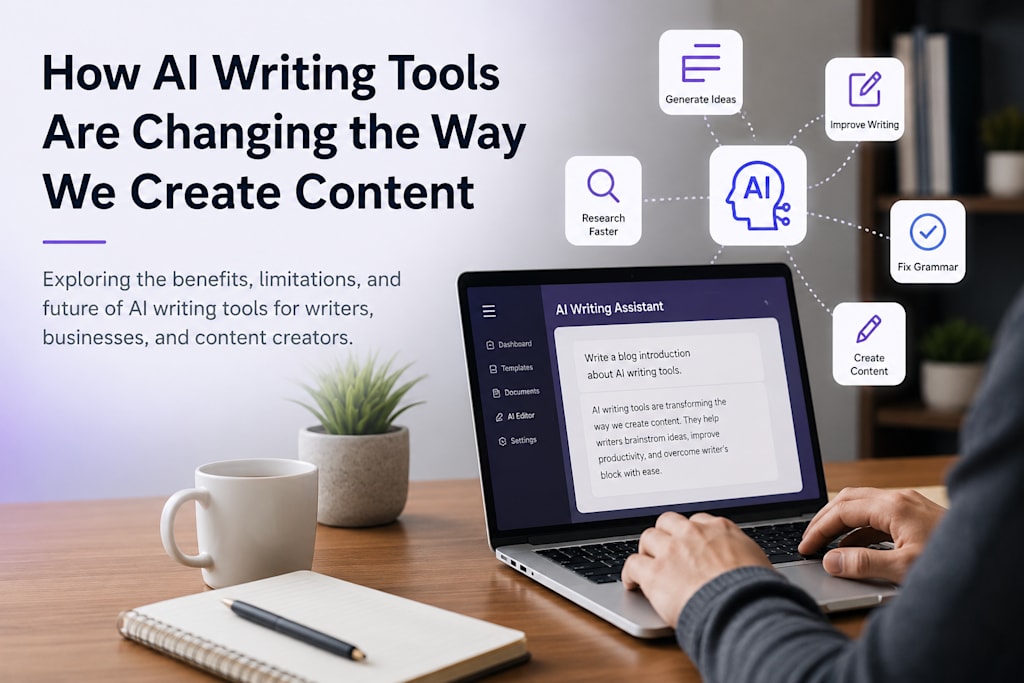
Writing has always required time, patience, research, and creativity. Whether someone is working on a blog post, social media caption, product description, email, or business proposal, turning ideas into clear words can sometimes be difficult.
Today, artificial intelligence is changing that process.
AI-powered writing tools are becoming common among content writers, marketers, business owners, students, and creators. These tools can help people generate ideas, improve sentences, correct grammar, organise information, and overcome writer’s block.
However, AI writing tools are not simply replacing writers. Instead, they are changing how writers work.
What Are AI Writing Tools?
AI writing tools are software platforms that use artificial intelligence to understand instructions and generate written content.
A user may provide a simple prompt, topic, question, or description. The tool then creates text based on that information.
Depending on the platform, an AI writing tool may help with:
- Blog post ideas
- Article outlines
- Social media captions
- Email drafts
- Product descriptions
- Headlines and titles
- Grammar correction
- Content summaries
- Rewriting and editing
- Search engine optimisation
Many of these tools are available as SaaS products.
SaaS stands for “Software as a Service.” It means users can access the software online instead of installing it permanently on a computer. Most SaaS writing tools offer free plans, monthly subscriptions, or premium packages.
Why Are AI Writing Tools Becoming Popular?
One of the main reasons for their popularity is speed.
A writer may spend several minutes thinking about the perfect headline or opening paragraph. An AI tool can generate multiple suggestions in seconds.
This does not mean that every suggestion will be perfect. However, it can give the writer a useful starting point.
AI writing tools are also popular because they make content creation more accessible. Someone who is not confident in their grammar or writing skills can use these tools to improve clarity and structure.
Small businesses can use them to prepare marketing content. Freelancers can use them to organise their ideas. Content creators can use them to maintain a regular publishing schedule.
The Benefits of Using AI Writing Tools
1. They Help Overcome Writer’s Block
Writer’s block can happen when someone knows what they want to discuss but does not know how to begin.
AI tools can suggest titles, introductions, headings, questions, and content angles. These suggestions can help writers move past the blank page.
2. They Save Time
AI tools can speed up early stages of writing, such as brainstorming, outlining, and drafting.
Writers can then spend more time improving the content, checking facts, and adding their own experiences.
3. They Improve Grammar and Readability
Some AI tools can identify grammar mistakes, awkward sentences, repeated words, and unclear language.
This can be especially helpful for writers who are creating content in a language that is not their first language.
4. They Generate Multiple Ideas
Sometimes, one idea can be presented in many different ways.
An AI writing tool can suggest different headlines, tones, structures, and approaches. The writer can then choose the option that best suits the audience.
5. They Support Different Types of Content
AI writing tools are not limited to blog posts.
They can assist with emails, advertisements, website copy, scripts, reports, descriptions, newsletters, and social media content.
The Limitations of AI Writing Tools
Although AI tools are useful, they are not always accurate.
They may generate incorrect information, repeat common ideas, misunderstand instructions, or produce content that lacks personality.
AI-generated writing may also sound generic when it is published without editing.
This is why human involvement remains important.
A writer should always review the content, check facts, improve the tone, remove unnecessary information, and add original thoughts.
AI can produce words, but the writer is responsible for making those words useful and trustworthy.
AI Should Be an Assistant, Not the Entire Writer
The best way to use AI is to treat it as a writing assistant.
A good writer does not simply copy the first answer generated by a tool. Instead, the writer uses AI to support research, planning, editing, or brainstorming.
The final content should still reflect the writer’s voice, judgement, experience, and understanding of the audience.
For example, an AI tool may create an outline for a review, but the writer should add personal observations about the product.
It may generate a list of benefits, but the writer should confirm whether those benefits are accurate.
It may suggest an introduction, but the writer should rewrite it so that it feels natural and original.
How to Choose an AI Writing Tool
There are many AI writing platforms available, so selecting the right one depends on the user’s needs.
Before choosing a tool, consider the following questions:
- Is it easy to use?
- Does it offer a free trial?
- What types of content can it create?
- Does it provide editing features?
- Can users control the writing tone?
- Is the pricing suitable?
- Does it protect user data?
- Does it support the required language?
- Are the generated results accurate and useful?
Reading independent reviews and testing free versions can help users make better decisions.
A tool that works well for social media captions may not be the best choice for long-form articles. Similarly, a platform designed for marketing teams may be too expensive or complicated for an individual writer.
The Future of AI and Content Writing
AI writing technology will continue to develop.
Future tools may offer better personalisation, stronger research features, more accurate editing, and improved understanding of different writing styles.
However, human creativity will remain valuable.
Readers connect with real experiences, honest opinions, emotions, stories, and unique perspectives. These are areas where human writers continue to play an essential role.
The future of writing may not be a competition between humans and AI. It may be a partnership in which technology handles repetitive tasks while people focus on creativity, strategy, and meaningful communication.
Final Thoughts
AI writing tools are making content creation faster and more accessible. They can help writers brainstorm ideas, create outlines, improve grammar, and prepare early drafts.
At the same time, they must be used responsibly.
Writers should check facts, respect intellectual property, avoid copying other people’s work, and clearly disclose when AI has supported the content.
AI can help someone write more efficiently, but quality still depends on human judgement.
The most valuable content will always be content that is accurate, helpful, original, and created with the reader in mind.
AI Disclosure: This article was created with the assistance of an AI writing tool and was reviewed and edited by the author before publication.
About the Creator
Sophie Bennett
I’m a content writer who explores and reviews digital tools, websites, apps, and online platforms. My goal is to share clear, honest, and easy-to-understand reviews that help readers choose the right tools for their needs.
Enjoyed the story? Support the Creator.
Subscribe for free to receive all their stories in your feed.
Comments
There are no comments for this story
Be the first to respond and start the conversation.