
How AI market intelligence reports influence brand strategy in the age of AI search
Why brands need stronger AI market intelligence once visibility alone stops explaining who gets recommended


Within today's rapidly evolving discovery landscape, brands can no longer rely exclusively on traditional SEO reports to understand their market position.
This article is adapted from LLM Authority Index’s article, Best AI Market Intelligence Reports for AI Search in 2026, exploring how market intelligence reporting must keep pace with the AI-generated answers that now shape buyer consideration and brand visibility.
AI-driven search has dramatically altered how brands are discovered, recommended, and compared.
Traditional SEO metrics alone are no longer enough; modern marketing, brand, and executive teams must understand and measure how AI systems recommend or exclude brands at the crucial moment of buyer choice.
This article distills the essentials of effective AI market intelligence reporting for 2026, provides practical frameworks for tracking brand performance in AI answers, and highlights the strategic implications for those looking to secure their share in this new discovery environment.
- AI Recommendation Share is a critical metric tracking not just if a brand is mentioned, but if it is actually recommended in AI-generated answers.
- Separation of high-intent (purchase-driven) and low-intent (informational) prompts is essential for accurate reporting.
- Citation visibility knowing which sources AI relies upon has become a major factor in shaping answers and brand credibility.
- Reports must interpret data in a competitive context, distinguishing true commercial impact from raw mention counts.
- Actionable intelligence linking measurement to strategic action is necessary for teams seeking market advantage.
Why Traditional SEO Reporting Is No Longer Enough
While legacy SEO reports track impressions, rankings, and backlinks, they seldom address the new reality: buyers increasingly ask AI systems for recommendations, comparisons, and alternatives receiving curated answers that shape the competitive field before a click ever occurs.
In this AI-powered environment:
- Visibility does not equal recommendation. A brand may be present in general answers but absent or unfavorably positioned in buyer-choice scenarios.
- The answer itself, not just the search result, determines shortlist inclusion and perception.
Modern market intelligence must shift from counting traffic to analyzing how AI systems present, prioritize, or leave out brands during decision moments.
For a clearer explanation of why visibility alone can mislead, read Why Share of Voice Is a Broken Metric in AI Search, which shows why being mentioned often is not the same as being recommended when AI systems shape buyer choice.
Defining AI Market Intelligence Reporting
An AI market intelligence report is a focused analysis of how AI systems describe, compare, cite, recommend, or exclude brands within a given category.
Key differences from traditional reporting include:
- Moving beyond web traffic, it measures “AI search visibility” how brands are shown, ranked, and discussed within AI-generated answers.
- Emphasis on the "recommendation layer," identifying when a brand is actively suggested to buyers seeking solutions.
- Recognition that simple mention counts or broad visibility don’t capture competitive position or buyer influence.
Core metrics in a strong AI market intelligence report:
- AI Recommendation Share: The percentage of AI-generated answers recommending or ranking a brand in buyer-choice contexts.
- Competitor Visibility: Which rival brands AI identifies as credible options.
- Recommendation Rank: Positioning within lists or answer sets.
- Citation Visibility: Which sources inform and shape the AI’s responses.
- Sentiment and Framing: How positively or negatively the brand is described.
- Prompt-Level Gaps: Identification of which buyer questions exclude the brand.
- Category Association: Whether the brand is grouped with commercially relevant use cases.
The Importance of AI Recommendation Share
Counting brand mentions, while easy, often leads teams astray. Not every appearance in AI answers is valuable; what matters is if the brand stands out when buyers ask for recommendations.
AI Recommendation Share is the decisive metric for executive teams in 2026. It emphasizes:
- Buyer's moment of choice: Is your brand shortlisted, recommended, or positioned as an “alternative” to avoid?
- Outcome, not just output: A brand wins when AI includes and recommends it for real purchase intent not just when it is mentioned.
Other visibility metrics such as Share of Voice or generic mentions can create a misleading sense of security if not dissected by prompt intent and recommendation strength.
Separating High-Intent from Low-Intent Prompts
Not all AI queries are created equal. Leading reports distinguish:
- High-intent prompts: These signal direct buyer investigation (“Which platform should I choose?” “Best alternatives to X?”).
- Low-intent prompts: These are educational or informational, less likely tied to commercial decisions.
Blending all queries creates reporting noise and can hide weaknesses where they matter most at the point of purchase consideration. The most actionable reports cluster prompts by intent, tracking performance where buyer decisions begin and end.
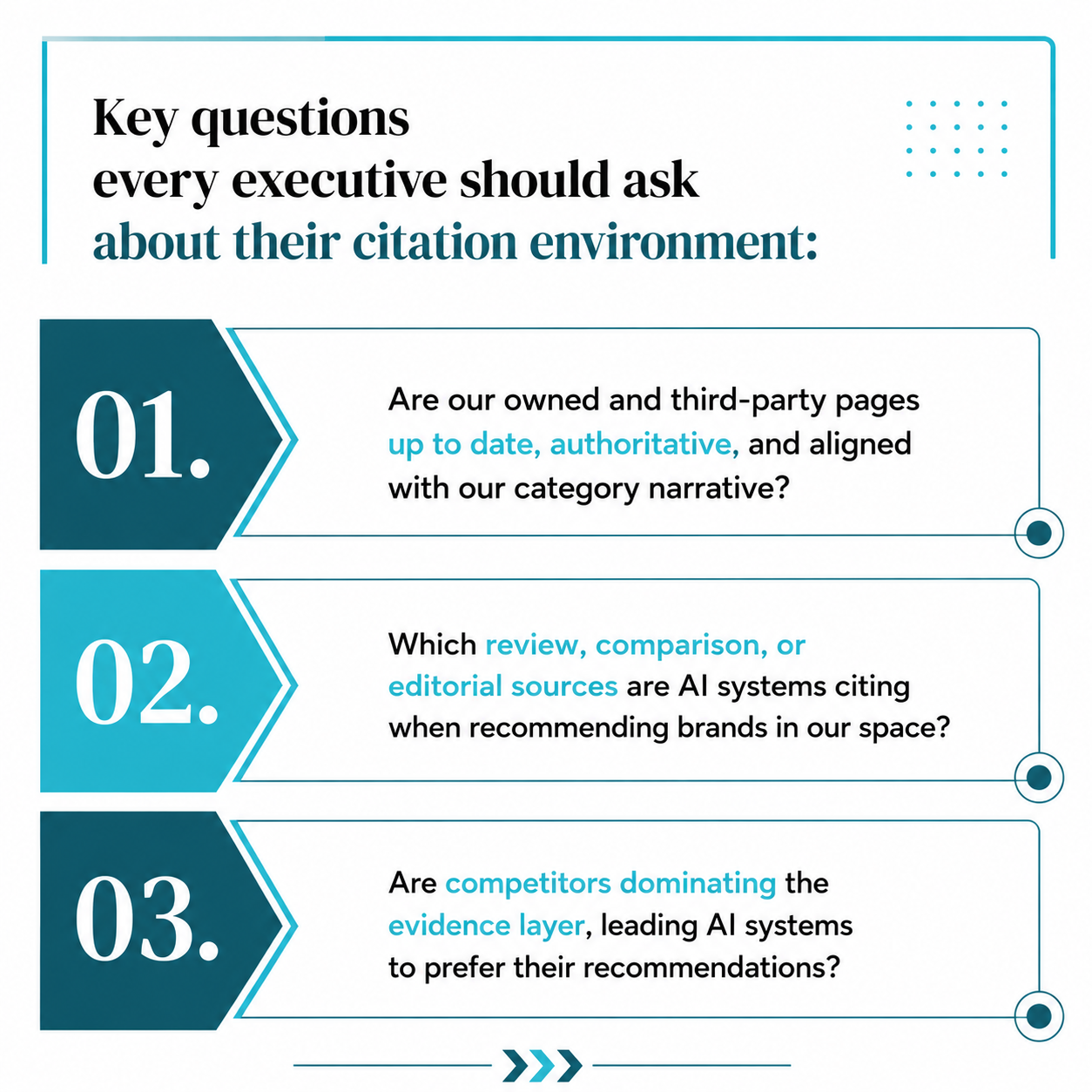
Citation Architecture: The Evidence Layer Behind AI Answers
AI does not rely solely on a brand’s own site. Its answers may draw from:
- Company and product pages
- Comparison articles and review platforms
- Industry databases, editorial content, communities, forums, documentation, podcasts, and even videos
This network constitutes a brand’s citation architecture and the public source environment underpinning how AI forms answers. Weaknesses here can lead AI to favor competitors or outdated impressions, despite recent marketing efforts.
Citation visibility in reporting reveals:
- Which sources are driving AI-generated market narratives
- Where competitor-rich or inaccurate sources may be diluting a brand’s position
- Opportunities for improving or diversifying cited content
If you want a practical framework for tracking this, read How to Measure Your Company’s Presence in AI Search, which explains how to evaluate inclusion, ranking, positioning, and prompt-level visibility in a commercially useful way.
From Data to Insight: What Makes a Report Executive-Ready
Executives and strategic teams need interpretation, not just data.
These reports provide not just a temperature check, but a roadmap for action clarifying where marketing, PR, SEO, or content investments can actually influence outcomes.
Types of AI Market Intelligence Reports
There is no single “right” report, but teams should understand the boundaries and best-use cases:
- Basic AI mention report: Detects if the brand appears at all (but risks equating all mentions).
- Prompt-level visibility report: Pinpoints gaps and specific exclusions.
- AI Share of Voice report: Summarizes overall AI response volume, blending all intent levels.
- AI Recommendation Share report: Focuses narrowly on buyer-choice prompts and recommendations.
- Citation visibility report: Maps source influence and authority environment.
- Competitor visibility report: Measures which rivals AI selects and recommends.
- Sentiment and framing report: Tracks reputation and description quality.
- Executive market intelligence report: Synthesizes data into strategic advice and risk assessment.
Mature organizations often deploy multiple report types but always clarify intent and impact for leadership.
How to Evaluate AI Market Intelligence Reports
Not all reports are created equal. Use these criteria for evaluation:
- Prompt design: Does the report focus on high-intent prompts aligned to real buyer behavior?
- Competitor set: Are the right competitors tracked and compared?
- Recommendation tracking: Is recommendation (not just presence) the primary metric?
- Positioning and rank: Are you first, or just among many options?
- Citation analysis: Which sources are shaping the AI’s view of your brand?
- Sentiment and category relevance: Are you described accurately and in commercially meaningful ways?
- Executive focus and actionability: Does the report clearly signal next steps or system weaknesses?
- Trend and change tracking: Are shifts in AI visibility explained over time?
The strongest reports blend measurement and meaningful business interpretation, not just dashboards or exports.
Common Pitfalls in AI Visibility Reporting
Beware of these frequent errors:
- Counting all mentions as wins: Not every appearance is equal recommendation and rank matters most.
- Score blending: Mixing low- and high-intent prompts hides performance at buyer decision points.
- Neglecting competitor context: Your position is only meaningful relative to direct rivals.
- Ignoring citations: Unseen weaknesses in your evidence layer can bias AI answers.
- Reporting without insight: Metrics without interpretation waste executive attention.
Strategic Lessons for Marketers and Executives
The modern discovery landscape demands:
- Rigorous measurement of how AI systems present and recommend brands
- A focus on high-intent prompts and effective citation architecture
- Reports that prioritize commercial impact, not vanity metrics
- Strategic interpretation that enables corrective action
Marketers, founders, SEO leaders, and brand strategists who master these principles will secure crucial visibility and recommendation-stage influence in an increasingly AI-mediated buyer journey.
About the Creator
Diana Brooks
A data nerd sharing case studies and observations on modern buying behavior, product discovery, and digital trust.
Enjoyed the story? Support the Creator.
Subscribe for free to receive all their stories in your feed.
Comments
There are no comments for this story
Be the first to respond and start the conversation.