
How AI Automation Is Transforming Supply Chain and Logistics
AI automation in the supply chain is not a trend. It is a structural shift in how goods move, decisions get made, and operations scale.
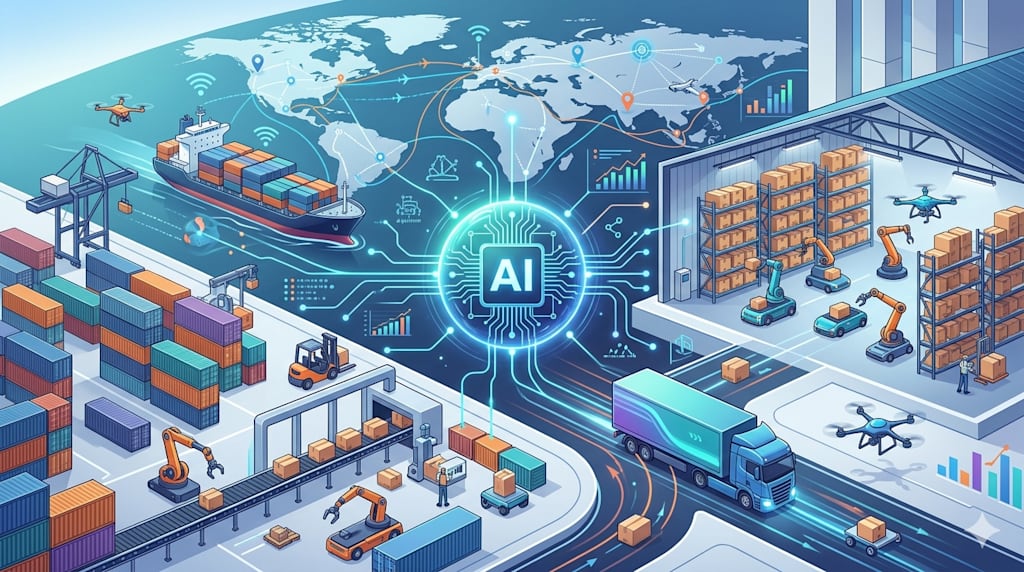
Supply chains have always been complex. But over the past decade, that complexity has multiplied. Global disruptions, shifting consumer expectations, rising fuel costs, and labor shortages have exposed how fragile traditional logistics networks can be.
AI automation in the supply chain is not a trend. It is a structural shift in how goods move, decisions get made, and operations scale. Companies that once relied on spreadsheets, manual forecasting, and reactive decision making are now deploying intelligent systems that anticipate problems before they occur, optimize routes in real time, and manage inventory with a level of precision that no human team could sustain at scale.
This guide breaks down what AI automation in the supply chain actually means, where it delivers the most value, and how businesses can move from curiosity to implementation.
What Is AI Automation in Supply Chain?
AI automation in supply chain refers to the use of artificial intelligence technologies, including machine learning, natural language processing, computer vision, and predictive analytics, to streamline, optimize, and in some cases fully manage logistics and supply chain operations.
Unlike traditional automation that follows fixed rules, AI systems learn from data. They improve over time, adapt to changing conditions, and make decisions based on patterns that humans would take far longer to detect.
The scope covers everything from the moment a raw material is ordered through to final delivery at the customer's door. AI touches demand planning, procurement, warehouse operations, transportation, customs compliance, and last mile logistics.
Why Supply Chain Leaders Are Prioritizing AI Now
Several forces have converged to make AI adoption in supply chain not just appealing but necessary.
First, data volumes have grown beyond what human teams can process. Modern supply chains generate millions of data points daily across suppliers, warehouses, carriers, and customers. AI systems process this data continuously without fatigue.
Second, customer expectations have tightened. Two day delivery is now a baseline expectation in many categories. Businesses that cannot predict demand accurately, route shipments efficiently, or communicate proactively with customers fall behind.
Third, disruption has become the norm. The COVID pandemic, port congestion, geopolitical instability, and climate events have shown that reactive supply chains carry enormous financial risk. AI gives companies the ability to model scenarios, identify risk exposure, and respond faster.
Fourth, labor costs and shortages have increased pressure to automate. Warehouse labor in particular has become expensive and difficult to retain. AI powered robotics and autonomous systems offer a path to consistent output without the volatility of a fully human workforce.
Key Areas Where AI Automation Is Making an Impact
Demand Forecasting and Inventory Planning
Inaccurate demand forecasting leads to two equally damaging outcomes: overstocking, which ties up capital and warehouse space, or stockouts, which cost sales and damage customer relationships.
AI forecasting systems analyze historical sales data, seasonal trends, external signals like weather and economic indicators, promotional calendars, and even social media activity to build more accurate demand models. These systems update in near real time, adjusting forecasts as conditions change rather than waiting for monthly planning cycles.
The result is leaner inventory, lower carrying costs, and fewer lost sales. For businesses with thousands of SKUs across multiple locations, this level of precision is simply not achievable through manual processes.
Procurement and Supplier Management
AI is changing how businesses select, monitor, and manage suppliers. Machine learning models can evaluate supplier performance across dozens of variables: on time delivery rates, quality scores, pricing patterns, geopolitical exposure, and financial stability signals.
Risk scoring models flag potential disruptions before they occur, giving procurement teams time to activate backup suppliers or adjust orders. Natural language processing tools analyze supplier contracts, identify unfavorable terms, and flag compliance risks faster than any legal or procurement team could manage manually.
AI also enables more dynamic procurement. Rather than placing orders on fixed schedules, intelligent systems can evaluate real time market pricing, anticipate supply shortages, and recommend optimal order timing to reduce cost.
Warehouse Operations and Robotics
The modern AI warehouse is a fundamentally different environment from the manual picking and packing operations of even a decade ago.
Computer vision systems track inventory in real time, identifying misplaced items, detecting damage, and guiding automated picking robots to the right locations. Machine learning algorithms optimize pick paths, reducing the distance traveled per order and increasing throughput without additional labor.
Autonomous mobile robots operate alongside human workers, handling repetitive transport tasks. AI scheduling systems assign work dynamically, balancing labor and robot capacity to handle fluctuating order volumes efficiently.
Predictive maintenance AI monitors equipment health continuously, identifying patterns that precede mechanical failures. Rather than waiting for a conveyor belt or forklift to break down during peak season, maintenance teams receive alerts and take action during planned downtime windows.
Transportation and Route Optimization
Logistics networks involve thousands of routing decisions every day. AI systems process real time traffic data, weather conditions, delivery windows, vehicle capacity constraints, and fuel costs to generate optimal routes dynamically.
This goes beyond simple navigation. AI route optimization considers the full fleet simultaneously, re routing vehicles in real time when conditions change and reassigning deliveries to maintain on time performance. The fuel savings alone can be substantial across large fleets.
For freight carriers and shippers, AI also powers dynamic load planning, maximizing the utilization of each vehicle and reducing the number of trucks on the road. This reduces cost per shipment and environmental impact simultaneously.
Last Mile Delivery
Last mile delivery is the most expensive and operationally complex segment of the logistics chain. It accounts for a significant share of total shipping costs, often between 40 and 50 percent, and it is where customer experience is most directly affected.
AI addresses last mile challenges in multiple ways. Predictive delivery windows give customers accurate time estimates and proactive updates. Route density optimization reduces the cost per stop. Failed delivery prediction models identify high risk addresses and trigger proactive interventions before a delivery attempt fails.
Autonomous delivery vehicles and drones, still in early deployment phases, represent the longer term transformation of last mile logistics, particularly for dense urban environments and remote locations.
Real Time Visibility and Control Towers
One of the most valuable AI applications in supply chain is not about physical operations at all. It is about visibility.
AI powered supply chain control towers aggregate data from across the network: suppliers, carriers, warehouses, customs, and customers. Machine learning models analyze this data continuously, surfacing exceptions, flagging risks, and generating recommended responses.
Instead of a logistics manager spending hours manually tracking shipments across multiple portals, an AI system monitors everything simultaneously and surfaces only what needs human attention. This shifts the role from manual monitoring to strategic decision making.
Control tower AI also enables scenario modeling. When a hurricane threatens a distribution center or a key supplier goes offline, AI systems can model the impact and simulate response options, helping teams make faster and better informed decisions.
Customs and Trade Compliance
For businesses operating across borders, customs compliance is a significant operational burden. Documentation errors cause delays and fines. Regulatory changes require constant attention.
AI business automation handles classification of goods using harmonized codes, identifies compliance risks before shipment, and monitors regulatory changes across jurisdictions. Natural language processing tools extract and verify information from shipping documents, reducing manual data entry and the errors that come with it.
Measurable Benefits of AI Automation in Supply Chain
The case for AI in supply chain is not theoretical. Organizations across manufacturing, retail, e commerce, and logistics have documented measurable improvements.
Inventory carrying costs typically fall when demand forecasting accuracy improves. McKinsey research has documented inventory reductions in the range of 20 to 50 percent for businesses deploying advanced AI planning tools.
On time delivery rates improve with dynamic routing and better visibility. Businesses using AI route optimization consistently report fuel cost reductions between 10 and 20 percent alongside measurable improvements in delivery performance.
Warehouse labor productivity increases when AI optimizes pick paths, automates routine transport tasks, and reduces the time workers spend searching for items.
Supplier risk exposure decreases when AI systems continuously monitor signals rather than relying on periodic audits or reactive responses to disruptions.
The cumulative effect across these areas is significant. Supply chain costs typically represent 5 to 10 percent of revenue in product businesses. Meaningful improvements in that number flow directly to the bottom line.
Best Practices for Implementing AI Automation in Supply Chain Business
Getting value from AI in supply chain requires more than purchasing software. Implementation approach determines outcomes.
Start with data quality. AI systems are only as good as the data they learn from. Before deploying AI forecasting or optimization tools, audit your data sources. Inconsistent, incomplete, or siloed data will undermine results regardless of which AI platform you choose.
Identify high impact entry points. Do not try to automate everything at once. Identify the processes where inaccuracy, inefficiency, or manual effort creates the most cost or risk. Demand forecasting and route optimization are common starting points because the ROI is measurable and relatively quick to realize.
Prioritize integration. AI tools that cannot connect to your existing systems, including your ERP, WMS, TMS, and carrier data, cannot function effectively. Evaluate integration capabilities carefully before committing to a platform. This is where AI business automation services can significantly improve deployment success.
Plan for change management. AI changes how people work. Warehouse staff, planners, and logistics managers need to understand how AI recommendations are generated, when to trust them, and when to apply human judgment. Training and communication are critical.
Build feedback loops. AI systems improve when they receive feedback on outcomes. Design your implementation so that actual results, whether a delivery was on time or a forecast was accurate, feed back into the model to drive continuous improvement.
Measure against baselines. Establish clear baseline metrics before deployment. Track the right indicators: forecast accuracy, inventory turns, cost per order, on time rate. This allows you to demonstrate ROI and identify areas where further optimization is needed.
Challenges Businesses Should Anticipate
AI automation in supply chain creates real value, but it also creates real challenges that businesses should plan for.
Data silos remain a persistent obstacle. Many businesses operate with fragmented systems that do not share data cleanly. Connecting these systems to enable AI is often the most time consuming part of any implementation.
Model accuracy requires ongoing attention. AI forecasts are probabilistic, not certain. When market conditions shift rapidly, models trained on historical data can lag until they are retrained. Businesses need processes for detecting when AI recommendations have become less reliable.
Vendor lock in is a risk. Many AI supply chain platforms are proprietary. Deep integration with a single vendor can create dependency. Evaluate platform flexibility and data portability before committing.
Explainability matters for trust. Planners and managers are unlikely to act on AI recommendations they do not understand. Prioritize platforms that provide transparent reasoning, not just outputs.
Cybersecurity exposure increases as supply chains become more connected and data rich. AI systems that aggregate supplier, carrier, and customer data create attractive targets. Security considerations should be part of every AI implementation plan.
Real World Applications Across Industries
Retail and e commerce: Major retailers use AI to manage seasonal demand swings, optimize distribution center slotting, and reduce split shipments by consolidating orders more intelligently. AI enables smaller retailers to compete with the inventory efficiency that was previously only achievable at enterprise scale.
Manufacturing: Automotive and electronics manufacturers deploy AI for supplier risk monitoring, production planning, and just in time inventory management. Predictive maintenance AI reduces unplanned downtime in production facilities.
Food and beverage: Perishable goods logistics requires tight precision. AI optimization of routes, temperature monitoring, and shelf life aware inventory management reduces waste and improves food safety compliance.
Pharmaceutical: Cold chain integrity and regulatory compliance make pharmaceutical logistics particularly demanding. AI systems monitor chain of custody, manage recalls efficiently, and ensure compliance documentation is accurate and complete.
Third party logistics providers: 3PLs use AI to optimize across multiple clients simultaneously, improving asset utilization and offering competitive pricing to clients whose individual volumes would not justify dedicated optimization resources.
Frequently Asked Questions
What is AI automation in supply chain?
AI automation in supply chain is the use of artificial intelligence technologies to perform or enhance supply chain tasks including demand forecasting, inventory management, procurement, warehouse operations, transportation optimization, and logistics compliance. These systems use machine learning and data analysis to make decisions and improve performance over time.
How does AI improve demand forecasting?
AI improves demand forecasting by analyzing a wider range of data signals than traditional statistical models, including historical sales patterns, seasonal trends, economic indicators, promotional activity, and external factors like weather events. These models update continuously rather than on fixed planning cycles, producing more accurate and timely forecasts.
Is AI automation only for large enterprises?
No. AI supply chain tools are increasingly accessible to mid market and smaller businesses through cloud based platforms with modular pricing. The entry point has lowered significantly over the past five years, and many tools do not require large internal data science teams to operate.
How long does it take to see ROI from AI in supply chain?
This depends on the scope of implementation and the quality of baseline data. Focused deployments in areas like route optimization or demand forecasting can show measurable results within three to six months. Broader transformations involving multiple systems and processes typically take 12 to 24 months to deliver full value.
What data is needed to implement AI in supply chain?
Core data requirements include historical transaction data, inventory records, supplier performance data, transportation and carrier data, and customer order data. The quality, consistency, and completeness of this data significantly affects AI performance. Most implementations begin with a data audit.
Can AI handle supply chain disruptions?
AI cannot prevent disruptions, but it significantly improves a business's ability to detect them early and respond quickly. Supply chain control towers powered by AI monitor risk signals continuously and model the impact of disruptions so that teams can evaluate and execute response options faster.
What are the most common AI supply chain tools?
Common categories include AI demand planning platforms, warehouse management systems with embedded AI, transportation management systems with dynamic routing, supplier risk monitoring platforms, and end to end supply chain visibility platforms. Specific vendors include Blue Yonder, o9 Solutions, Llamasoft (now part of Coupa), FourKites, Project44, and many others depending on the use case.
Conclusion
AI automation in supply chain is reshaping the economics and performance of logistics operations at every scale. The businesses seeing the greatest impact are not necessarily those with the largest budgets. They are the ones that started with clear objectives, invested in data quality, and approached AI implementation as an ongoing capability rather than a one time project.
The operational advantages, lower costs, better forecasting, faster response to disruption, and improved customer experience, are real and documented. The businesses that build these capabilities now are establishing advantages that will compound over time as their AI systems continue to learn and improve.
The question is not whether AI will become central to supply chain operations. It already is. The question is how quickly your business will build the capabilities to compete in that reality.
About the Creator
Enjoyed the story? Support the Creator.
Subscribe for free to receive all their stories in your feed.
Comments
There are no comments for this story
Be the first to respond and start the conversation.