
How a Household Appliance Brand Started Showing Up in AI Recommendations
Why brands must establish visibility and credibility earlier in the shopper journey, before the click happens
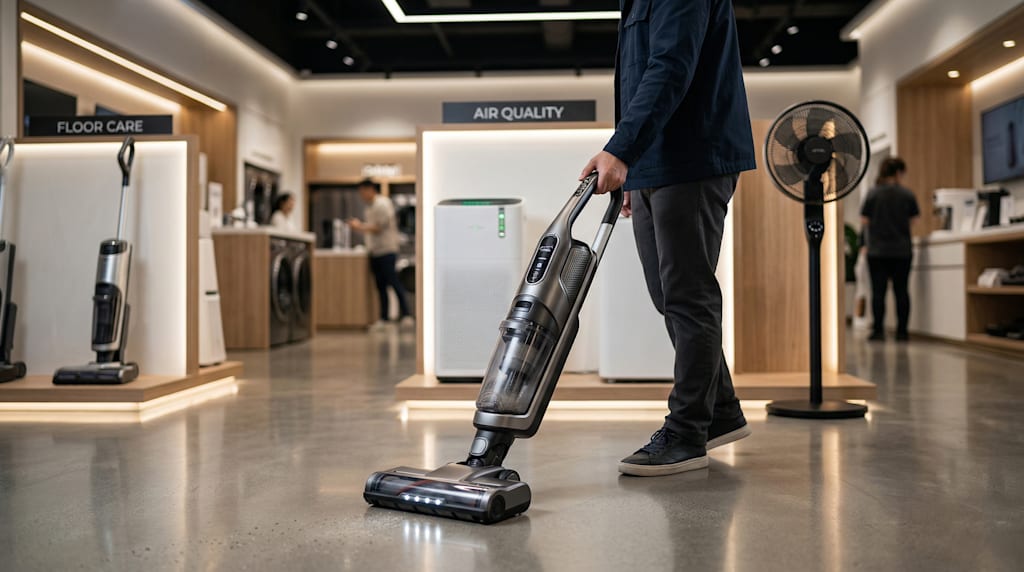
A household appliance brand was facing a discovery problem that many teams still underestimate: shoppers were no longer relying on product pages and search rankings alone.
They were using AI summaries, comparison-style prompts, and public community discussions to decide which products deserved attention.
This article adapts a CiteWorks Studio case study into a more reader-focused narrative for Vocal.
The numbers remain unchanged, but the bigger story is what those numbers suggest: if your brand is missing from the sources AI systems trust, you may be losing consideration before the click ever happens.
- Discovery in home appliances shifted toward comparisons, AI summaries, and public discussion environments.
- The brand needed to improve visibility across both page-one search and AI-generated recommendations.
- The campaign tracked citation patterns, brand mentions, and AI share of voice across major AI platforms.
- The strongest outcome signals included a 400% month-over-month lift in ChatGPT brand mentions and top-10 rankings for 13,679 keywords.
- Some of the most important context sits inside the original case study, which is worth reviewing directly.
What happens when a brand is still visible in search, but starts disappearing from the places where recommendations are actually formed?
That is the real tension behind this household appliance case. The category itself did not become less competitive overnight. What changed was where buyers started making up their minds.
More shoppers began comparing products through AI tools, community threads, and condensed recommendation summaries long before they reached a product page.
But instead of laying out every detail upfront, it focuses on the more interesting question: what does this case reveal about how appliance discovery now works, and why are so many brands still measuring the wrong thing?
What Changed in This Market
For years, appliance marketers could treat search visibility as the main scoreboard. Rank well, earn clicks, and trust that product pages would carry the rest.
That model is no longer complete.
In this case, shopper behavior had shifted toward comparison-style research. Buyers were increasingly leaning on a mix of Google results, AI-generated summaries, and trusted public discussions to evaluate options.
A few high-authority community forums had become especially influential in shaping what AI tools surfaced and summarized.
That matters because AI systems do not simply rank pages. They synthesize the web’s existing signals.
They compress reviews, discussion threads, comparison content, and recurring public narratives into a single answer.
So even if a brand still has some search presence, it can lose ground at the exact moment a buyer asks for recommendations.
For a category like home appliances, where durability, value, and performance matter, that shift is commercially significant. A brand can be left out of the recommendation layer before the customer ever clicks through.
What the Brand Needed
The brand did not just need more traffic.
It needed a better way to understand how it appeared across two systems at once: traditional search and AI-driven product discovery.
That meant looking beyond page-one rankings and asking harder questions.
Which sites were AI systems actually referencing?
Which public sources were shaping the brand’s context?
How often was the brand showing up compared with competitors?
And when shoppers asked high-intent questions, was the brand being named at all?
That is what makes this case more interesting than a standard SEO story. The challenge was not only to rank. It was to become visible inside recommendation-stage discovery.
What the Agency Did
It approached the work by first mapping how AI recommendations were being formed.
The campaign tracked how major AI systems described the brand and which sources fed those summaries. Reporting covered AI Overviews, ChatGPT, Gemini, AI Mode, Perplexity, and Copilot.
That made it easier to see which product pages, reviews, and public discussions were most often shaping the brand’s appearance in AI answers.
From there, the work focused on measurable movement. Month-over-month tracking was used to monitor whether the campaign was producing stronger citations, more brand mentions, and better visibility across AI responses.
The more strategic move, though, was not just measurement. It was improving the source environments already influencing AI-generated summaries.
In consumer appliance buying, recommendation context often forms in public forums and comparison discussions. So instead of relying only on broad content production, the campaign worked to strengthen accurate, positive brand context in those environments.
The original case study contains the full explanation of how that reference set was improved and why those sources mattered so much in this category.
Results From the Campaign
This is where the case starts to get more compelling.
Across traditional search and AI-generated product summaries, the brand recorded measurable gains for high-intent queries.
It also reports 13,679 keywords appearing in Google’s top 10, covering 3.9 million in combined monthly search volume and about $4,866 in paid-search benchmark value.
There was more: the campaign strengthened brand context across 100 high-impact community sources and cited pages influencing AI answers, while securing an average ranking position of #7 for all high-intent keywords.
And then there is the modeled value estimate. Over a 3-month campaign with close to 200 engagements, the source reports an estimated $122,454.73 in total estimated monthly branded value, including $119,757.18 in organic keyword value and $2,697.55 in LLM-cited pages value.
The methodology note matters here: this was a directional estimate based on tracked keyword visibility and modeled paid-equivalent value, not exact attribution.
That caveat should not weaken the story. It sharpens it. The point is not that one neat number explains everything.
The point is that the brand improved visibility across both classic search and AI recommendation environments at the same time.
Why This Matters for Marketers and Operators
The deeper lesson is not limited to appliances.
Brands now compete in two discovery systems at once. One is the familiar world of rankings, clicks, and page-one visibility.
The other is the growing layer of AI-generated answers, recommendation summaries, and cited third-party context.
If marketers only report on rankings, they may miss where buyer consideration is actually being won or lost.
This case suggests that AI visibility is not a side metric. It is part of modern demand capture.
When AI tools summarize what the web already says, the quality of the surrounding citation footprint starts to influence who gets remembered, compared, and recommended.
That is why this case is worth reading closely. Not because it offers a gimmick, but because it reflects a larger shift: rankings still matter, but they no longer tell the whole story.
Key Definitions
AI Visibility
AI visibility is how often and how clearly a brand appears inside AI-generated answers and recommendation flows. It matters because buyers may form opinions before they ever click a website.
Citation Architecture
Citation architecture is the set of sources that consistently shape how AI systems talk about a brand, product, or topic. In practical terms, it is the review pages, forum threads, articles, and other public references that help define the answer AI tools produce.
AI Share of Voice
AI share of voice tracks how frequently a brand appears in AI-generated answers compared with competitors. It helps teams understand whether they are actually present in the recommendation layer, not just in search rankings.
Generative Engine Optimization
Generative engine optimization is the practice of improving the chances that AI systems use and cite your brand when generating answers. It extends beyond traditional SEO by focusing on the environments and signals AI systems synthesize.
About the Creator
Linda Villar
Data nerd turning complex metrics into compelling narratives. Exploring the 'how' and 'why' behind success stories.
Enjoyed the story? Support the Creator.
Subscribe for free to receive all their stories in your feed.
Comments
There are no comments for this story
Be the first to respond and start the conversation.