
Flawed Disciplinary Investigations
Why Employers Lose at Tribunal Even When the Employee Did It

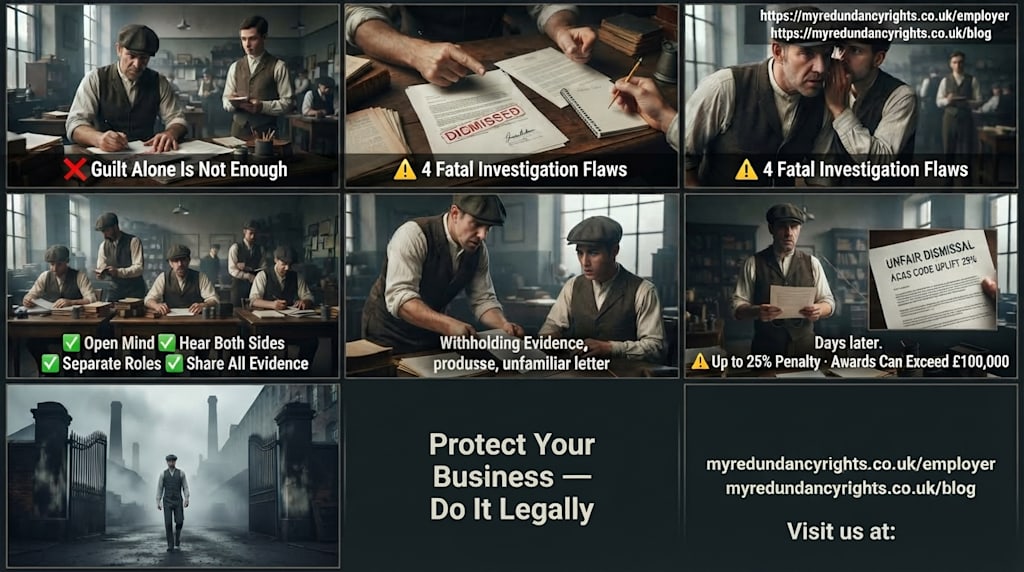
Think you have an open-and-shut case of gross misconduct? Here is the number one reason employers still lose at tribunal — even when the employee did it.
Employment Tribunals do not only ask whether the employee committed the act. They ask whether the employer genuinely believed it, had reasonable grounds for that belief, and carried out as much investigation as was reasonable in all the circumstances. That three-part standard — known as the Burchell Test — is where most employers lose cases they thought were unloseable.
The Burchell Test: The Standard Every Employer Must Meet
Established in the case of British Home Stores v Burchell [1980], the Burchell Test sets out the legal standard for a fair belief in misconduct. To satisfy it, an employer must demonstrate:
Genuine belief — that the employee committed the act
Reasonable grounds — for holding that belief at the time of dismissal
Reasonable investigation — that as much investigation as was reasonable in all the circumstances was carried out before the decision was made
Failing any one of those three limbs can make an otherwise justified dismissal unfair. And the investigation — the third limb — is where most employers fall short.
"We had CCTV footage, two witness statements, and a full confession," said one HR director following an unfair dismissal finding. "The tribunal agreed the employee had done it. But we had used the same manager to investigate, chair the hearing, and handle the appeal. The finding was unfair dismissal on procedural grounds. The cost was significant."
Fatal Flaw One: The Predetermined Outcome
The most damaging mistake an employer can make is deciding the sanction before completing the investigation.
Tribunals look for evidence of an open mind throughout the process. Where emails, meeting notes, or witness selection show that the company was gathering evidence to support a decision already made — rather than genuinely investigating the allegation — procedural fairness is compromised from day one.
Warning signs that a tribunal will identify:
Suspension letters that describe the outcome rather than the allegation
Witness selection limited to those likely to support dismissal
Investigation reports that document only incriminating evidence
Hearing invitations that signal dismissal is the expected outcome
The investigation must be genuine. Its purpose is to establish the facts — not to build a case.
Fatal Flaw Two: Failing the Reasonable Investigation Standard
A reasonable investigation requires the employer to look at the full picture — not just the evidence of guilt.
Under the Burchell Test, an employer must consider exculpatory evidence, interview key defence witnesses, and take account of any mitigating circumstances or context that may be relevant to the allegation. Refusing to interview a witness the employee has named, failing to review relevant system logs or communications, or dismissing context without consideration are all investigative failures that tribunals recognise.
According to ACAS, the scope of a reasonable investigation depends on the seriousness of the allegation — but the principle is consistent: the employer must look for the truth, not just for confirmation of what they already believe.
Fatal Flaw Three: Blurring the Roles
The investigator, the decision-maker, and the appeals manager must be three separate individuals — or at minimum, the roles must be clearly separated at each stage.
Where the same manager investigates the allegation, chairs the disciplinary hearing, and then handles the employee's appeal, the tribunal will find either actual bias or the appearance of bias — both of which undermine the fairness of the process.
The ACAS Code of Practice is explicit: where practically possible, different people should handle each stage. In smaller organisations where that is genuinely not possible, the employer must document why and demonstrate that steps were taken to mitigate any conflict of interest.
Fatal Flaw Four: Withholding Evidence Before the Hearing
An employee facing a disciplinary hearing must receive advance notice of the full case against them — including copies of all written evidence, witness statements, and documentation — with sufficient time to prepare a proper response.
Presenting surprise evidence during the hearing itself — CCTV footage, emails, or witness statements the employee has not previously seen — is a procedural failure. The employee cannot respond effectively to evidence they have not had time to review. Tribunals take a dim view of this practice regardless of how compelling the evidence is.
Best practice is to provide all evidence at least 48 hours before the hearing — and to give the employee the opportunity to request an adjournment if additional time is needed.
Suspension During Investigation
Suspension is not a neutral act. Tribunals increasingly scrutinise whether suspension was reasonable and proportionate — and whether it was allowed to run so long that it amounted to a breach of trust and confidence in itself.
Suspend only where there is a genuine risk to the investigation, to colleagues, or to the business. Keep suspension as short as possible. Review it regularly and document the reasons for continuing it. An employee suspended for three months while an investigation that should have taken two weeks drags on is building a separate constructive dismissal claim alongside the original allegation.
The ACAS 25% Uplift
Where an employer fails to follow the ACAS Code of Practice on Disciplinary and Grievance Procedures, an Employment Tribunal can increase any compensation award by up to 25%. This uplift is applied in addition to the basic and compensatory awards — and it applies even where the underlying conduct was serious.
From April 2025, the compensatory award cap is £115,115. A 25% uplift on the maximum award adds over £28,000 to the cost of a procedural failure. Where discrimination is involved, the award is uncapped.
Your Action Plan
Before any investigation begins, appoint a separate investigator, decision-maker, and appeals manager — and document the appointments
Instruct the investigator to seek out exculpatory evidence as well as incriminating evidence — document both
Interview every witness the employee names — document why any are excluded
Provide all evidence to the employee at least 48 hours before the disciplinary hearing
Review the grounds and proportionality of any suspension at least every two weeks
Apply the Burchell Test at every stage — genuine belief, reasonable grounds, reasonable investigation
Ensure the dismissal letter includes the right of appeal and a clear deadline
A flawed investigation does not just lose a tribunal case. It hands the employee a stronger claim than they would otherwise have had. Get the process right from day one.
About the Creator
myredundancyrights
Free, plain-English UK employment law guidance — redundancy, unfair dismissal, gross misconduct, PIPs and more. Know your rights before it's too late.
Enjoyed the story? Support the Creator.
Subscribe for free to receive all their stories in your feed.
Comments
There are no comments for this story
Be the first to respond and start the conversation.