
Fire and Rehire: What Your Employer Can and Cannot Legally Force You to Accept
What Is Fire and Rehire?

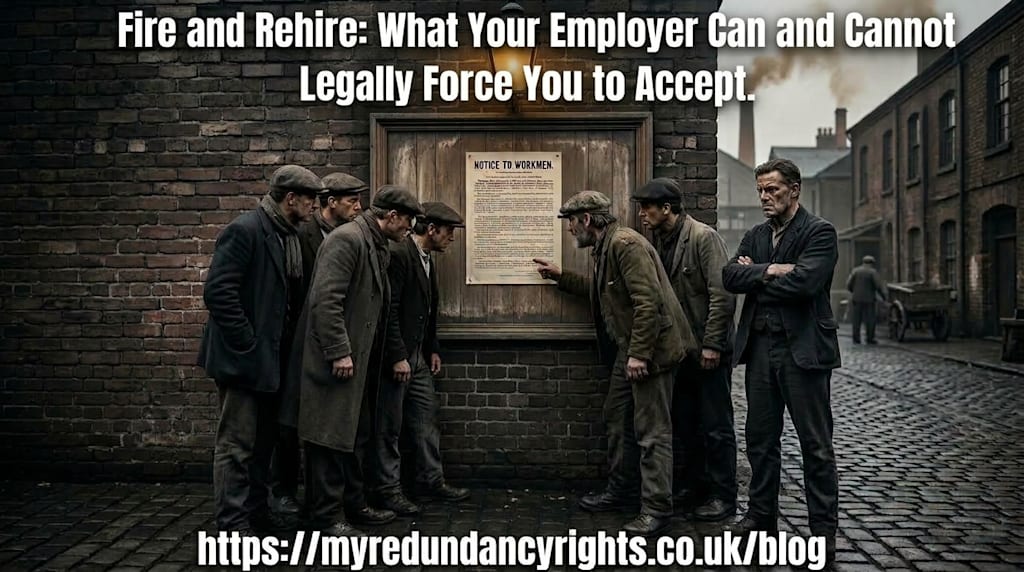
If your employer is forcing you to sign a new contract, stop right now. UK businesses cannot legally change your terms without following rigorous procedures. Learn the exact legal boundaries protecting your job security before you sign anything away.
What Is Fire and Rehire?
Fire and rehire — formally known as dismissal and re-engagement — is the practice of an employer terminating an employee's existing contract and offering re-employment on new, typically worse, terms. It is not new. But the scale at which UK employers deployed it during and after the pandemic brought it into sharp public focus — and prompted the government to act.
The tactic works by exploiting a legal gap: an employer cannot unilaterally change a fundamental term of your contract without your consent. But they can dismiss you and offer you a new contract with different terms. The threat — take the new terms or lose your job — is the leverage.
What many employers and most employees do not know is that this leverage now operates within strict legal boundaries. Ignore those boundaries, and the dismissal becomes automatically unfair.
The Statutory Code of Practice
In July 2024, the government introduced a statutory Code of Practice on Dismissal and Re-engagement. This code fundamentally changed the legal landscape for fire and rehire.
Under the code, employers are required to:
Consult meaningfully with affected employees or their representatives before proposing contract changes
Share all relevant information about the proposed changes and the business reasons behind them
Allow sufficient time for genuine consultation — not a box-ticking exercise
Explore all alternatives to dismissal and re-engagement before resorting to it
Not use the threat of dismissal as a negotiating tactic during consultation
The code does not make fire and rehire illegal. But it makes it significantly harder to do lawfully — and significantly more expensive to get wrong. Employment tribunals must take the code into account when deciding unfair dismissal claims, and they can uplift any compensation award by up to 25% where an employer has unreasonably failed to follow it.
What Your Employer Cannot Legally Force You to Accept
Your contract of employment is a legally binding document. The terms within it — particularly those described as fundamental or express terms — cannot be changed without your agreement. Your employer cannot unilaterally alter the following:
Your base salary or hourly rate of pay
Your contracted working hours
Your job title and core duties where these are expressly stated
Your place of work where this is a fixed contractual term
Your holiday entitlement above the statutory minimum
Your notice period
Any agreed bonus or commission structure that forms part of your contract
Pension contributions where contractually guaranteed
If your employer attempts to impose any of these changes without your consent, they are in breach of contract. If they dismiss you for refusing to accept the changes, that dismissal may be automatically unfair — particularly where the statutory code has not been followed.
What Employers Can Change Without Your Consent
Not every workplace change requires your agreement. Employers retain what is known as management discretion over certain operational matters — particularly where the employment contract is silent on those specifics. These typically include:
Minor changes to internal processes and procedures not specified in the contract
Changes to reporting lines where your role itself remains unchanged
Updates to workplace policies that do not form part of the contract itself (staff handbooks are generally not contractually binding unless specifically incorporated)
Changes to working practices that fall within reasonable managerial instruction
The key question is always whether the proposed change affects a term that is expressly stated in your contract, or whether it falls within the scope of what a reasonable employer could instruct under a general management discretion clause. Where the line falls is often disputed — and employment tribunals decide those disputes.
What to Do If Your Employer Threatens Fire and Rehire
If you receive notification that your employer intends to change your contract terms — with or without an explicit threat of dismissal — take the following steps immediately:
Do not sign anything under pressure. You are entitled to time to consider proposed changes. An employer who demands an immediate signature is not following the statutory code.
Request the business reason in writing. The statutory code requires employers to share relevant information about why the change is being proposed. Ask for it formally.
Check whether a genuine consultation process is underway. If you are in a workplace with a recognised trade union or employee representatives, they should be involved. If you are not, you are entitled to individual consultation.
Take note of the timeline. How much notice is being given? Is the employer allowing time for genuine discussion, or is the process a formality?
Do not resign in response to pressure. If your employer's conduct amounts to a fundamental breach of your contract, you may have grounds for constructive dismissal — but this is a legal step that requires careful assessment before action.
Use the MRR Legality Checker to assess your position before you respond, sign, or resign.
The Compensation Consequences for Employers
An employer who dismisses and re-engages without following the statutory code faces significant financial exposure. Where a tribunal finds that the code was not followed:
The dismissal may be found automatically unfair
Compensation can be uplifted by up to 25%
Where the dismissal is connected to a protected characteristic — such as the new terms disproportionately affecting older workers, part-time workers, or workers with caring responsibilities — a discrimination claim may run alongside the unfair dismissal claim, with no cap on compensation
For employees, this means a fire and rehire situation handled carelessly by an employer is not a dead end. It is a potential claim.
The Future of Fire and Rehire in the UK
The Employment Rights Bill, introduced in October 2024, proposes to go further than the current statutory code by significantly restricting the circumstances in which dismissal and re-engagement can be used lawfully. The direction of travel is clear: fire and rehire as a casual negotiating lever is being closed down by legislation.
For employees facing it now, the statutory code is the protection available. For employers considering it, the legal and reputational cost of getting it wrong has never been higher.
"My employer sent a new contract with a pay cut and said sign within a week or we'll let you go. I used the Legality Checker and discovered they hadn't followed the code at all. I didn't sign, I got proper advice, and the contract change was withdrawn." — Anonymous MRR user
If your employer is proposing contract changes — whether or not dismissal has been mentioned — assess your legal position now
About the Creator
myredundancyrights
Free, plain-English UK employment law guidance — redundancy, unfair dismissal, gross misconduct, PIPs and more. Know your rights before it's too late.
Enjoyed the story? Support the Creator.
Subscribe for free to receive all their stories in your feed.
Comments
There are no comments for this story
Be the first to respond and start the conversation.