
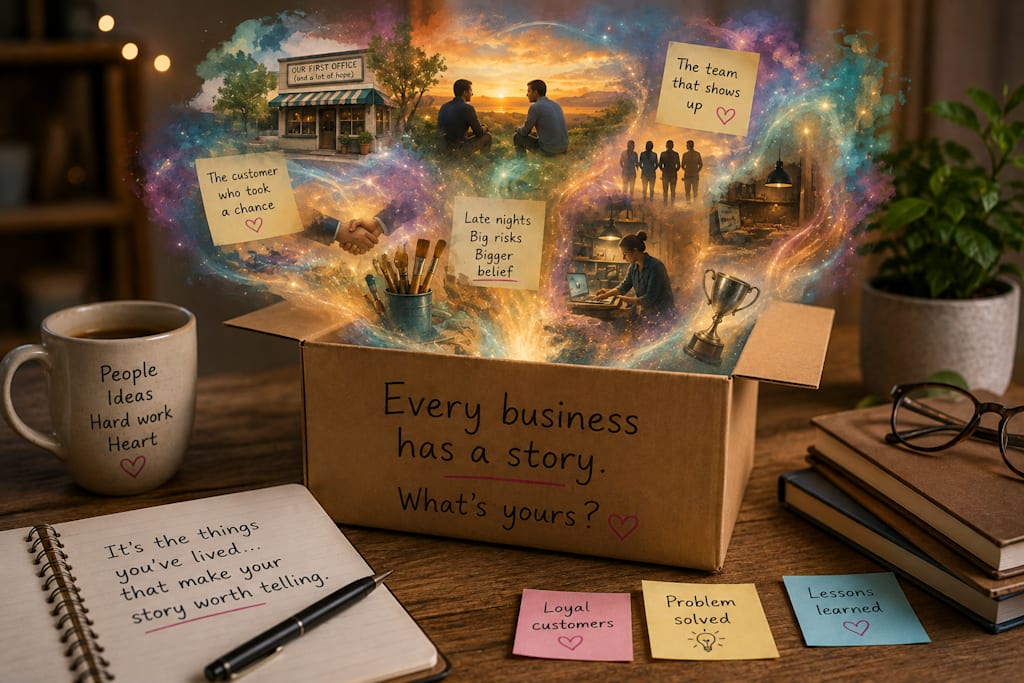
Every business has a story
Most owners just don'e realise how powerful it can be
There’s a question I ask people all the time.
It usually comes somewhere in the middle of a conversation, after we’ve covered the obvious things.
What do you do?
How long have you been doing it?
How did you get here?
And then I ask:
“So… tell me the story of your business.”
There is very often a pause.
Not a dramatic pause. More the sort of pause that suggests the person at the other end of the phone is wondering what on earth I expect them to say.
Then comes the answer.
“There’s not much to tell, really.”
I’ve heard versions of it hundreds of times.
“We’re just a small family business.”
“We’ve been doing this for years.”
“There’s nothing particularly different about us.”
“We just do what we say we’re going to do.”
And one of my personal favourites:
“We’re pretty boring, really.”
The reality? They almost never are.
In fact, I’ve learned that when somebody tells me there’s “not much to tell”, there’s a reasonable chance I’m about to hear a very good story.
They just don’t know it yet.
The problem with living inside your own story
I think we all do this.
Things that once seemed extraordinary gradually become ordinary simply because they happen to us every day.
If you’ve spent twenty years building a business, you probably don’t wake up thinking:
Goodness. I have spent twenty years building this business.
You think about Tuesday.
Someone has called in sick.
A customer needs something urgently.
Something has broken.
Someone hasn’t paid an invoice.
There’s an email you’ve been meaning to answer since last Thursday.
And apparently the printer has decided today is the day it will finally give up on life.
You get on with it.
Twenty years of experience becomes “what I do”.
Hard-earned judgement becomes “common sense”.
A loyal customer becomes “someone we’ve worked with for ages”.
An employee who has been with you since practically the beginning becomes “Dave”.
Extraordinary things become normal.
And normal things don't feel like stories.
“There’s not much to tell”
I remember one conversation with the owner of a construction business.
When I asked about the story behind the company, the response was more or less what I expected.
There wasn't much to tell.
They’d been around for years.
They did good work.
They had experienced people.
Their clients were happy.
Pretty standard stuff.
Except I’m incapable of leaving an answer like that alone.
So I started asking questions.
How did the business begin?
What were those first few years like?
Who gave you your first proper opportunity?
Why did they choose you?
Did they use you again?
Why?
What happened when a project went wrong?
Who has been with you the longest?
What are you proudest of?
What would your longest-standing customer say about you?
And slowly, almost accidentally, another version of the business appeared.
There were customers who had stayed with them for years.
There were relationships that had survived difficult projects, changes of personnel and economic ups and downs.
There were employees who had been part of the business for a significant chunk of their working lives.
There were projects where things hadn't gone according to plan and the team had stayed until the problem was solved.
There were occasions when people had gone back after hours because something wasn't quite right.
There were customers who no longer bothered shopping around for certain jobs.
They just rang.
None of this had come up when I'd originally asked what was special about the business.
To the owner, it wasn't special. It was simply what they did.
“But everyone does that, don’t they?”
This might be the sentence I hear most often after uncovering something interesting.
“But everyone does that, don’t they?”
No. They really don’t.
Not everyone answers the phone at an unreasonable hour because somebody has a problem.
Not everyone has people who stay with them for fifteen years.
Not everyone has customers who keep coming back.
Not everyone notices something outside their responsibility and fixes it anyway because leaving it isn't the right thing to do.
Not everyone changes a process simply because there must be a better way.
But if you've behaved like that for years, you stop seeing it.
It isn't a philosophy.
It isn't a strategy.
It's Tuesday.
And I think that's fascinating.
The little things people mention accidentally
The best stories rarely arrive neatly packaged.
Nobody says:
“Now I shall tell you an illuminating anecdote that perfectly demonstrates my character.”
At least nobody I've spoken to does.
Instead, the interesting bits tend to slip out sideways.
Someone will casually mention:
“We've worked with them for eighteen years.”
Eighteen years?
Hang on.
You can't just drop eighteen years into the conversation and move on.
Or:
“We had a bit of a disaster at the beginning, but we sorted it out.”
A disaster?
What happened?
Or:
“We ended up making our own system because the one we had wasn't really working.”
You made your own?
Why?
Or my favourite kind:
“Oh, that's nothing. We've always done that.”
Those are the moments when my ears prick up.
Because people are very good at telling you what they think is impressive.
But they're often terrible at recognising what actually is.
I ask “why?” far too much
I’m aware that I can probably be quite annoying.
I ask questions.
Then I ask questions about the answers.
Then sometimes I go back to something mentioned twenty minutes earlier because it has been bothering me.
“Wait. Before we move on…”
I have also been known to ask “why?” about six more times than any reasonable adult should.
But eventually, every now and then, somebody says:
“I’d never really thought about it like that.”
That's the moment I love.
Because suddenly they can see it too.
Something they had dismissed as ordinary looks different when viewed from a few steps away.
The facts haven't changed.
Their perspective has.
We confuse familiarity with insignificance
I've thought about this a lot.
Why are we so bad at recognising our own stories?
I think familiarity has something to do with it.
We notice things that are new.
We stop noticing things that are always there.
You don't walk into your house every evening and admire the position of the light switches.
You know where they are.
You don't think about the route you take to the supermarket.
You've driven it a hundred times.
And you don't necessarily think about the judgement you've developed after twenty years doing the same kind of work.
You just know what to do.
But someone who doesn't have those twenty years might find that knowledge remarkable.
The same goes for relationships.
If a customer has been with you for fifteen years, eventually they're simply part of the furniture.
But fifteen years is a long time for somebody to keep choosing you.
That means something.
So does the employee who stayed.
The customer who came back.
The person who recommended you to somebody else.
The problem you solved.
The mistake you never made again.
The awful year you somehow survived.
The decision that cost you money but allowed you to sleep at night.
Those aren't corporate achievements.
They're stories.
The stories hiding in ordinary businesses
I've now had versions of these conversations with hundreds of people.
Different industries.
Different personalities.
Different businesses.
Some people can talk for an hour without drawing breath.
Others give me answers so short I briefly wonder whether I've accidentally started conducting a police interview.
Some have beautifully organised records of everything they've ever done.
Others appear to operate an information management system based primarily on memory and an inbox containing 47,000 emails.
But almost everyone has something they've stopped noticing.
The employee who started at the bottom and now runs a team.
The customer who has been there since the early days.
The process they invented because the obvious solution didn't work.
The phone call that changed everything.
The project that almost broke them.
The opportunity they nearly didn't take.
The person who took a chance on them.
The moment they nearly gave up.
The moment they decided not to.
And very often, none of those things appear when you first ask someone about their business.
You have to keep talking.
Maybe we all need someone standing further away
There's something quite lovely about watching somebody rediscover their own story.
They start the conversation telling me there isn't much to say.
An hour later, we're still talking.
And somewhere along the way, the business they described as ordinary has become something else entirely.
Not because I've made it sound better.
Not because the facts changed.
But because we've looked at those facts from a different angle.
And I wonder whether this applies to far more than business.
Perhaps we're all standing too close to parts of our own lives.
Perhaps the things we've survived have become “that thing that happened”.
The skills we worked hard to learn have become “things everyone knows”.
The kindnesses we've repeated for years have become “just what you do”.
The people who keep choosing us have become familiar.
Maybe familiarity makes us underestimate all sorts of things.
So these days, when someone tells me:
“There’s really not much to tell.”
I tend not to believe them.
I just keep asking questions.
Because every business has a story.
Every person does too.
And sometimes the most interesting parts are the ones we've been looking at for so long that we can no longer see them.
About the Creator
Enjoyed the story? Support the Creator.
Subscribe for free to receive all their stories in your feed.
Comments
There are no comments for this story
Be the first to respond and start the conversation.