
Elon Musk and the Power of First Principles Thinking: Rethinking Innovation
Written by Daniel Aharonoff

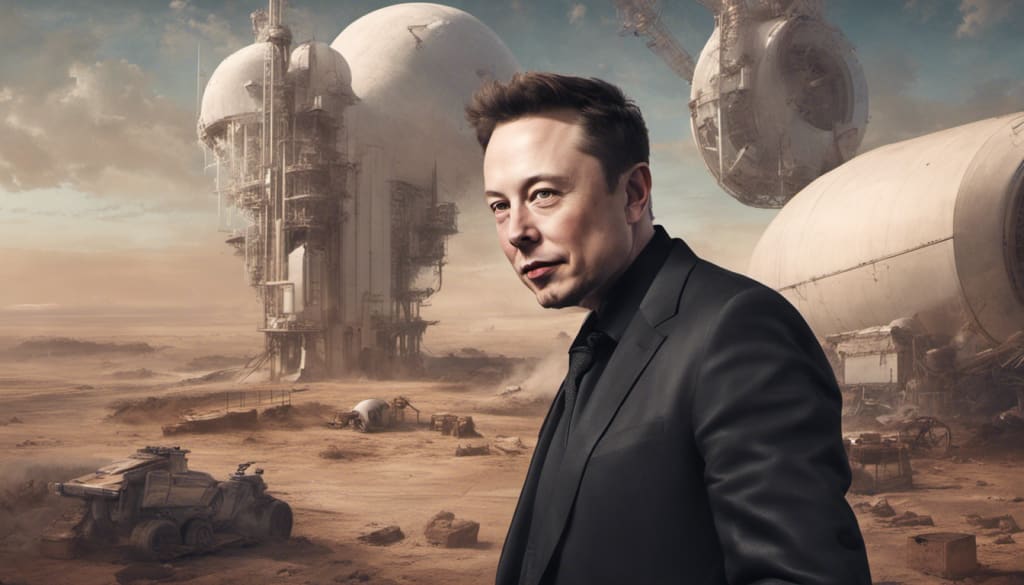
Elon Musk's journey as a paradigm-shifter and industrial maverick is a testament to the potential of first principles thinking to not just disrupt markets, but to redefine them. His strategy isn’t just a mere application of an ancient philosophical concept; it’s a rigorous practice of re-examining the very roots of entrenched technologies and industries to ignite revolutions within them.
When Elon Musk looks at the transportation sector, he doesn't see cars; he sees a complex system of energy, materials, and engineering waiting to be optimized. His approach with Tesla has been about more than just creating an electric car; it’s been about rethinking what a car can be. From the ground up, Musk has redesigned the very concept of the vehicle as a personal transportation device, integrating software, hardware, and energy in ways previously unimagined. This comprehensive reimagining has led to cars that are not merely electric but are also capable of updating themselves with the latest software, driving autonomously, and generating data that helps to continually improve their functionality.
But Musk's influence extends beyond the products his companies create. His first principles approach has infiltrated Tesla's manufacturing processes, where he has introduced innovations like the 'Gigafactory'. Here, by rethinking the supply chain and production scale, Musk aims to drive down battery costs through vertical integration and economies of scale, all grounded in the fundamental economics of materials and manufacturing processes.
In the aerospace industry, Musk's SpaceX has not only challenged the notion of what a rocket can do but also how space missions are funded and what they can achieve. By treating rockets as reusable vehicles — akin to airplanes — Musk has shattered the cost barriers that have long hindered space exploration and satellite deployment. SpaceX's achievements in landing and reusing rockets, which once seemed like a plot from a science fiction novel, have become almost routine, paving the way for ambitious projects like Starlink, which seeks to provide high-speed internet across the globe through a constellation of satellites.
Moreover, Musk's vision extends beyond Earth. His advocacy for a multi-planetary human presence and his plans for Mars colonization force a reconsideration of humanity's place in the cosmos. By applying first principles to the challenge of interplanetary travel, Musk's SpaceX is working on the Starship spacecraft, intended not just to reach Mars but to ferry humans there, sustain human life, and possibly return to Earth.
In the energy sector, Musk's endeavors are equally transformative. SolarCity, which merged with Tesla, aims to revolutionize how we generate and consume electricity. By leveraging Tesla's expertise in battery storage, Musk envisions a world where homes are powered by solar energy stored in efficient battery cells, redefining the energy grid's architecture from a centralized model to a distributed one.
But Musk’s influence isn’t solely technological — it's cultural. His public persona, characterized by bold statements and big bets, has captured the public imagination, stirring interest in STEM fields and inspiring a new generation of entrepreneurs and engineers. His approach has encouraged a culture of bold thinking and risk-taking that is crucial for breakthrough innovations.
Musk’s companies are also redefining what a 21st-century workforce looks like. By attracting talent from around the globe and across industries, he has built teams that are not just interdisciplinary but also driven by a shared purpose. This has been key to his companies' abilities to innovate at the intersections of different technologies and sectors.
Yet, the first principles methodology is not without its critics. Detractors point to the many challenges Musk's companies have faced, from production delays to regulatory hurdles. But these setbacks are often part and parcel of the process of pioneering uncharted territories. The essence of Musk's philosophy is not deterred by failure; rather, it's fueled by it, seeing each challenge as an opportunity to reassess and rebuild.
Musk's legacy may very well lie in his ability to instill first principles thinking as a cornerstone of modern innovation. His success serves as a beacon, illuminating the potential for radical improvement when we dare to return to the foundational questions of why and how. Through this lens, the future appears not as a linear extension of the present but as a landscape of possibilities limited only by the fundamental truths of science and the breadth of human imagination. This is a future that Musk is not just predicting but actively constructing, one first principle at a time.
About the Creator
Daniel Aharonoff
Tech investor and entrepreneur with 26+ years in digital media. Exploring blockchain and AI potential more at https://aharonofftechtales.com
Enjoyed the story? Support the Creator.
Subscribe for free to receive all their stories in your feed.
Comments
There are no comments for this story
Be the first to respond and start the conversation.