
Discovery vs. Demand Is Becoming the Growth Question Most Teams Are Still Framing Backward
Why AI-driven discovery is starting to shape which brands earn demand in the first place

Most growth strategies still assume the market reveals demand first.
Then brands compete to capture it.
That logic powered a lot of the digital era. But LLM Authority Index argues that AI is changing the order of events. In AI-mediated environments, discovery shaping demand is no longer just the front door to demand. It increasingly helps shape demand itself.
The old model worked because intent was visible
The source article lays out the traditional sequence clearly: Demand → Traffic → Conversion → Revenue. In that model, users express intent through a query or action, companies compete to intercept that demand, and channels are judged by how effectively they convert visible intent into revenue.
Search volume becomes a proxy for market interest. Clicks become a proxy for attention. Conversions become a proxy for commercial success.
That framework made sense when users did most of the discovery work themselves. They searched multiple times, compared long lists of results, browsed multiple pages, and gradually narrowed the field.
AI changes what happens before demand becomes measurable
The source says that sequence is breaking down because users increasingly ask a question, receive a synthesized answer, adopt a shortlist, and move toward one of the recommended options.
A portion of what used to be visible demand becomes partially hidden inside the discovery process itself.
That is the real shift.
Demand is no longer only expressed. It is increasingly influenced. The article argues that AI can shape commercial intent before that intent becomes fully observable in traditional marketing systems.
For a brief explanation of the topic, watch this video.
Discovery now comes before demand
This is where the source reframes the growth model.
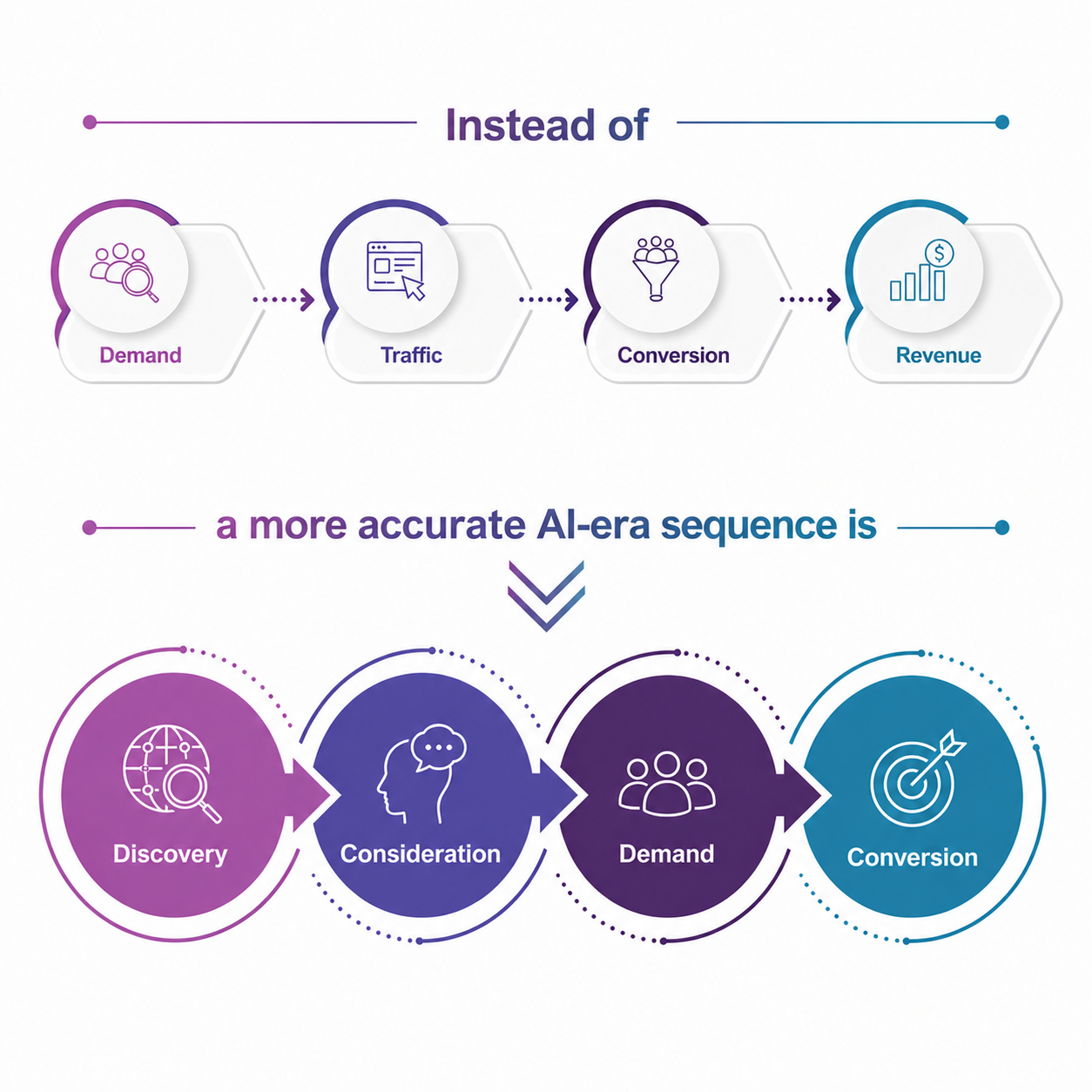
The article is careful here: it does not say AI creates demand from nothing. It says AI increasingly shapes the path through which latent or emerging demand becomes directed demand.
That means discovery is not just awareness anymore.
According to the article, in an AI-driven commercial context, discovery is the process by which a user becomes aware of, evaluates, and begins to prefer a company or product through AI-mediated responses.
It includes which companies are included in the answer, how they are ranked, how they are framed, how many options are shown, what comparative logic is used, and which brands are excluded entirely.
This is why growth starts to look different
Once discovery starts shaping preference, the company’s role changes too. The source puts it simply: in the old model, companies competed to capture demand.
In the new model, companies increasingly compete to be part of the discovery process that directs demand.
That sounds subtle until you see the implication.
If a company is not included in the AI response, positioned strongly within it, associated with the relevant use case, or recommended in the important prompt clusters, it may never receive the chance to compete for the demand at all.
The article calls this strategically important because it is not just a visibility issue. It is a gatekeeping issue.
The bottleneck appears before traffic
The source illustrates this with a concrete prompt: “What is the best payroll platform for a 50-person company with hourly employees?”
If the AI system narrows the market to Company A, Company B, and Company C, then the shortlist is already being formed before the user browses ten search results or compares twenty providers. If your company is not in that shortlist, you are not part of consideration.
That is what the article calls the discovery bottleneck.
AI compresses freedom of comparison by showing only a handful of recommended options, only the first few brands the model treats as credible, and only the summary it chooses to present.
Competition shifts from “Can we get traffic?” to “Can we make the shortlist at all?”
Demand metrics still matter, but they no longer tell the whole story
The article is explicit that classic demand metrics such as search volume, clicks, impressions, sessions, and pageviews are not useless. They are incomplete.
They tell you what is visible after or during the discovery process, but they do not tell you which companies AI is recommending, which brands are being excluded, where consideration is being redirected, how recommendation rank is changing over time, or whether competitors are becoming more central to commercial prompts.
That is where the related LLM Authority Index piece on What Is LLM Discovery Intelligence? becomes especially relevant.
It argues that SEO analytics was built for a page-based, click-driven environment, while AI discovery is increasingly recommendation-based, response-based, and influence-driven.
Its core claim is that companies now need a measurement framework that shows whether they are part of the decision before the click happens.
AI does not just capture demand. It redistributes it.
One of the strongest ideas in the source article is that AI can redirect demand between companies that are frequently recommended, companies that are weakly included, and companies that are absent altogether.
In an AI-driven environment, the answer itself redistributes attention by deciding which companies are included, which are left out, and which are framed as most relevant.
That makes discovery economically important in a new way.
The related article on AI Discovery Economics sharpens that point by arguing that AI visibility cannot be valued the same way as traditional traffic visibility.
A click is an opportunity to influence a decision. A recommendation influences the decision before the click happens.
It also argues that high-intent prompts carry disproportionate value and that exclusion from AI recommendations creates a hidden revenue loss.
The growth constraint has moved upstream
The source says older growth constraints still matter: traffic, impressions, click-through rates, conversion rate, cost of acquisition, and reach.
But AI introduces another one before all of them: inclusion in AI-driven discovery. If the company is not surfaced in the right prompts, with the right ranking, in the right contexts, many of the older growth levers begin later than they used to.
That is why the article introduces discovery-led growth: a model in which a company’s ability to grow increasingly depends on how effectively it participates in AI-mediated discovery before the user ever reaches traditional website or channel touchpoints.
The priorities shift toward appearing in high-intent prompts, ranking strongly inside responses, being recommended in commercially meaningful use cases, aligning positioning with the way AI systems structure the category, and understanding where competitors are favored and why.
That is the partial reveal.
About the Creator
Daniel Sheppard
I analyze brands, break down strategy, and write case studies on what drives visibility, trust, and growth.
Enjoyed the story? Support the Creator.
Subscribe for free to receive all their stories in your feed.
Comments
There are no comments for this story
Be the first to respond and start the conversation.