
Designing Legally Defensible Redundancy Selection Criteria
A Practical Guide For UK Employers

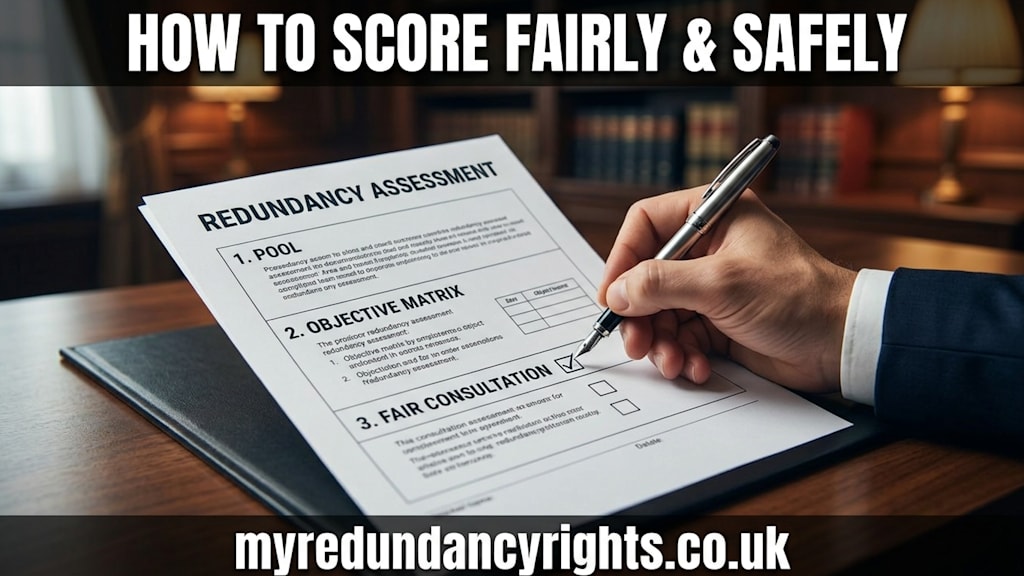
One small flaw in your redundancy selection criteria could cost your business thousands at an employment tribunal. Most employers who face successful unfair dismissal claims didn’t set out to discriminate — they used vague, subjective criteria that couldn’t withstand legal scrutiny when challenged.
This guide sets out the exact framework for building an objective, evidence-based scoring system that protects your business at every stage — from initial design through to appeals.
Why Subjective Criteria Fail at Tribunal
The most common mistake employers make is allowing managers to score employees based on instinct. “Attitude,” “team fit,” and “potential” sound reasonable in a management meeting. In an employment tribunal, they are indefensible — because they cannot be evidenced, they are inconsistently applied, and they are wide open to discrimination challenges.
UK employment tribunals in 2026 are increasingly sophisticated in identifying criteria that appear objective but mask subjective bias. Attendance scores that penalise disability-related absences. Performance ratings that reflect a manager’s personal relationship with the employee rather than documented output. Future skills assessments with no evidential basis.
Each of these is a legal timebomb. The framework below defuses them.
The Core Principle: Measurable, Verifiable, and Documented
Every criterion in your scoring matrix must meet three tests before it is used:
Measurable — it can be expressed as a number or a clearly defined category
Verifiable — it is supported by documentary evidence that existed before the redundancy process began
Consistently applied — the same standard is applied to every employee in the pool, by the same process
If a criterion cannot pass all three tests, remove it from the matrix.
Navigating Indirect Discrimination
Before finalising your criteria, stress-test each one for indirect discrimination risk. Ask: does this criterion disproportionately disadvantage employees who share a protected characteristic?
Common traps include:
Attendance records — absences related to disability or pregnancy-related illness must be excluded from scoring. Failing to do so is direct discrimination under the Equality Act 2010
Flexible working patterns — part-time workers must not be scored less favourably for working reduced hours, as this disproportionately impacts women
Length of service — while not automatically discriminatory, heavy weighting of service can indirectly disadvantage younger workers. Use it sparingly and justify it clearly
Recent performance ratings — where an employee has been on maternity or adoption leave, performance ratings from the leave period cannot be used. Scores must reflect periods of active employment only
Document your discrimination risk assessment in writing before scoring begins.
Selecting Your Objective Metrics
Hard metrics that consistently withstand legal scrutiny include:
Documented attendance record — using HR system data, excluding protected absences
Formal disciplinary record — live warnings only, documented in writing
Documented performance against targets — sales figures, output data, appraisal scores from formal reviews
Qualifications and certified skills — verifiable credentials relevant to the role
Breadth of skills and versatility — defined by a pre-agreed rubric, not manager opinion
For softer criteria such as adaptability or future skills requirements, convert them into measurable rubrics before scoring. Define what a score of 1, 3, and 5 looks like in concrete, behavioural terms — and document those definitions before any employee is assessed.
Weighting Your Criteria
Once your criteria are defined, assign percentage weights that reflect genuine business needs. A business restructuring for skills-based reasons might weight qualifications and versatility more heavily. A cost-reduction exercise might weight performance against targets.
Rules for weighting:
Weights must be set before scoring begins — not adjusted after scores reveal an inconvenient result
No single criterion should carry so much weight that it renders the others irrelevant
The weighting rationale must be documented and defensible — why does this criterion carry this weight for this business at this time?
Require two independent scorers for every employee — a line manager and a senior HR professional. Where scores diverge significantly, require written justification from both before a consensus score is agreed. Solo manager scoring is one of the most common sources of bias and one of the easiest targets for tribunal claimants.
Presenting Scores and Managing Appeals
Share individual scores with each employee in writing before their consultation meeting — not during it. An employee who sees their scores for the first time in the room cannot meaningfully challenge them. That is a procedural failure that tribunals notice.
In the consultation meeting:
Walk through each criterion and the evidence behind the score
Allow the employee to challenge any score and present counter-evidence
Record every challenge and every response in contemporaneous notes
Where a challenge has merit, adjust the score — and document why
If an appeal is made against the final selection decision, hear it independently. The appeal manager must review the original scoring evidence, the employee’s grounds, and reach their own documented conclusion. A rubber-stamp appeal process has no legal value.
Your Compliance Checklist Before Issuing Any Notice
Before any formal redundancy notice is issued, confirm in writing that:
All criteria were set and documented before scoring began
Protected absences were excluded from attendance scores
Indirect discrimination risk was assessed and documented
Two independent scorers were used for every employee
Scores were shared in writing before individual consultation meetings
Every challenge was recorded and considered
The right of appeal is confirmed in the outcome letter
Every item evidenced. Every step documented. That is what a legally defensible redundancy selection process looks like.
About the Creator
myredundancyrights
Free, plain-English UK employment law guidance — redundancy, unfair dismissal, gross misconduct, PIPs and more. Know your rights before it's too late.
Enjoyed the story? Support the Creator.
Subscribe for free to receive all their stories in your feed.
Comments
There are no comments for this story
Be the first to respond and start the conversation.