
Competitive Velocity May Matter More Than Current AI Visibility
Why the companies gaining ground fastest in AI search may matter more than the ones leading today

Most companies still evaluate competition in AI search like they are checking a scoreboard.
Who is visible today. Who looks strongest right now. Who appears to be leading this quarter.
That mindset is already too static. LLM Authority Index’s competitive velocity in AI search argues that in AI-mediated discovery, current position is only part of the picture.
What matters just as much, and sometimes more, is movement: which companies are gaining recommendation shares, expanding into higher-intent prompts, climbing into stronger answer positions, and building momentum before the rest of the market notices.
In AI search, competition does not only happen through rank. It happens through acceleration.
Static metrics can hide the real shift
The source article makes a sharp point early. Most familiar marketing metrics are backward-looking. Share of Voice tells you how present a company was in a given period. Rankings show where it stood at a moment in time.
Traffic reflects what happened after decisions were already starting to form. Those metrics still tell you something, but they often miss the speed of change that shapes the next competitive outcome.
That is why the article introduces Competitive Velocity: the rate at which a company is improving or deteriorating in AI-mediated discovery relative to competitors.
It is not just a visibility metric. It is a movement metric. The question is no longer only “Who is leading?” It is “Who is accelerating?”
Why AI makes competition move faster
Traditional search was easier to inspect. Rankings were visible, keywords were clearer, and movement felt more discrete.
AI changes that because the system is dynamic, context-sensitive, and structured around synthesized answers rather than static result pages.
Small shifts in phrasing, use case, or prompt structure can change which companies get recommended and how they are framed. Recommendation dynamics can also compound over time, which means early movement matters more than many teams expect.
That turns AI competition into a trajectory problem, not just a position problem.
A company can look secure today and still be losing future relevance through small, compounding changes in ranking, inclusion, prompt expansion, or recommendation frequency.
Those changes may not show up immediately in traffic, pipeline, or revenue, but they may already signal that a competitive transition is underway.
Here’s a short video that breaks down the topic:
What Competitive Velocity actually tracks
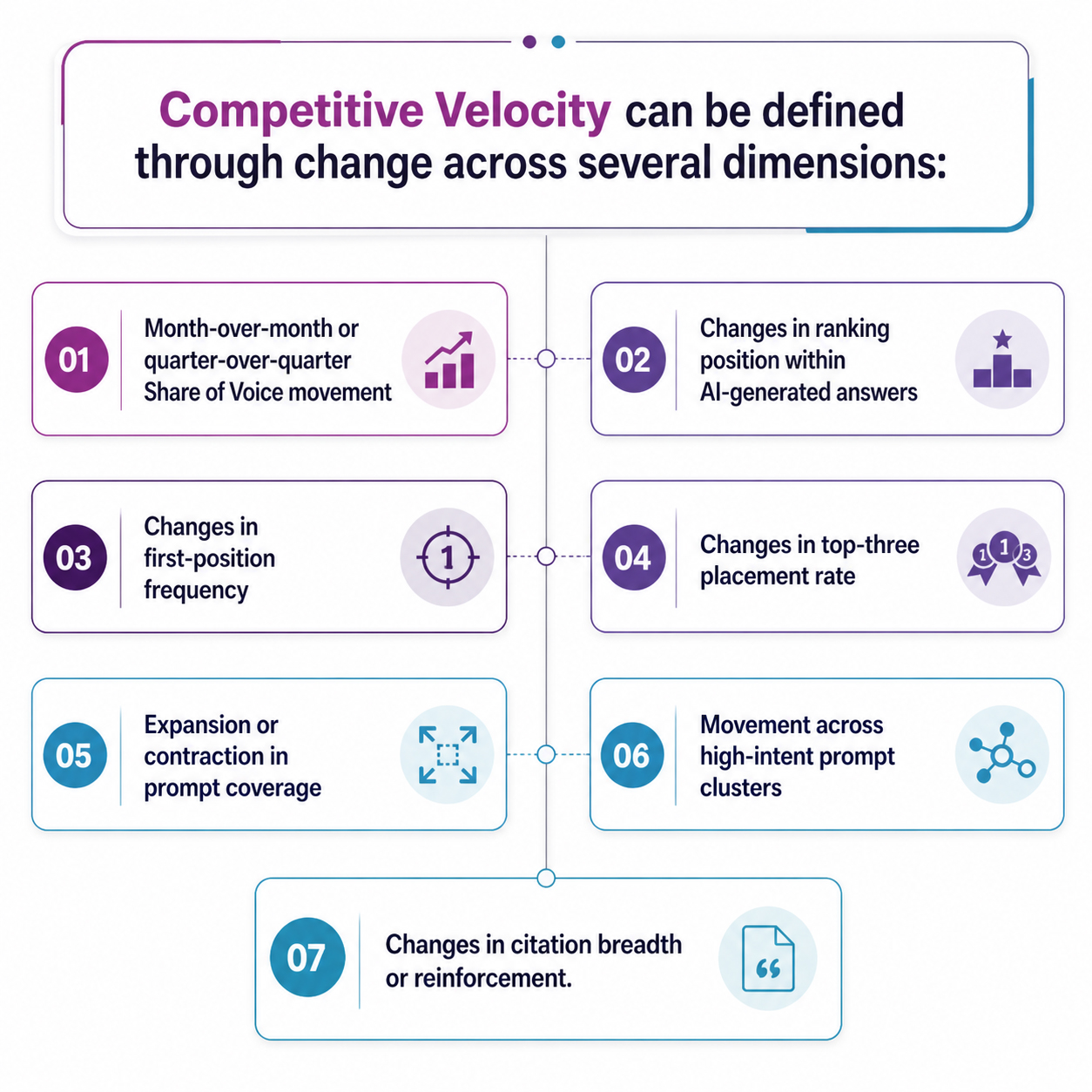
That distinction matters because a company can have high visibility and low velocity if it is broadly present but not improving.
Another can have lower visibility and high velocity if it is rapidly expanding coverage, climbing into top positions, and displacing competitors where buying intent is strongest.
This fits naturally with LLM Authority Index’s article on How to Measure Your Company’s Presence in AI Search, which argues that presence has to be measured in layers: inclusion, coverage, ranking, and positioning.
Presence tells you whether you are in the answer environment. Velocity tells you whether your position inside that environment is improving or weakening over time.
Why movement can matter more than current rank
The source article uses a simple comparison. Company A still holds top positions in many important prompts and looks stable in overall AI visibility, but is gradually losing first-position frequency and weakening in several high-intent clusters.
Company B still ranks below Company A in aggregate, but is increasing recommendation frequency month over month, improving average ranking position, and expanding into more commercially valuable prompt categories.
If you only look at current position, Company A still looks stronger. If you look at movement, the story changes fast.
That is the strategic value of velocity.
It reveals threats earlier than traditional reporting systems usually do.
The article describes it as an early-warning system because it shows which competitors are appearing more often, climbing into top positions, expanding into high-intent prompts, and becoming more structurally present in AI answers before those shifts fully show up in revenue outcomes.
Why Share of Voice alone can mislead teams
This is where the related article Why Share of Voice Is a Broken Metric in AI Search adds an important warning. It argues that Share of Voice is still directionally informative, but broken as a standalone metric because presence and influence are no longer the same thing.
A company can appear frequently and still lose if it is framed weakly, listed later, or rarely treated as the preferred option. Another can appear less often and still influence more decisions if it is usually presented first and more strongly.
That makes the source article even sharper. Static Share of Voice can reassure you that you are visible. Competitive Velocity can tell you whether that visibility is actually strengthening, plateauing, fragmenting, or being overtaken in the areas that matter most.
The hidden risk is invisible acceleration
One of the best ideas in the source article is “invisible acceleration.” This happens when a competitor is gaining ground in AI discovery in ways that do not yet register clearly in traditional dashboards.
It may move from occasional inclusion to consistent top-three presence, increase first-position frequency in a few valuable prompt clusters, gain stronger framing in recommendation-style answers, or expand into adjacent prompts the target company has not covered.
None of those shifts has to create an immediate traffic shock to matter.
By the time the downstream numbers soften, the acceleration may already be advanced.
About the Creator
William Myers
Independent researcher publishing comprehensive case studies on modern market dynamics and organizational behavior.
Enjoyed the story? Support the Creator.
Subscribe for free to receive all their stories in your feed.
Comments
There are no comments for this story
Be the first to respond and start the conversation.